


🩸 RedBloodJournal.com
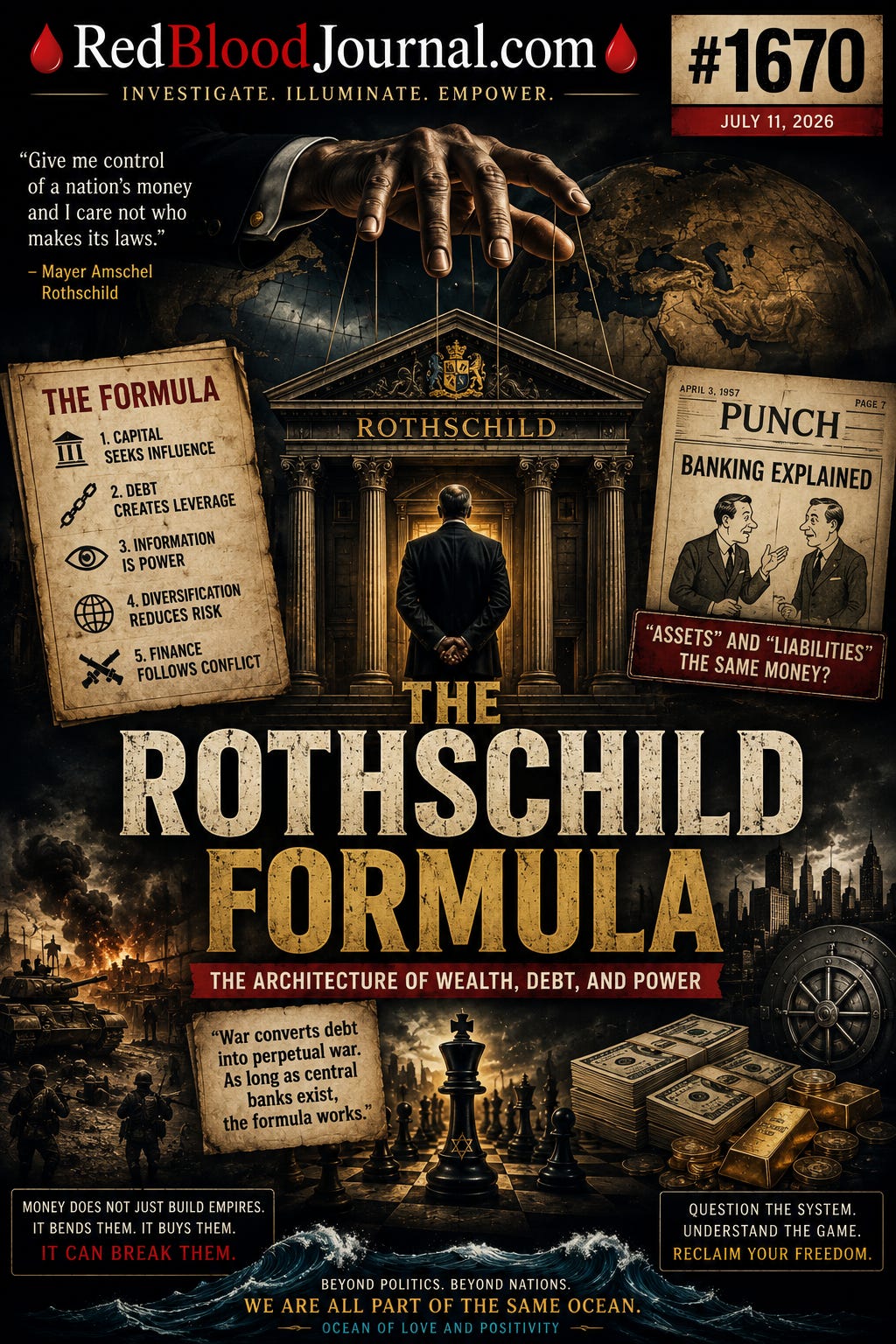
#1670 – The Rothschild Formula
Finance, Power, and the Debate Over the Architecture of Modern Influence
PROLOGUE
Few names in financial history evoke as much fascination, controversy, and speculation as the Rothschild family.
To some historians, they represent one of history’s most successful banking dynasties.
To others, they have become a symbol—sometimes fairly, sometimes unfairly—of broader questions about finance, debt, war, and political influence.
The phrase “The Rothschild Formula” is not a formal doctrine recognized in academic economics. Rather, it is a popular label used in books, documentaries, and commentary to describe an alleged pattern in which financial power becomes a strategic instrument of geopolitical influence.
The Formula as Commonly Described
According to authors such as G. Edward Griffin and others who discuss this idea, the formula can be summarized as follows:
1. Capital Seeks Influence
Money is not viewed merely as wealth.
It becomes a tool for acquiring long-term political and economic influence.
2. Debt Creates Leverage
Governments borrow.
Debt accumulates.
As obligations grow, creditors may gain increasing leverage over national decisions.
Whether this dynamic is beneficial or harmful depends on the specific historical circumstances and remains the subject of ongoing debate.
3. Information Is Power
Successful banking has historically depended on obtaining reliable information faster than competitors.
The Rothschild family’s extensive communications network in the 19th century is well documented and contributed significantly to their commercial success.
Stories claiming extraordinary or secret manipulation of markets beyond the historical record remain contested.
4. Diversification Reduces Risk
Rather than relying on a single country or industry, major financial institutions often diversify across sectors and regions.
This principle is widely accepted in modern finance.
5. Finance Follows Conflict
Wars require financing.
Reconstruction requires financing.
Governments frequently borrow during both periods.
Many historians note that conflict has historically increased demand for credit, although interpretations differ regarding who benefits most and to what extent.
Between History and Interpretation
The concept known as the “Rothschild Formula” blends documented financial history with broader interpretations about the relationship between banking and political power.
Some elements—such as government borrowing, diversification, and the historical role of banking houses in sovereign finance—are well established.
Other claims, particularly those alleging coordinated global control by a single family or institution, are not supported by mainstream historical evidence and often rely on speculation.
It is therefore important to distinguish between documented events, interpretation, and conspiracy narratives.
A Larger Question
Regardless of one’s view of the Rothschild family specifically, the discussion raises enduring questions:
How much influence should private financial institutions have over public policy?
How should governments balance borrowing with long-term sovereignty?
Can economic dependence shape political decisions?
What safeguards best protect democratic accountability?
These questions extend far beyond any one family or institution.
Ocean Reflection
Money is among humanity’s greatest inventions.
It can build hospitals or armies.
It can finance schools or wars.
It can create prosperity or deepen inequality.
Like every powerful tool, its moral character depends not on the currency itself, but on the intentions of those who wield it.
History reminds us that financial systems are ultimately created by people, and people remain accountable for how those systems affect the lives of others.
The greatest wealth any civilization can accumulate may not be measured in gold, debt, or markets, but in the dignity, freedom, and well-being of its people.
🌊 Ocean of Love and Positivity
⚖️ The Rothschild Formula:
Architecture of Global Financial Influence
Jul 11, 2026
The provided text examines the Rothschild Formula, a concept that explores the intersection of private banking and geopolitical power. It describes how the family historically utilized fast information networks, diversification, and sovereign debt to gain significant influence over national governments. While acknowledging the family’s documented success in nineteenth-century finance, the source distinguishes between verified history and unproven conspiracy theories regarding global control. The narrative highlights the moral ambiguity of money, noting that capital can be used to fund both social progress and military conflict. Ultimately, the passage uses the Rothschild legacy as a lens to question the proper balance between private financial interests and democratic accountability. Each point serves to emphasize that the true value of a civilization lies in the well-being of its citizens rather than its accumulated wealth.


