


🩸 RedBloodJournal.com
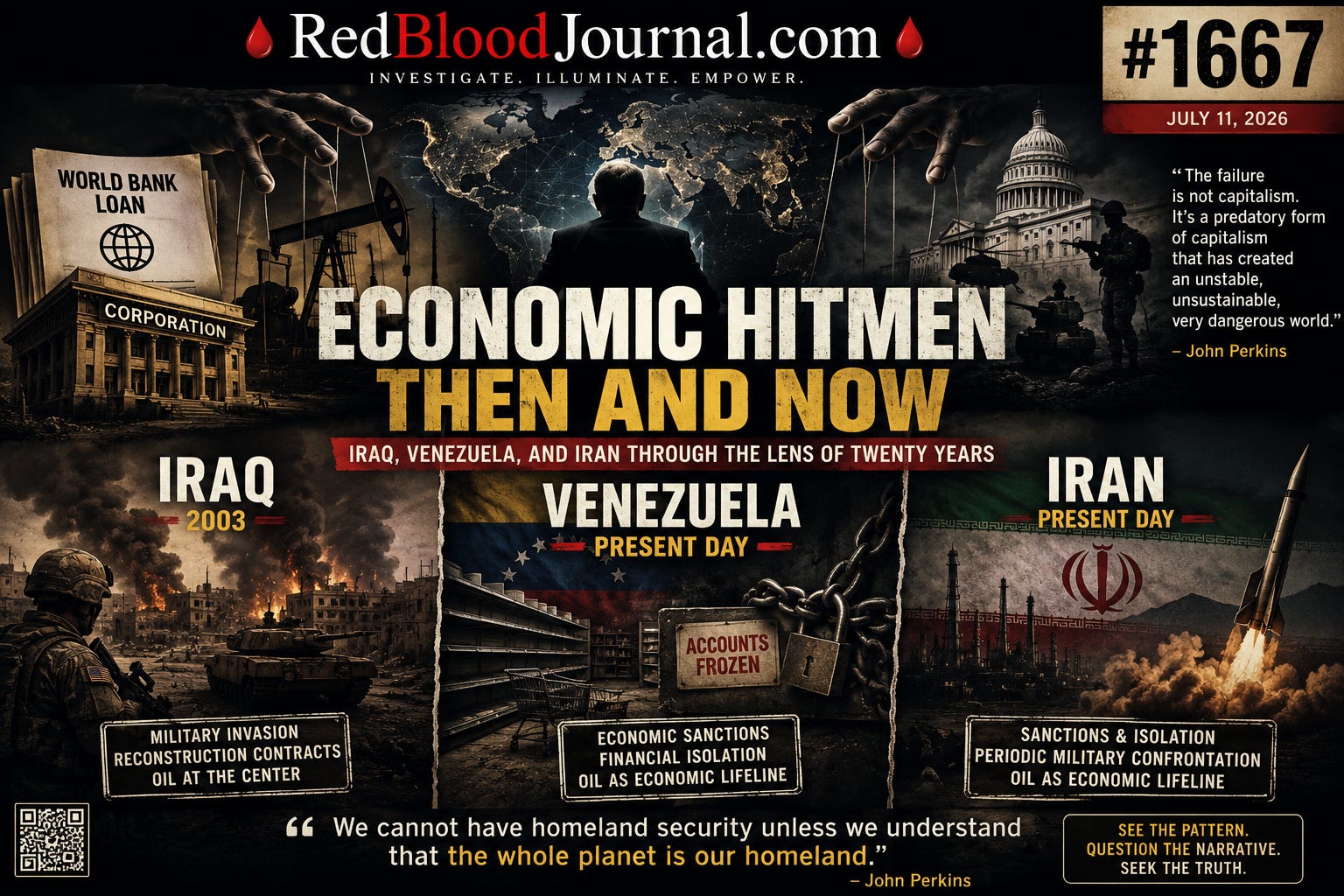
#1667 – Economic Hitmen Then and Now
Iraq, Venezuela, and Iran Through the Lens of Twenty Years
Introduction
Years after the Iraq War, former consultant John Perkins popularized the concept of the “economic hitman.” He described a system in which wealthy nations and multinational corporations allegedly used debt, infrastructure projects, political leverage, and, in some cases, military force to secure strategic influence over resource-rich countries.
Whether one accepts every aspect of this interpretation or not, it provides an analytical framework that can be compared with more recent geopolitical events.
The question is not whether history repeats exactly.
The question is whether the methods evolve while the objectives remain similar.
Iraq (2003)
According to the framework described in the transcript:
Strategic interest centered on oil.
Financial leverage preceded political leverage.
Debt and reconstruction became major components after military intervention.
Infrastructure contracts benefited large foreign corporations.
Military presence became long-term.
The transcript characterizes this as a cycle of economic influence backed, when necessary, by political or military power.
Venezuela
Unlike Iraq, Venezuela has experienced:
extensive economic sanctions,
financial isolation,
restrictions on oil exports,
diplomatic recognition battles,
competing claims of legitimate government.
Instead of a large-scale foreign invasion, pressure has largely been economic and diplomatic.
Supporters of sanctions argue they are intended to pressure the government over democratic and human rights concerns.
Critics argue they have also contributed to broader economic hardship for ordinary Venezuelans.
Iran
Iran presents a different model.
Over several decades the country has experienced:
sanctions,
restrictions on banking,
limits on technology transfers,
pressure over its nuclear program,
periodic military confrontations and covert operations.
Unlike Iraq in 2003, Iran has maintained an indigenous state structure despite these pressures.
Recent events have also included direct military exchanges and heightened regional tensions.
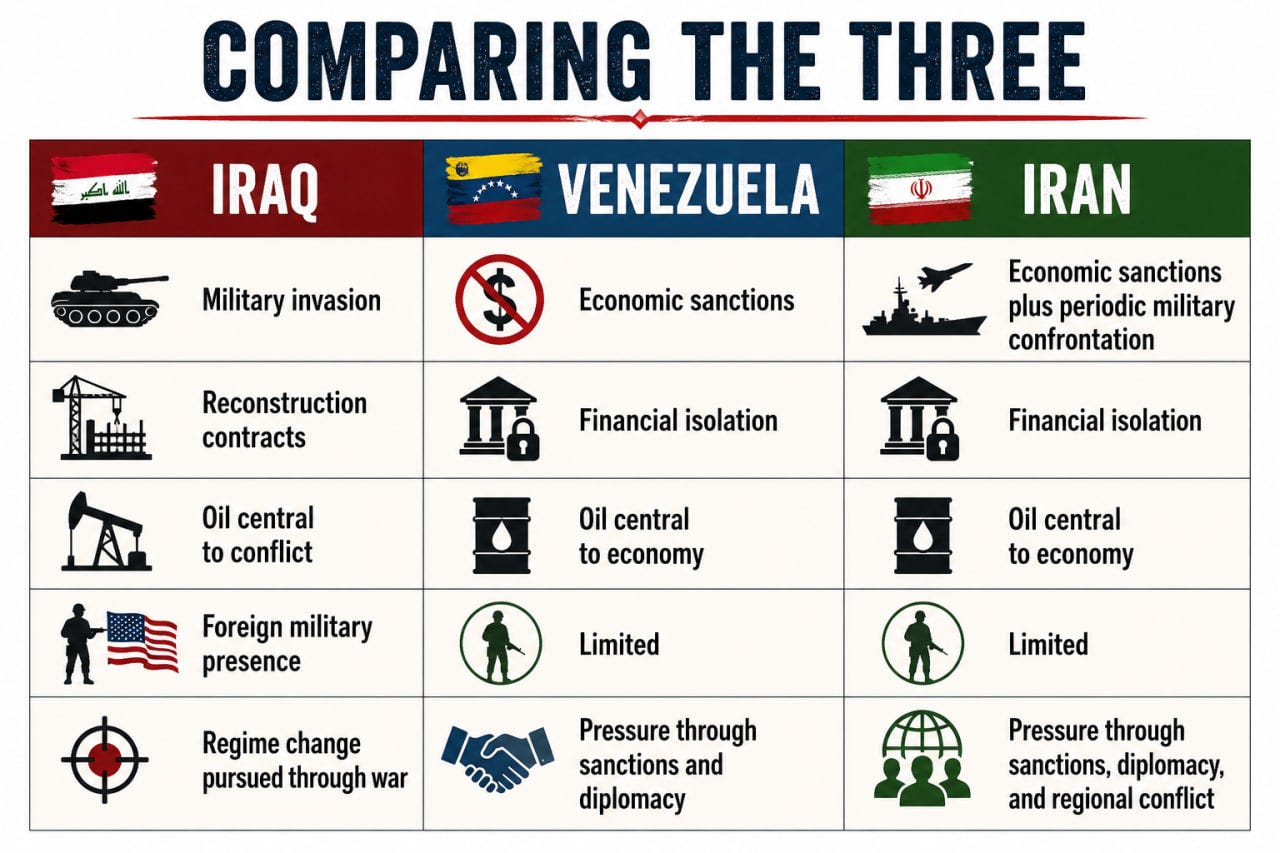
Comparing the Three
IraqVenezuelaIranMilitary invasionEconomic sanctionsEconomic sanctions plus periodic military confrontationReconstruction contractsFinancial isolationFinancial isolationOil central to conflictOil central to economyOil central to economyForeign military presenceLimitedLimitedRegime change pursued through warPressure through sanctions and diplomacyPressure through sanctions, diplomacy, and regional conflict
One Pattern Worth Examining
The transcript argues that influence often follows a progression:
Financial leverage.
Political leverage.
Diplomatic pressure.
Intelligence operations.
Military intervention if earlier methods fail.
Whether this sequence accurately explains every historical case remains debated.
However, it provides one lens through which observers compare events across different regions.
Another Observation
One notable difference is that modern conflicts increasingly emphasize:
financial systems,
banking restrictions,
sanctions,
cyber capabilities,
information campaigns,
proxy conflicts,
rather than relying solely on conventional military invasions.
This suggests that the tools of geopolitical competition may have diversified even if strategic competition itself has not disappeared.
Final Reflection
The transcript was recorded after the Iraq War, yet many of the themes it raises—economic leverage, strategic resources, infrastructure financing, sanctions, and political influence—continue to appear in discussions about international affairs today.
Whether Iraq, Venezuela, and Iran represent examples of the same geopolitical pattern or fundamentally different situations is a matter of ongoing debate. Comparing them carefully requires distinguishing between documented events, competing interpretations, and broader theories about how power is exercised in the international system.
Red Blood Journal Observation
History rarely repeats itself in identical form. More often, the instruments change while the underlying contests over resources, influence, and strategic advantage continue. For observers, the challenge is to separate established facts from interpretation while recognizing recurring patterns where the evidence supports them.
⚖️ Architects of Influence:
From Iraq to Global Economic Leverage
Jul 11, 2026
This text examines the evolution of geopolitical influence by comparing the 2003 invasion of Iraq with more modern pressures applied to Venezuela and Iran. Central to the analysis is the concept of the “economic hitman,” a framework suggesting that powerful nations use debt, infrastructure projects, and financial leverage to control resource-rich regions. While Iraq was characterized by direct military intervention, the source highlights how modern tactics have shifted toward economic sanctions, banking restrictions, and diplomatic isolation. These diverse strategies are presented as different tools used to achieve similar strategic goals regarding oil and regional power. Ultimately, the report encourages readers to distinguish between documented historical facts and the broader theoretical patterns of global political leverage.


