


Here is the complete professional report:
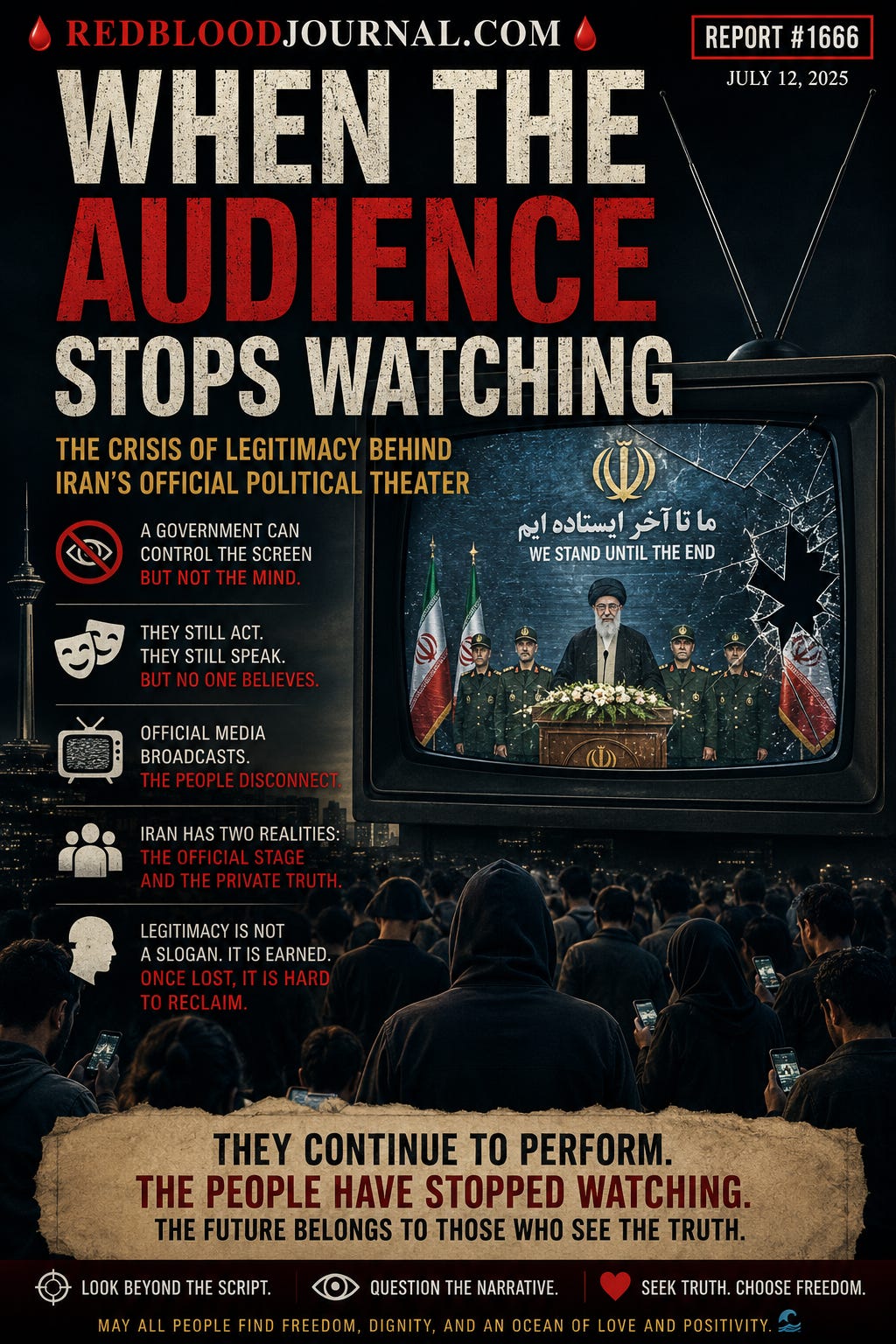
🩸 RedBloodJournal.com
REPORT #1666
When the Audience Stops Watching
The Crisis of Legitimacy Behind Iran’s Official Political Theater
Executive Summary
A government can continue to control ministries, television networks, courts, security forces, and public institutions long after it begins losing the confidence of the population.
That distinction matters.
Authority is not the same as legitimacy.
Authority can be maintained through institutions, pressure, surveillance, economic dependence, and force. Legitimacy depends on whether the governed still believe that the system speaks for them, represents them, or deserves their trust.
The central question for American policymakers and other foreign decision-makers is therefore not merely whether Iran’s present leadership remains in control.
The deeper question is whether the political performance presented through official Iranian media still has a meaningful audience inside the country.
There are growing signs of a widening distance between the state’s public narrative and the private reality experienced by many Iranians. Official speeches continue. Carefully produced television programs continue. Religious and political figures continue declaring unity, resistance, sacrifice, and national determination.
But a political theater becomes unstable when the audience no longer believes the script.
The Difference Between Power and Legitimacy
Power asks:
Can the government enforce its decisions?
Legitimacy asks:
Does the population believe the government has the moral and political right to make those decisions?
A state may possess the first while steadily losing the second.
This creates a dangerous illusion for foreign governments.
From the outside, official institutions may still appear organized. Government representatives attend negotiations. Military commanders issue warnings. State television broadcasts crowds, speeches, funerals, ceremonies, and declarations of national unity.
These images can create the impression of a functioning political consensus.
But a government’s ability to produce images does not prove that the public accepts their meaning.
The camera can show a crowd.
It cannot show the millions who chose not to attend.
The television can broadcast a speech.
It cannot measure how many viewers have emotionally disconnected from the speaker.
A Movie Without an Audience
The present Iranian leadership continues to produce what resembles an elaborate political film.
The actors appear.
The slogans are repeated.
The enemies are identified.
The sacrifices are praised.
The victories are announced.
The threats are dramatized.
The official media presents the production as if the entire nation remains emotionally invested in it.
Yet the real danger for the system may be that many citizens are no longer watching.
This does not necessarily mean that every Iranian shares the same political preference. Iran is a large, diverse country containing monarchists, republicans, reformists, nationalists, religious conservatives, secular citizens, ethnic minorities, workers, students, veterans, business owners, and millions who may reject every organized political faction.
The important point is not that all Iranians agree.
The important point is that large numbers may no longer regard official state messaging as a trustworthy description of reality.
Once that psychological separation occurs, propaganda begins losing its most important resource: attention.
When the Public Stops Listening
Governments often fear organized opposition.
But another condition may be equally threatening:
mass indifference toward official communication.
When citizens stop believing official media, they do not necessarily protest every day. They may simply stop listening.
They lower the television volume.
They ignore official speeches.
They treat political announcements as theater.
They assume that casualty figures, economic statistics, military victories, diplomatic achievements, and public-support claims have been shaped for political purposes.
At that stage, even truthful statements may struggle to gain credibility because the institution delivering them has exhausted public trust.
The system can continue speaking, but its words no longer travel.
It still possesses microphones.
It may no longer possess ears.
The Blindness of External Policymakers
Foreign governments frequently make the mistake of treating the recognized state as if it were identical to the population.
It is not.
Diplomats negotiate with officials because officials control the institutions of government. That is understandable.
The danger begins when diplomatic recognition is confused with popular legitimacy.
American leaders may hear statements from Iranian negotiators, military commanders, clerics, or government representatives and interpret them as expressions of Iranian national will.
But those officials speak for the governing structure.
Whether they speak for the population is a separate question.
A policy toward Iran that fails to distinguish between the Iranian state, the present leadership, and the Iranian people risks strengthening the very structure that many citizens may view as unrepresentative.
The Official Screen and the Private Country
There may now be two Irans operating at the same time.
The first Iran exists on official television.
It is unified.
It is obedient.
It supports the leadership.
It accepts economic suffering as sacrifice.
It considers confrontation a national duty.
It interprets government survival as national survival.
The second Iran exists inside homes, workplaces, private conversations, encrypted messages, family gatherings, and individual memory.
It may be exhausted.
It may be economically wounded.
It may distrust both domestic rulers and foreign powers.
It may want stability without dictatorship, national independence without isolation, and peace without political surrender.
These two Irans cannot be understood through the same television screen.
The Failure of Repetition
Propaganda depends heavily on repetition.
A government repeats the same phrases until they become familiar:
resistance,
martyrdom,
foreign conspiracy,
national unity,
historic victory,
divine obligation,
enemy aggression,
and inevitable triumph.
Repetition can strengthen belief when trust already exists.
But repetition can deepen cynicism when trust has disappeared.
The more disconnected the official narrative becomes from daily life, the more theatrical the performance appears.
Citizens experiencing inflation, unemployment, corruption, censorship, fear, and political exclusion may hear grand declarations of victory very differently from the officials delivering them.
What is intended as inspiration may be received as insult.
The Regime’s Greatest Vulnerability
Military weakness can be repaired.
Weapons can be replaced.
Commanders can be promoted.
Alliances can be rebuilt.
Economic agreements can be negotiated.
Public trust is far more difficult to restore.
A government that loses legitimacy eventually becomes dependent on increasingly narrow circles of loyalty:
security institutions, ideological networks, financial beneficiaries, political families, and individuals whose survival is tied directly to the survival of the system.
This produces a shrinking structure.
The government may still appear large because its buildings, uniforms, media channels, and bureaucracies remain visible.
But internally, its true social base may be contracting.
A political system becomes fragile when it must continually display support because genuine support can no longer be assumed.
The American Miscalculation to Avoid
The United States has repeatedly misread foreign societies by focusing too heavily on governments, elites, military institutions, and diplomatic channels.
Iran presents the same danger.
American policymakers may assume that preserving the existing state structure provides stability.
But stability imposed through a system lacking legitimacy may only postpone a larger crisis.
The opposite mistake is equally dangerous.
Treating all Iranians as eager for foreign military intervention would also ignore the complexity of Iranian society and the deep historical sensitivity toward outside interference.
The correct approach requires separating four distinct realities:
the Iranian nation,
the Iranian population,
the Iranian state,
and the present governing structure.
These are related, but they are not identical.
A Government Can Control the Screen but Lose the Story
The present leadership may still control national broadcasting.
It may control which political figures appear.
It may control which protests are shown.
It may control the vocabulary used to describe war, negotiations, opposition, foreign governments, and internal divisions.
But controlling the screen is not the same as controlling interpretation.
Citizens bring their own experiences to every message.
They compare official claims with empty wallets, restricted freedoms, lost relatives, political prisoners, failed promises, and decades of disappointment.
The state may write the script.
The population decides whether to believe it.
The Silence That Foreign Governments Misread
Silence is often interpreted as consent.
That can be a serious error.
In highly controlled environments, silence may represent fear, exhaustion, calculation, or disbelief rather than approval.
A population does not need to demonstrate every day in order to reject a government emotionally.
It may withdraw cooperation gradually.
It may obey publicly and reject privately.
It may continue working, studying, raising children, and surviving while no longer considering the political system legitimate.
This invisible withdrawal is difficult to measure.
But it can become one of the strongest forces in political history.
The Importance of Listening Beyond the Regime
Foreign policymakers seeking to understand Iran must look beyond official spokesmen and televised ceremonies.
They must study:
public behavior,
migration patterns,
labor unrest,
youth attitudes,
cultural resistance,
economic frustration,
private media consumption,
political prisoners,
women’s movements,
generational divisions,
and the difference between public compliance and genuine loyalty.
No single exile group, political faction, royalist movement, reformist organization, or foreign government can claim automatic ownership of the Iranian public voice.
The people of Iran must ultimately determine Iran’s future.
But foreign powers can either recognize that principle or continue treating the country as a negotiation conducted exclusively among governments.
Final Observation
The greatest misunderstanding may be the belief that because the present leadership still speaks, the people are still listening.
A government can dominate the airwaves while losing the nation’s attention.
It can control the cameras while losing credibility.
It can continue presenting ceremonies, speeches, threats, and declarations of unity while much of the population watches the performance as a badly written movie whose ending has already become predictable.
The leaders and directors of American policy must recognize that the Iranian government is not automatically the voice of the Iranian people.
Negotiating with state officials may be necessary.
Mistaking those officials for the nation is not.
The future of Iran will not ultimately be decided by the volume of official speeches.
It will be decided by whether the people still accept the authority of those standing behind the microphones.
When the audience stops watching, the theater may continue for a time.
But the performance has already begun to lose its power.
🩸 RedBloodJournal.com
The government may own the television station.
The people still decide whether to believe the program.
🌊 May the people of Iran, and all people living under systems they no longer trust, find a future built upon dignity, truth, freedom, and an ocean of love and positivity.
🎭 Iran’s Political Theater:
The Crisis of Legitimacy
Jul 11, 2026
This report examines the growing disconnect between the Iranian government’s official narrative and the private reality of its citizens. It argues that while the state maintains institutional authority through force and media control, it has suffered a profound crisis of legitimacy as the public stops believing its propaganda. This “political theater” continues to broadcast images of unity and strength, yet these displays are increasingly met with mass indifference or cynicism from a population exhausted by economic and social hardship. For foreign policymakers, the text warns against mistaking state declarations for the genuine will of the Iranian people. Ultimately, the source suggests that a government’s power becomes fragile and unstable once it loses the psychological trust of the governed.


