


🩸 RedBloodJournal.com
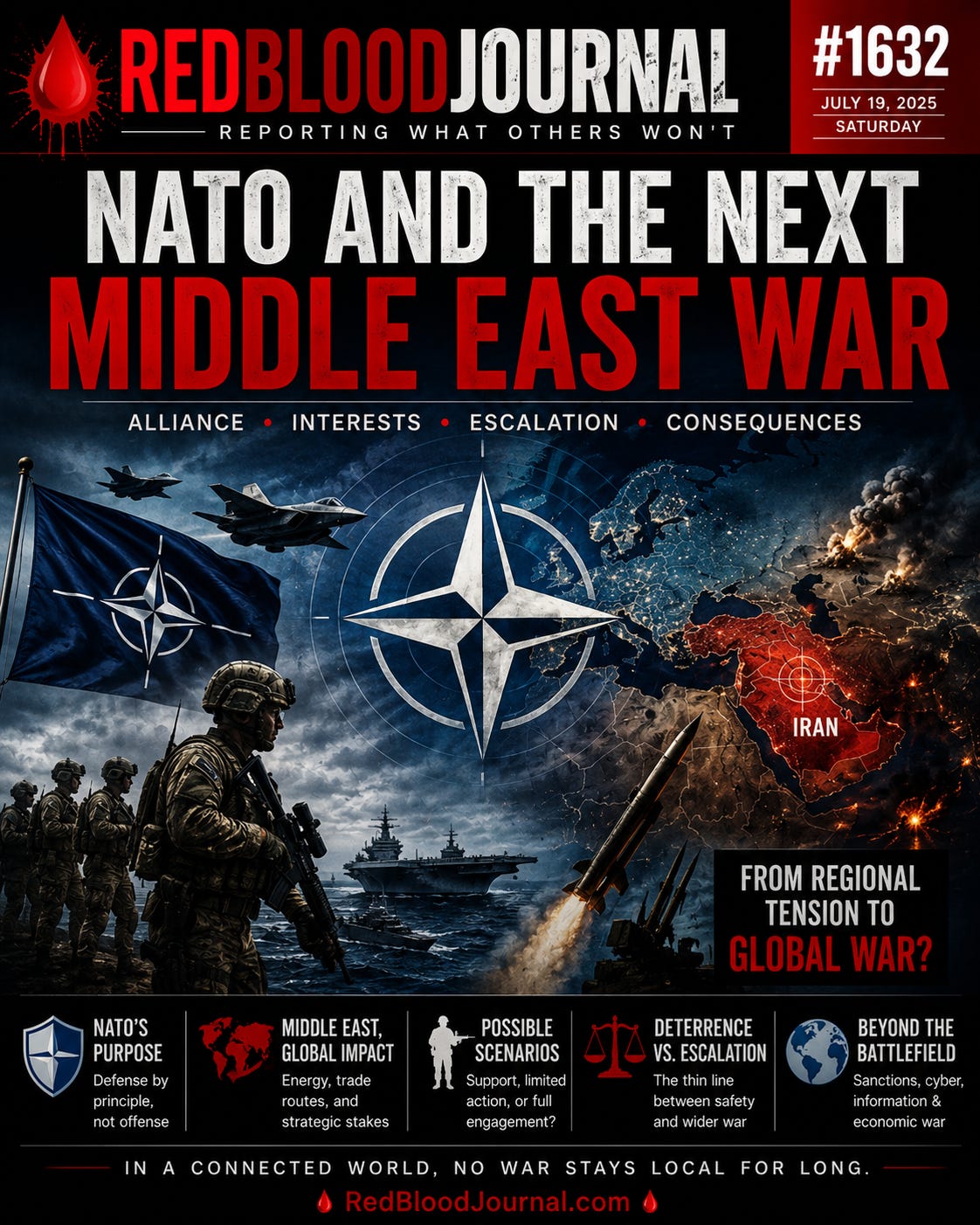
#1632 – NATO and the Next Middle East War
When Does a Regional War Become an International One?
Throughout modern history, regional conflicts have rarely remained regional for long.
Economic interests.
Energy supplies.
Trade routes.
Military alliances.
Political commitments.
Each has the potential to draw additional nations into conflicts that initially involve only a few participants.
As military tensions surrounding Iran continue to intensify, a new question is emerging:
Could NATO become increasingly involved if the conflict continues to expand?
Recent statements from NATO leaders have expressed support for strong responses to attacks affecting regional security, while continuing to emphasize that NATO remains a defensive alliance rather than a participant in offensive military operations. (Reuters)
NATO’s Purpose
The North Atlantic Treaty Organization was established for collective defense.
Its founding principle is straightforward:
An attack against one member may be treated as an attack against all.
That commitment was designed primarily to deter aggression against NATO members.
It was not originally created to manage every conflict occurring outside alliance territory.
Nevertheless, modern conflicts often blur those boundaries.
Cyberattacks...
Missile strikes...
Energy disruptions...
Maritime security...
Terrorism...
Each can affect NATO members even when the fighting begins elsewhere.
The Middle East’s Global Importance
The Middle East occupies one of the world’s most strategically important regions.
Large portions of global energy exports pass through nearby sea lanes.
Major shipping routes connect Europe, Asia, and Africa.
Military bases belonging to numerous countries are spread across the region.
As a result, instability rarely affects only neighboring states.
Economic consequences can rapidly spread worldwide.
The Alliance Question
Several possibilities could develop if regional fighting expands.
Scenario One
NATO members continue providing intelligence, logistics, and defensive support while avoiding direct combat.
Scenario Two
Individual NATO countries participate independently without acting under a formal NATO mission.
Scenario Three
A direct attack on NATO territory or forces triggers collective defense obligations.
At present, NATO leaders continue to distinguish between support for member security and direct alliance participation in combat operations. (Reuters)
The Balance Between Deterrence and Escalation
Military alliances face a continual dilemma.
Showing too little resolve may encourage further aggression.
Showing too much resolve risks widening the conflict.
Every movement of ships...
Aircraft...
Missile defenses...
Military exercises...
Can be interpreted either as defensive preparation or offensive signaling.
This ambiguity is one reason international crises often become increasingly difficult to manage once military forces begin mobilizing.
Beyond the Battlefield
Wars today extend far beyond conventional military operations.
Financial sanctions.
Cyber operations.
Information campaigns.
Energy markets.
Diplomatic pressure.
Economic competition.
Public opinion.
These instruments often shape the outcome as much as military power itself.
A conflict can expand globally without every nation firing a single shot.
The Observer’s Perspective
History demonstrates that alliances evolve alongside changing security realities.
Whether NATO’s future role remains limited or expands will depend upon events that cannot yet be predicted with certainty.
Current public statements indicate continued support for protecting alliance members while avoiding unnecessary escalation into a wider war. (Reuters)
The distinction between supporting regional stability and entering a regional war remains one of the most important strategic questions facing policymakers today.
Final Reflection
The future of NATO’s involvement in Middle Eastern security remains uncertain.
Military alliances are built to deter conflict.
Yet history reminds us that alliances can also become increasingly engaged as conflicts widen.
Whether today’s tensions remain regional or develop into something broader will depend not only on military decisions, but also on diplomacy, restraint, and the willingness of governments to prevent escalation before events outrun political control.
🩸 Red Blood Journal Opinion
This report examines the strategic implications of current events using publicly available information and historical context. Future military or diplomatic developments cannot be predicted with certainty, and readers should distinguish confirmed events from analytical interpretation.
🌍 The NATO Dilemma: Alliances and the Middle East Crisis
1 source·Jul 10, 2026
The provided text explores the complex strategic challenges facing NATO as tensions escalate in the Middle East, specifically regarding the potential for a regional war to expand into a global conflict. While the organization is traditionally a defensive alliance focused on collective protection, modern threats like energy disruptions, cyberattacks, and maritime instability frequently blur geographic boundaries. The source outlines several potential paths for the alliance, ranging from indirect logistical support to the activation of formal defense obligations if member states are directly targeted. Ultimately, the report emphasizes the precarious balance between maintaining a credible military deterrent and avoiding an unwanted escalation that could draw international powers into a broader fight. This analysis underscores that NATO’s future involvement depends on a mix of diplomatic restraint, economic pressures, and the unpredictable nature of modern warfare.


