


🩸 RedBloodJournal.com
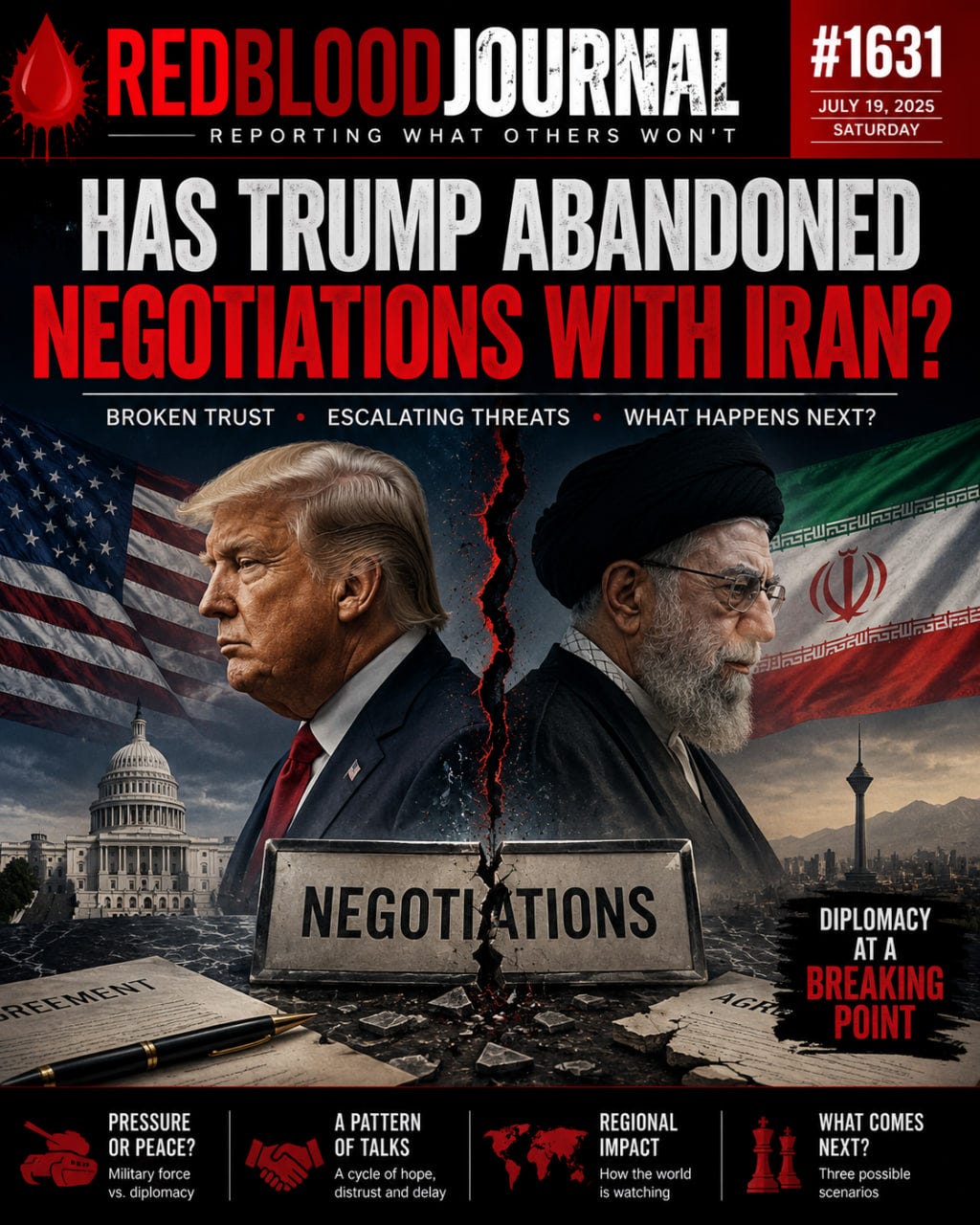
#1631 – Has Trump Abandoned Negotiations with Iran?
When Diplomacy Reaches Its Breaking Point
For months, observers watched an unusual pattern unfold.
Military pressure.
Economic pressure.
Negotiation.
More military pressure.
More negotiation.
It appeared that both Washington and Tehran were attempting to discover where the other’s breaking point truly existed.
Now the language coming from President Donald Trump suggests that something fundamental may have changed.
Recent public statements indicate deep frustration with the Iranian leadership, with Trump declaring that the interim understanding had effectively collapsed while questioning whether further negotiations were worthwhile. His rhetoric has shifted noticeably from describing negotiations as possible to portraying them as futile. (Reuters)
Whether this marks the permanent end of diplomacy—or merely another phase of strategic bargaining—remains one of the most important questions in the Middle East today.
The Pattern Behind the Negotiations
Looking back, the sequence appears familiar.
Pressure creates urgency.
Negotiations begin.
Talks stall.
Military actions resume.
Each side accuses the other of acting in bad faith.
Then another opportunity for diplomacy appears.
Rather than a straight line toward peace or war, the process resembles a cycle where negotiations and military leverage reinforce one another instead of replacing one another.
Supporters of continued diplomacy argue that negotiations remain the least costly path.
Critics argue that repeated negotiations merely provide time for each side to reposition itself politically, economically, or militarily.
Trump’s New Tone
Recent remarks represent one of the strongest public condemnations yet directed at Iran’s current leadership.
Instead of emphasizing future agreements, Trump publicly questioned whether additional discussions were worthwhile, suggesting that previous attempts had produced little trust. (Reuters)
Such statements naturally raise an important question:
Has diplomacy truly ended?
Or is this simply another negotiating tactic designed to increase pressure before returning to the table?
History offers examples supporting both possibilities.
Negotiation as Leverage
International negotiations rarely occur in isolation.
Military deployments...
Economic sanctions...
Political messaging...
International alliances...
Domestic politics...
All become negotiating tools.
From this perspective, public declarations that “talks are over” can themselves become part of the negotiation process.
Declaring negotiations finished may increase pressure on an opponent to make concessions.
Conversely, it may genuinely signal that political leaders believe diplomacy has failed.
Only future actions—not speeches alone—can determine which interpretation proves correct.
What Happens Next?
Several broad possibilities remain.
Scenario One
Military pressure continues while diplomatic channels remain unofficially open through intermediaries.
Scenario Two
Negotiations resume after both sides conclude that continued escalation is too costly.
Scenario Three
Military confrontation expands before diplomacy eventually returns.
None of these outcomes can presently be confirmed.
Each remains plausible depending upon future political and military developments.
The Observer’s Position
For independent observers, perhaps the most valuable lesson is to distinguish between rhetoric and confirmed policy.
Political speeches often communicate intentions.
Military actions communicate capabilities.
Diplomatic behavior communicates priorities.
These three do not always move together.
History repeatedly shows that today’s declaration of “no negotiations” can become tomorrow’s summit meeting—or today’s peace proposal can become tomorrow’s battlefield.
Final Reflection
Whether Donald Trump has permanently abandoned negotiations with Iran cannot yet be stated as fact.
His recent language clearly signals growing frustration and a willingness to increase pressure.
It does not necessarily prove that diplomacy has disappeared forever.
International politics frequently operates through cycles rather than straight lines.
For observers, the challenge is not predicting the next headline.
It is recognizing the pattern beneath the headlines.
Only time will determine whether this moment marks the end of negotiations—or merely another chapter in a much longer strategic contest.
🩸 Red Blood Journal Opinion
This report presents analysis and interpretation based on publicly available statements and recent developments. Future diplomatic and military decisions remain uncertain, and readers are encouraged to distinguish verified events from analytical interpretation.
🔄 The Strategic Cycle of US-Iran Diplomacy
Jul 10, 2026
The provided text analyzes the volatile diplomatic relationship between the United States and Iran, focusing on whether President Trump has definitively ended negotiations. It suggests that the current hostile rhetoric may be a strategic tool within a recurring cycle of military pressure and political bargaining rather than a permanent rupture. By examining the patterns of international diplomacy, the source explains how public declarations of failure often serve to increase leverage over an opponent. The author outlines several future scenarios, ranging from continued escalation to the quiet use of intermediaries to maintain communication. Ultimately, the report cautions observers to distinguish between aggressive political language and actual policy shifts, as the situation remains fluid. This analysis underscores that while official talks appear stalled, the underlying strategic contest continues to evolve through alternating phases of conflict and dialogue.


