


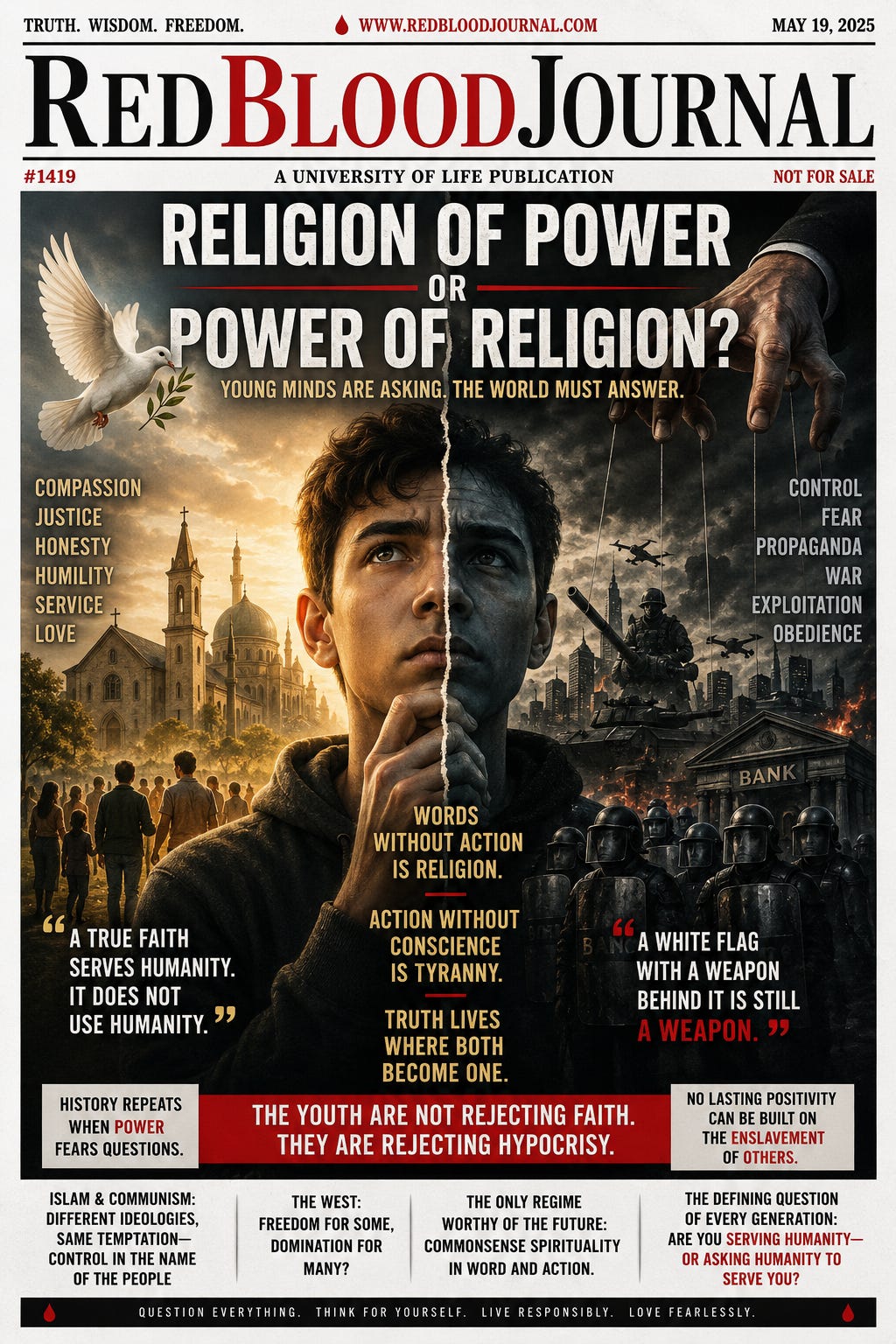
🩸 #1419 — The Religion of Power or the Power of Religion?
Throughout history, every civilization has faced the same question:
Is religion guiding political power, or is political power guiding religion?
The answer to that question may explain why many younger people are increasingly skeptical—not only of governments but also of the institutions that claim to speak on behalf of God.
For many in the younger generation, the issue is not whether Christianity, Islam, Judaism, or any other religion contains profound spiritual teachings. Nearly every major faith teaches compassion, charity, forgiveness, and justice. The deeper concern is whether those ideals are reflected in the conduct of the institutions that represent them.
Young people have grown up with unprecedented access to information. They compare official narratives with historical records, independent reporting, and competing perspectives. They are less inclined to accept authority simply because it has always existed. Instead, they ask a simple question:
Do the actions match the words?
When a nation proclaims peace while engaging in repeated military conflicts, or when governments invoke freedom while supporting policies that critics argue diminish the sovereignty of other nations, some young observers perceive a contradiction. Whether those policies are justified or not, the perceived gap between stated values and political conduct can weaken confidence in institutions associated with those governments.
The same scrutiny is directed toward every religious and political system.
Some critics argue that governments ruling in the name of Islam have used religion to justify extensive control over society. Others point to communist governments that promised equality but produced highly centralized authority. Although their ideologies differ, critics contend that both systems have, at times, concentrated power in ways that limited individual freedom.
Likewise, some observers believe that parts of the modern Western world have become closely intertwined with economic and political power, creating the perception that religious identity and geopolitical interests are no longer easily separated. Others strongly reject that interpretation. The debate itself illustrates a broader concern: people increasingly judge institutions by what they do rather than by what they claim.
Perhaps the common thread is not a particular religion or political ideology but the human temptation to preserve power.
Power often speaks the language people most want to hear. It may speak of equality, freedom, security, democracy, justice, revolution, or faith. Yet if those words become instruments for expanding authority instead of serving humanity, the language changes while the mechanism remains familiar.
The greatest danger is not religion.
The greatest danger is any institution that substitutes obedience for understanding and dependence for personal responsibility.
A truly spiritual society would not fear questions. It would welcome them.
It would not demand loyalty to institutions before loyalty to conscience.
It would not ask people to surrender independent thought in exchange for belonging.
Its leaders would demonstrate humility before asking for trust.
Its actions would consistently reflect its teachings.
Such a society remains more of an aspiration than a political reality.
Perhaps this explains why so many young people continue searching—not necessarily for a different religion, but for authenticity. They are looking for a place where words and actions are inseparable, where compassion is practiced rather than advertised, and where truth does not require force to defend itself.
A white flag is universally recognized as a symbol of peace. But if the hand raising the white flag secretly conceals a weapon, the flag ceases to represent peace and instead becomes a disguise.
The same principle applies to every government, every ideology, and every religion.
No institution earns trust through its symbols alone.
It earns trust through its conduct.
Perhaps humanity has not yet fully experienced a civilization whose highest authority is neither wealth, military strength, political influence, nor religious hierarchy, but the consistent practice of common-sense spirituality—a society in which compassion, honesty, humility, accountability, and personal responsibility are lived every day rather than merely preached.
Until words and actions become one, every system will continue to face the same question from every new generation:
Are you serving humanity—or asking humanity to serve you?
That may be the defining question of the University of Life.
🩸 RedBloodJournal.com 🩸
⚖️The Conscience of Power:
The Quest for Authentic Authority
Jun 30, 2026
This text explores the growing skepticism among younger generations toward traditional religious and political institutions that prioritize the maintenance of power over their stated moral values.
The author argues that modern youth value authenticity and look for a consistent alignment between an organization’s actions and its rhetoric.
Many established systems are criticized for using the language of freedom or faith as a mere tool for social control and institutional expansion.
Ultimately, the source suggests that true authority is not found in hierarchy or symbols, but in the practice of compassion, honesty, and accountability.
The piece serves as a call for a spiritual society that welcomes questioning and values individual conscience above blind institutional loyalty.


