


🩸 Red Blood Journal #1417
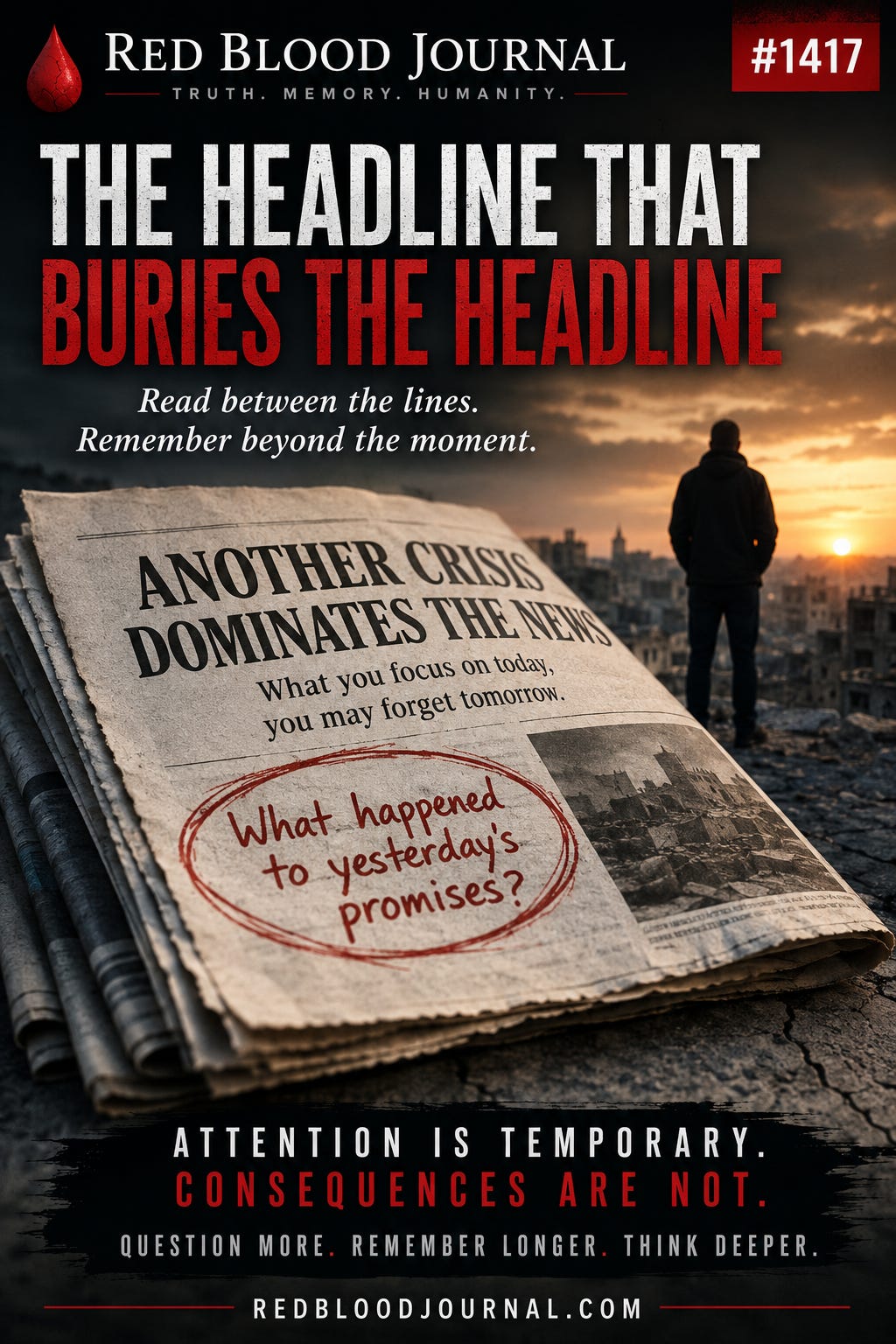
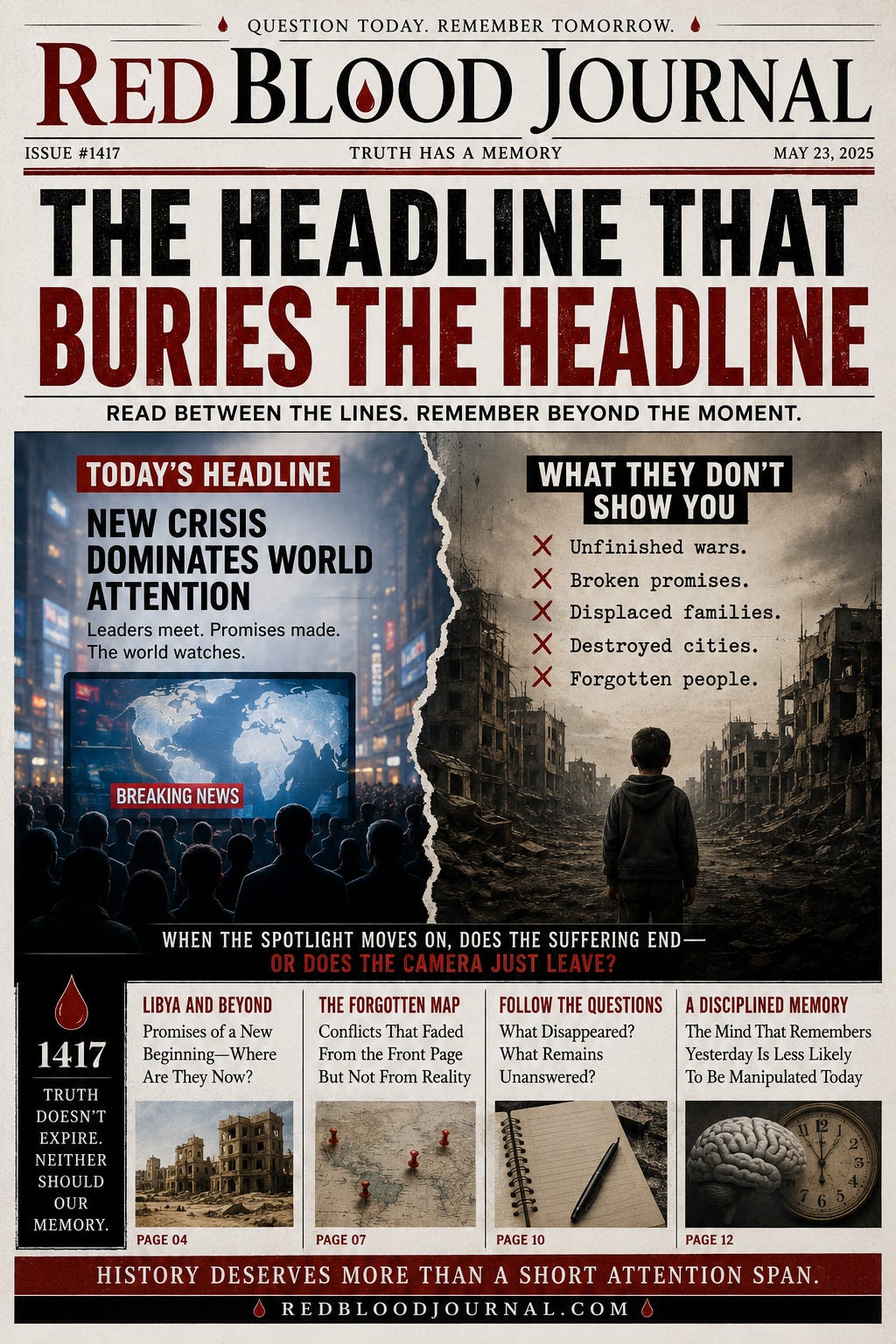
The Headline That Buries the Headline
One of the most powerful abilities a human being can develop is the ability to read between the lines instead of simply reading the lines.
Headlines tell us where to look today.
Reading between the lines asks a different question:
What are we no longer looking at?
Every major event dominates public attention for a time. Governments make decisions. Militaries act. Journalists report. Citizens argue. Then, gradually, another crisis arrives, another conflict begins, another controversy takes center stage.
The spotlight moves.
But history does not.
For the observer, this raises an important discipline: before becoming consumed by today’s story, look back at yesterday’s. Ask what became of the people who disappeared from the front pages. Ask whether the promises made during the height of public attention were fulfilled. Ask whether the suffering ended, changed form, or simply continued outside the world’s focus.
This does not mean assuming that every new headline exists to distract from an older one. Events can arise for many reasons. But it does mean recognizing that public attention is finite, while the consequences of major events often last for years or decades.
A society that remembers only today’s crisis can easily forget yesterday’s unanswered questions.
The strongest observer develops a longer memory.
When reading about one conflict, remember the previous one.
When hearing promises of liberation, revisit the places where similar promises were made before.
When a nation disappears from the news, ask whether peace arrived—or whether the cameras simply left.
History deserves more than a short attention span.
The goal is not to become cynical. The goal is to become disciplined.
The mind that remembers yesterday is less likely to surrender its judgment today.
Read the headlines.
Then read the silence that follows.
Sometimes what disappears from the news teaches as much as what remains in it.
🩸 RedBloodJournal.com 🩸
👁️ The Discipline of Silent Histories
Jun 30, 2026
This text explores the essential cognitive discipline of analyzing events beyond the immediate glare of modern news cycles.
It argues that while public attention is finite, the long-term consequences of political and military actions persist far longer than their presence on the front page.
By investigating what happens when the media spotlight shifts, individuals can hold powerful institutions accountable for past promises that might otherwise be forgotten.
The author emphasizes that true historical awareness requires looking back at yesterday’s crises to see if suffering actually ended or if it simply became invisible.
Ultimately, maintaining a longer memory serves as a safeguard against manipulation and helps preserve independent judgment in an era of constant distraction.
Focusing on the silence following a headline reveals more about the state of the world than the sensationalism of current events.


