


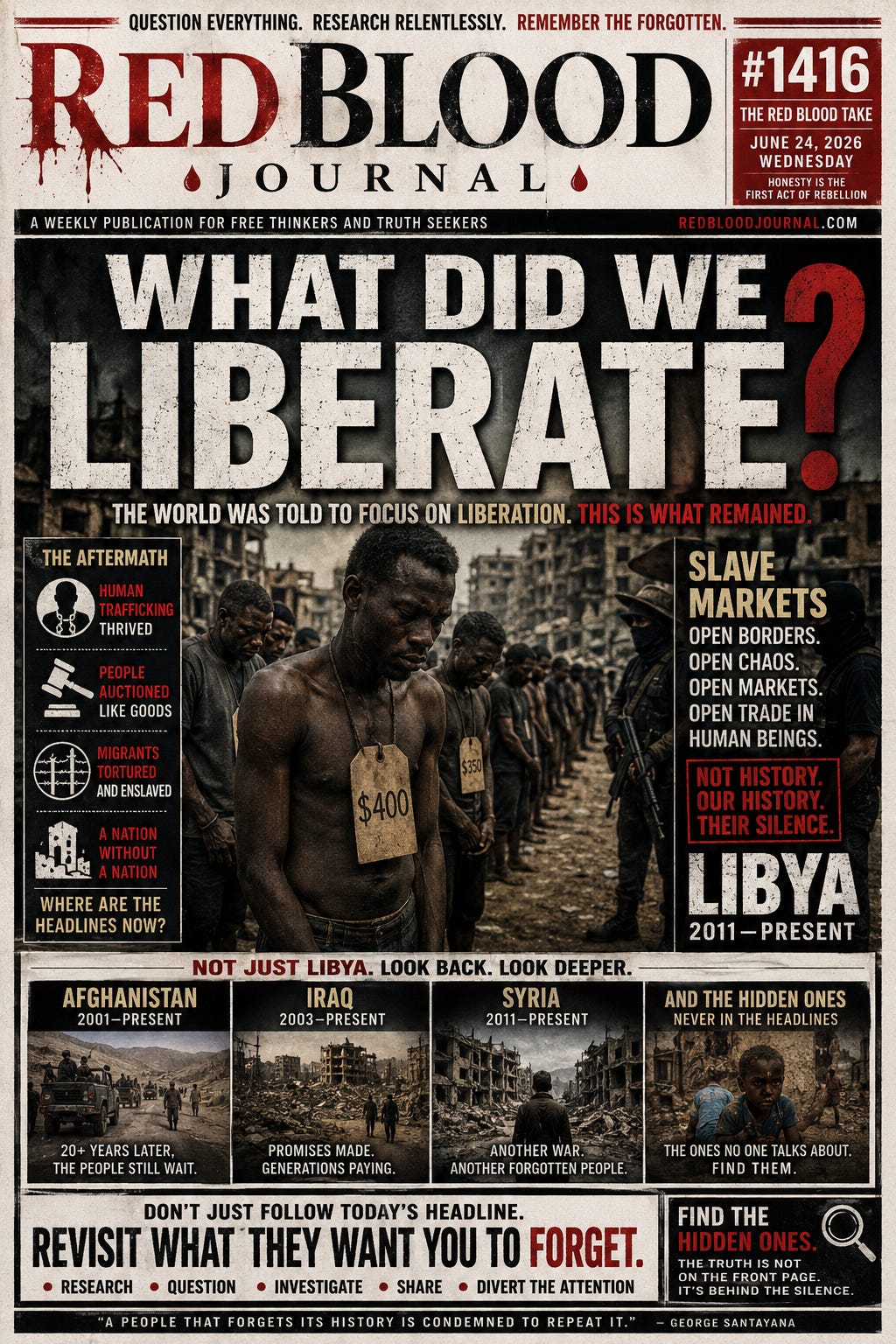
🩸 Red Blood Take #1416
The Forgotten Liberation
Every generation has its defining headlines.
The news tells us where to look, what to fear, who the heroes are, who the villains are, and what deserves our immediate attention. For weeks or months, every newspaper, every television station, and every social media platform speaks with remarkable intensity about a single place.
Then, almost overnight, silence.
A new crisis appears.
A new enemy emerges.
A new humanitarian emergency replaces the previous one.
Yesterday’s tragedy becomes yesterday’s news.
But history does not end when the cameras leave.
One country deserves to be revisited—not because it is unique, but because it illustrates a question every thoughtful person should ask.
Libya.
For months, the world was told that Libya represented a struggle between oppression and liberation. The world’s attention became fixed on one man, one government, one conflict.
The military campaign ended.
Muammar Gaddafi was killed.
Many people assumed the story had reached its conclusion.
In reality, it had only reached its beginning.
As Libya descended into prolonged instability, international organizations, journalists, and humanitarian groups documented a reality that shocked the conscience of the world.
Modern slave markets.
Human beings.
Bought.
Sold.
Traded.
Not centuries ago.
Not in history books.
In the twenty-first century.
Migrants fleeing poverty and violence became victims of criminal trafficking networks operating in conditions of insecurity and weak state authority. Images of men being auctioned for labor spread around the world.
For a brief moment.
The world reacted with horror.
Then...
Silence.
Where did the headlines go?
Where were the daily countdowns?
Where were the endless debates?
Where were the special broadcasts asking what had happened to the people after liberation?
Instead, attention moved elsewhere.
The cameras found another crisis.
The audience followed.
Libya slowly disappeared from public conversation.
That should concern every citizen regardless of political belief.
Because the question is larger than Libya.
It is about memory.
If we celebrate interventions, should we not also examine their long-term outcomes?
If governments justify action in the name of humanitarian principles, should citizens not revisit those places years later and ask whether those principles produced the promised results?
Those questions are not partisan.
They are responsible.
History should not be measured by the speeches delivered before military action.
It should be measured by the lives of ordinary people long after the speeches have ended.
The lesson does not stop with Libya.
Think backward.
How many countries once occupied every headline but are rarely discussed today?
How many families continue living with consequences that no longer interest the global audience?
How many promises were made?
How many promises were fulfilled?
And then ask an even more important question.
Which countries never became major headlines at all?
Which humanitarian disasters never attracted television cameras?
Which forgotten communities continue suffering without international attention?
Those are the hidden headlines.
The stories that never trended.
The stories that disappeared before the final chapter was written.
The stories that require citizens—not algorithms—to rediscover them.
The purpose of this report is not to tell you what conclusion to reach.
It is to encourage a habit.
Whenever the world insists that one crisis deserves all your attention, pause.
Turn around.
Look at the previous headline.
Ask what became of the people.
Ask what became of the promises.
Ask what became of the children who inherited the aftermath.
Do not let history end where the news broadcast ends.
Sometimes the loudest lesson is found in yesterday’s forgotten headline.
Sometimes the greatest responsibility of a citizen is not to chase today’s story, but to revisit yesterday’s.
Because yesterday’s forgotten people are still living today’s reality.
🩸 RedBloodJournal.com 🩸
🗞️ The Silence Following the Headlines
Jun 30, 2026
This passage examines how the global media cycle frequently abandons significant humanitarian crises once the initial sensation fades.
Using the aftermath of the Libyan intervention as a primary example, the text highlights the tragic disconnect between temporary political headlines and the enduring suffering of people left behind in unstable regions.
The author argues that international attention is fleeting, often ignoring the rise of modern slave markets and systemic collapse that follow military actions.
Readers are encouraged to develop a sense of civic responsibility by looking past current trends to investigate the long-term outcomes of past conflicts.
Ultimately, the source serves as a critique of historical amnesia, urging citizens to remember the human lives that continue to exist long after the news cameras have moved on to a new emergency.


