


🩸 Red Blood Journal
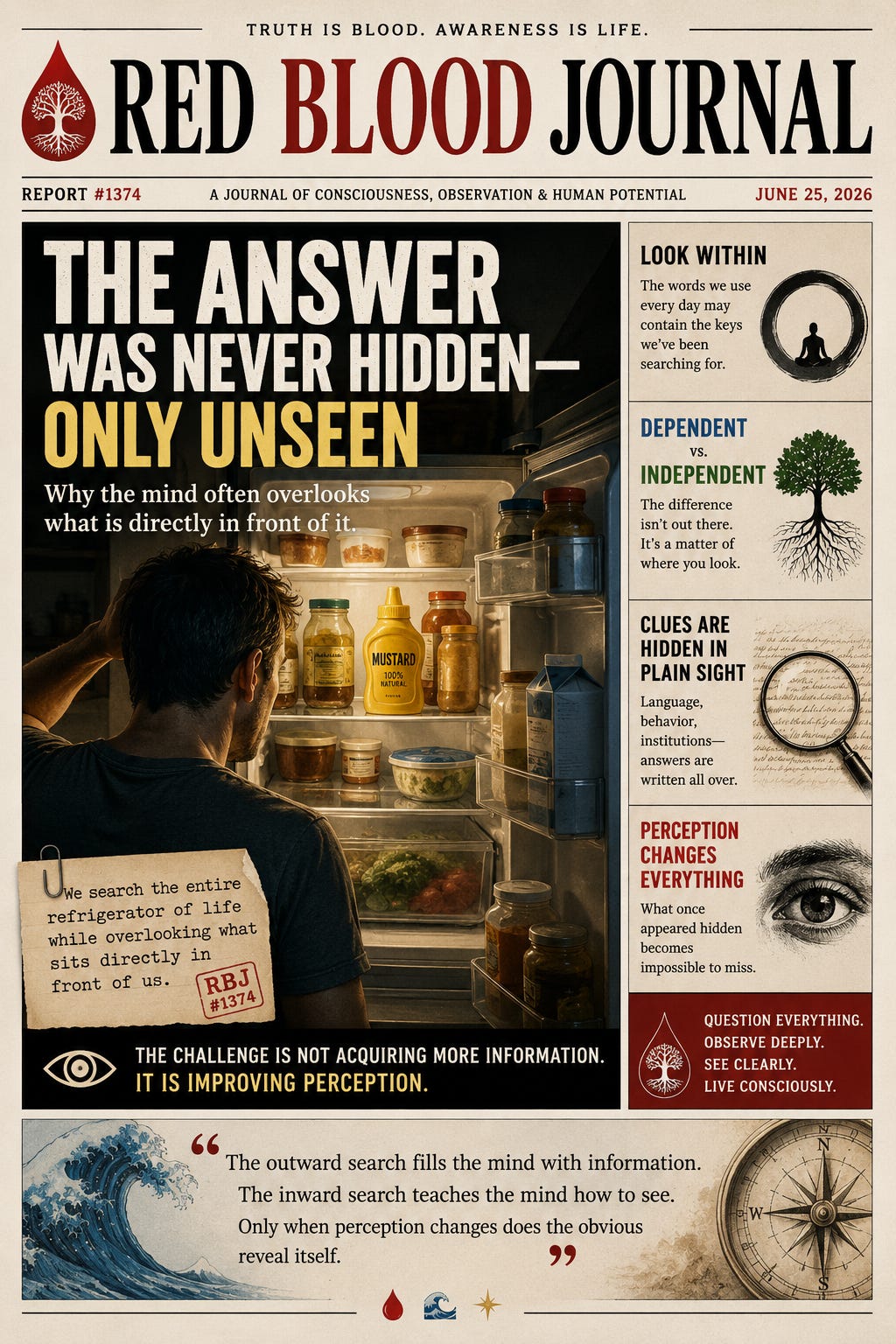
The Answer Was Never Hidden — Only Unseen
Subtitle: Why the mind often overlooks what is directly in front of it.
Report #: 1374
Date: June 25, 2026
There is a strange experience almost everyone has had.
You open the refrigerator looking for the mustard, the milk, or the leftovers. You search shelf after shelf. You become convinced it is not there.
Then someone else walks over, reaches in, and picks it up immediately.
“It was right in front of you.”
The object was never hidden.
Only the ability to see it was.
Perhaps life works the same way.
Many of the answers humanity searches for may not be hidden in distant places, secret organizations, or ancient mysteries. They may be written all around us—in our language, our behavior, our institutions, and even the ordinary words we use every day.
We simply read them without seeing them.
Take the words dependent and independent.
Most people understand them only in political or economic terms.
But look again.
A dependent person looks outward. Their happiness, security, identity, and purpose rely on something outside themselves—a government, a religion, a political party, a relationship, wealth, recognition, or approval.
An independent person has learned to generate those qualities from within. External things may enrich life, but they no longer define it.
Perhaps that is why the greatest teachers throughout history repeatedly pointed inward.
Not because the outer world is unimportant.
But because dependence on it produces endless searching.
The mind is trained from childhood to search outside itself.
Who has the answers?
Which expert?
Which politician?
Which religion?
Which book?
Which ideology?
Meanwhile, the observer inside quietly waits.
The irony is almost humorous.
We search the entire refrigerator of life while overlooking what sits directly in front of us.
The clues are hidden in plain sight.
Language itself often preserves wisdom that the conscious mind no longer notices.
The challenge, then, is not acquiring more information.
It is improving perception.
The difference between ignorance and understanding is often not the absence of evidence.
It is the inability to recognize what has been visible all along.
Perhaps the greatest discoveries are not made by finding something new.
Perhaps they are made by finally seeing what was always there.
Closing Reflection
The outward search fills the mind with information.
The inward search teaches the mind how to see.
Only when perception changes does the obvious reveal itself—and what once appeared hidden becomes impossible to miss.
🩸🌊✨
👁️ The Architecture of Sight:
Recognizing the Obvious
Jun 25, 2026
The provided text explores the paradox of human perception, arguing that the solutions to life’s greatest mysteries are often already visible yet go unnoticed.
By using the metaphor of a person failing to find an item in a refrigerator, the author illustrates how the mind frequently overlooks the obvious while searching for complex answers.
The narrative emphasizes a critical distinction between external dependence and internal independence, suggesting that true understanding comes from looking inward rather than relying on outside authorities.
This philosophical perspective posits that personal growth is not about gathering new information, but rather about refining one’s vision to recognize existing truths.
Ultimately, the source suggests that wisdom is encoded in our daily language and surroundings, waiting for a shift in consciousness to be revealed.
Correcting our mental blindness allows us to finally see the profound realities that have been present all along.


