


🩸 RedBloodJournal.com #1325 🩸
Point Ten:
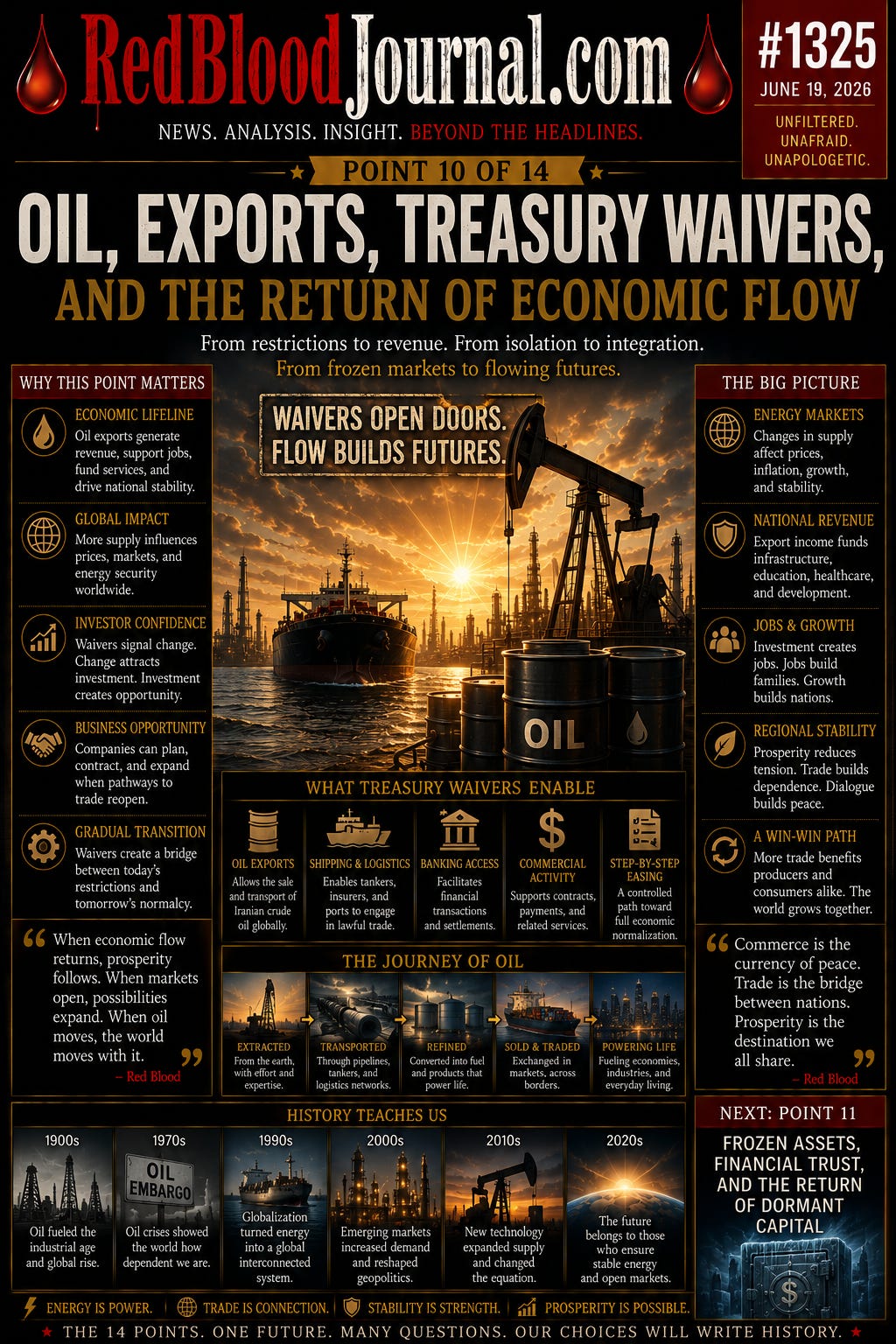
Oil, Exports, Treasury Waivers, and the Return of Economic Flow
By Red Blood
The tenth point of the reported fourteen-point agreement moves from theory to reality.
From diplomacy to commerce.
From negotiation to implementation.
According to the reported language, the United States would provide Treasury waivers allowing Iranian oil exports and related commercial activities while broader sanctions are being removed.
At first glance, this appears technical.
A regulatory adjustment.
A financial authorization.
A bureaucratic mechanism.
Yet beneath the legal language lies one of the most important commodities in modern civilization.
Oil.
For more than a century, oil has shaped economies, governments, alliances, conflicts, and entire regions.
Point Ten is not merely about exports.
It is about the reopening of economic circulation.
The Commodity That Changed History
Few resources have altered human history as dramatically as oil.
It powers transportation.
It fuels industry.
It supports agriculture.
It moves goods.
It heats homes.
It underpins global logistics.
Modern civilization was built during the age of abundant energy.
Because of this reality, access to energy became inseparable from geopolitics.
Control over production mattered.
Control over transportation mattered.
Control over pricing mattered.
Control over markets mattered.
Point Ten sits at the intersection of all four.
The Meaning of a Waiver
A waiver is an interesting concept.
A law remains in place.
A restriction remains on paper.
Yet permission is granted.
Temporary.
Conditional.
Limited.
The waiver creates a bridge between two realities.
The old system.
And the new system.
Point Ten suggests that negotiators recognized an important truth.
Major economic transitions rarely occur instantly.
Markets require adjustment.
Contracts require modification.
Financial institutions require guidance.
Trade requires certainty.
The bridge exists so that movement can begin before the final destination is reached.
The Return of Flow
Economies thrive on circulation.
Money circulates.
Goods circulate.
Services circulate.
Energy circulates.
When circulation slows, economies weaken.
When circulation resumes, opportunities emerge.
Oil exports represent more than barrels moving across oceans.
They represent revenue.
Investment.
Employment.
Government budgets.
Infrastructure projects.
Private sector activity.
The return of exports often becomes the return of momentum.
The Market Reaction
Financial markets pay attention to signals.
Sometimes more than outcomes.
The announcement that exports may resume can influence expectations long before the first shipment departs.
Investors calculate future possibilities.
Businesses examine future opportunities.
Governments adjust forecasts.
Markets do not merely react to events.
They react to anticipated events.
Point Ten may therefore carry significance beyond the immediate volume of exports.
It alters expectations.
And expectations often shape reality.
The Global Energy Equation
Energy markets are among the most interconnected systems on Earth.
A change in one region affects pricing elsewhere.
A disruption in one country influences decisions on another continent.
The world energy system functions like a vast network of connected reservoirs.
Pressure changes in one area eventually affect the whole system.
This is why governments, corporations, and investors closely watch developments involving major producers.
The significance extends beyond national borders.
The Confidence Factor
Economics depends heavily upon confidence.
Confidence is difficult to measure.
Yet its effects are everywhere.
A business owner hires because of confidence.
An investor commits capital because of confidence.
A bank extends credit because of confidence.
Confidence is often the invisible fuel behind visible growth.
Point Ten may be viewed as an attempt to restore confidence.
Not merely in oil markets.
But in the possibility of normalization.
The Strategic Resource
Oil has always occupied a unique position.
It is both a commodity and a strategic asset.
A business product and a geopolitical instrument.
An economic resource and a national security consideration.
This dual nature explains why discussions surrounding oil rarely remain purely economic.
Politics inevitably enters the conversation.
History repeatedly demonstrates this pattern.
Point Ten reflects that reality.
The Door Behind the Door
Perhaps Point Ten is not truly about oil.
Perhaps it is about reintegration.
The gradual return of participation.
The reopening of commercial pathways.
The restoration of connections.
Every society requires exchange.
Every economy requires movement.
Every market requires confidence.
Oil becomes the symbol.
But the underlying issue is broader.
Access.
Participation.
Flow.
The first nine points addressed war, recognition, time, presence, trade, reconstruction, sanctions, deterrence, and uncertainty.
Point Ten addresses circulation.
The movement of resources through economic arteries.
And that movement naturally leads to another question.
What happens to wealth that has already been frozen?
That question emerges in Point Eleven.
Because before new money can flow, old money may first need to be released.
The Ocean of Love and Positivity awaits.
Next: 🩸 RedBloodJournal.com #1326 — Point Eleven: Frozen Assets, Financial Trust, and the Return of Dormant Capital
🛢️ Point Ten: Reopening the Arteries of Global Economic Flow
Jun 19, 2026
This text examines the tenth point of a proposed diplomatic agreement, focusing on the restoration of economic movement through the use of U.S. Treasury waivers.
These legal authorizations would permit the export of Iranian oil, serving as a critical bridge between current sanctions and future normalization.
The author emphasizes that oil is a strategic asset that influences global geopolitics, market expectations, and the overall restoration of international confidence.
Beyond simple trade, the passage characterizes these exports as a vital means of reopening financial arteries and encouraging economic circulation.
Ultimately, the source suggests that this policy is a symbolic and practical step toward reintegrating a restricted economy into the global landscape.


