


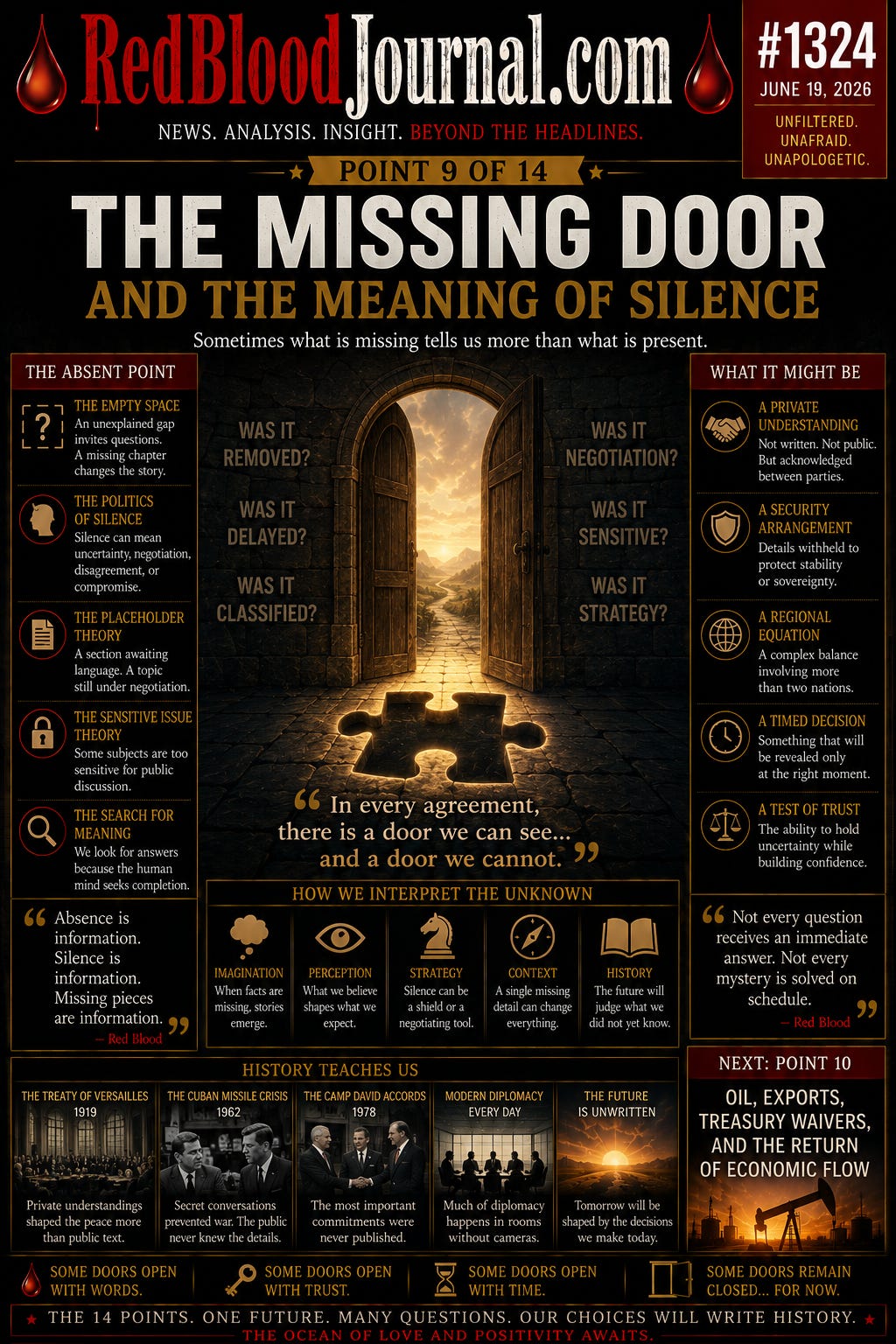
🩸 RedBloodJournal.com #1324 🩸
Point Nine:
The Missing Door and the Meaning of Silence
By Red Blood
Of all the points in the reported fourteen-point agreement, Point Nine may be the most fascinating.
Not because of what it says.
But because of what it does not say.
The transcript discussed Points One through Eight.
Then it moved forward.
Point Ten appeared.
Point Eleven appeared.
Yet Point Nine remained largely absent.
Unexplained.
Undefined.
Invisible.
Most observers immediately focus on what is present in a document.
Few examine what is missing.
History suggests that omissions can be just as revealing as statements.
Sometimes more revealing.
The Empty Space
Imagine reading a book and discovering a missing chapter.
Imagine reviewing a financial report with one section removed.
Imagine studying a map and finding a blank area where information should be.
The absence immediately attracts attention.
The mind begins asking questions.
Was it forgotten?
Was it removed?
Was it delayed?
Was it classified?
Was it intentionally left open?
The empty space becomes a story of its own.
Point Nine occupies such a space.
The Politics of Silence
Silence is often misunderstood.
Many assume silence means nothing.
History frequently demonstrates the opposite.
Silence can mean uncertainty.
Silence can mean negotiation.
Silence can mean disagreement.
Silence can mean compromise.
Silence can mean sensitivity.
Silence can mean strategy.
Diplomats understand this better than most.
The issues discussed publicly are not always the issues discussed privately.
Sometimes the most important conversations occur behind closed doors.
Sometimes the most important paragraph is the one nobody wishes to discuss openly.
The Placeholder Theory
One possibility is that Point Nine served as a placeholder.
A section awaiting final language.
A section requiring additional negotiation.
A section where consensus had not yet been achieved.
This is common in major negotiations.
Complex agreements rarely emerge fully formed.
They evolve.
Sections are revised.
Language changes.
Conditions are added.
Deadlines shift.
The public often sees only the finished document.
The process remains invisible.
The Sensitive Issue Theory
Another possibility is that Point Nine touches a subject considered too sensitive for public discussion.
History is filled with agreements containing public provisions and private understandings.
Not necessarily secret clauses.
But understandings.
Assurances.
Expectations.
Informal commitments.
Strategic ambiguities.
The official text may say one thing.
The practical implementation may depend on another.
Point Nine invites such speculation precisely because information is absent.
The Human Need for Completion
Human beings dislike incomplete patterns.
When information is missing, imagination fills the gap.
Sometimes accurately.
Sometimes inaccurately.
This is why rumors thrive in periods of uncertainty.
The less information available, the more narratives emerge.
Point Nine demonstrates this principle perfectly.
Its absence generates attention precisely because people seek completion.
The Missing Piece
Every puzzle contains a final piece.
Before it is placed, countless interpretations remain possible.
After it is placed, the picture changes.
Point Nine resembles that missing piece.
Not because it necessarily contains the most important information.
But because its absence affects the interpretation of everything around it.
Context matters.
A single missing detail can alter the meaning of an entire agreement.
History’s Blank Pages
History contains many blank pages.
Lost documents.
Classified documents.
Destroyed documents.
Redacted documents.
Unrecorded conversations.
Private meetings.
Unknown understandings.
Future historians spend decades trying to reconstruct these gaps.
Sometimes they succeed.
Sometimes they do not.
The lesson is simple:
Absence is information.
Silence is information.
Missing pieces are information.
The Door Behind the Door
Perhaps Point Nine is not about a missing paragraph at all.
Perhaps it is about uncertainty itself.
Human beings crave certainty.
Politics rarely provides it.
Agreements are signed before every detail is known.
Markets move before outcomes are certain.
Nations make decisions without complete information.
The future has always contained blank spaces.
Point Nine reminds us of that reality.
Not every question receives an immediate answer.
Not every mystery is solved on schedule.
Sometimes the most honest position is observation.
Not certainty.
Observation.
The first eight points addressed war, recognition, time, presence, trade, reconstruction, sanctions, and deterrence.
Point Nine addresses uncertainty.
The unknown.
The unwritten.
The unseen.
And from that silence we move to Point Ten.
Because eventually uncertainty encounters action.
And Point Ten concerns one of the most practical actions in the entire agreement.
Oil.
Commerce.
Exports.
And the reopening of economic flow.
The Ocean of Love and Positivity awaits.
Next: 🩸 RedBloodJournal.com #1325 — Point Ten: Oil, Exports, Treasury Waivers, and the Return of Economic Flow
🕳️ The Architecture of Silence:
Deciphering the Missing Point Nine
Jun 19, 2026
The provided text explores the strategic significance of Point Nine, a conspicuously absent or unaddressed section within a major fourteen-point diplomatic agreement.
By examining why this specific point was omitted from public transcripts, the author suggests that omission and silence are often more revealing than explicit statements in international negotiations.
The narrative proposes several theories for this void, ranging from ongoing private deliberations to the possibility that the topic was simply too sensitive for public disclosure.
This gap in information creates a psychological tension, as human nature compels observers to fill missing patterns with their own interpretations and theories.
Ultimately, the source characterizes Point Nine as a symbol of uncertainty, serving as a bridge between foundational issues like war and trade and the practical economic actions detailed in the subsequent sections.
The text concludes that in the realm of history and politics, blank spaces function as vital information that can alter the context of an entire document.


