


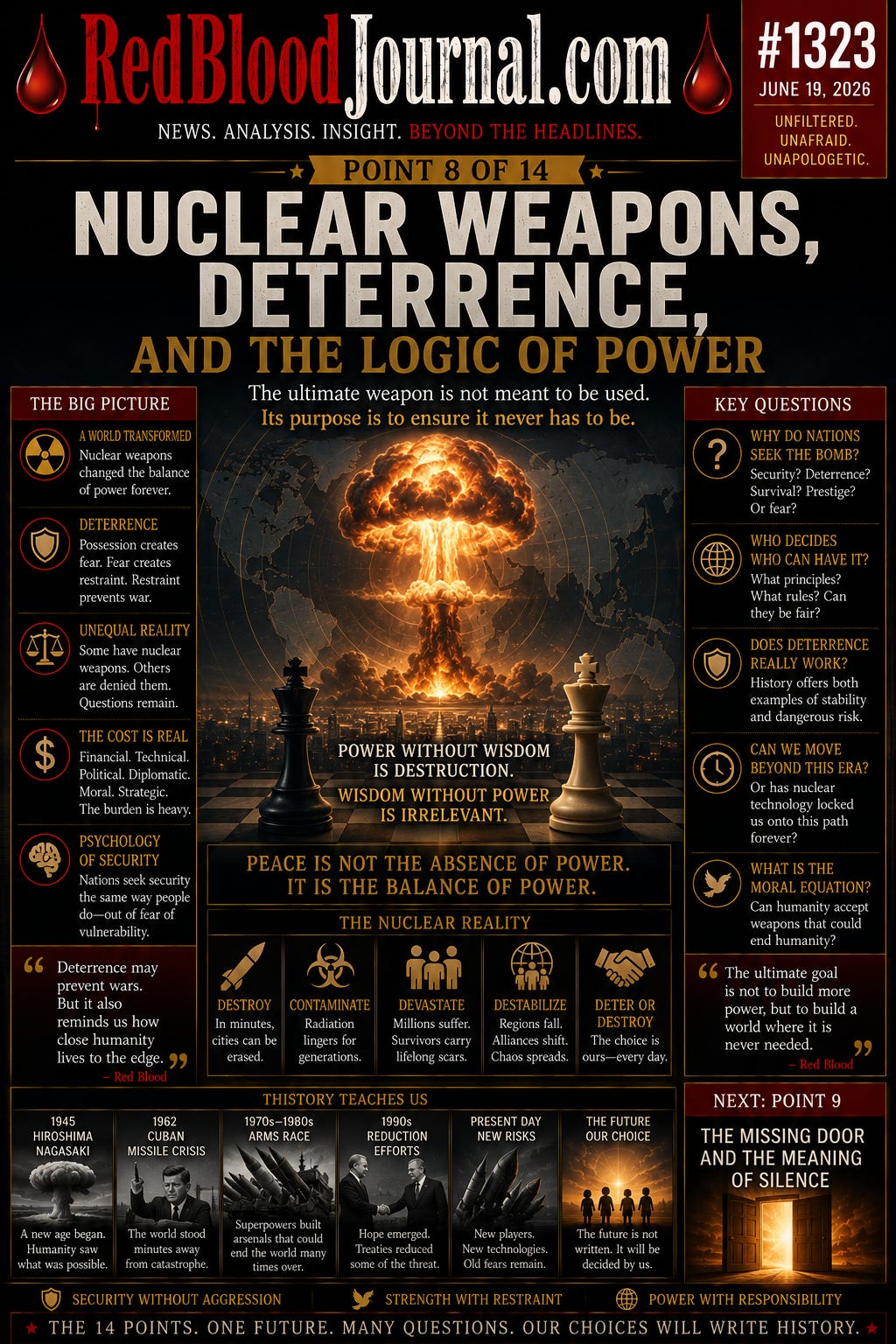
🩸 RedBloodJournal.com #1323 🩸
Point Eight:
Nuclear Weapons, Deterrence, and the Logic of Power
By Red Blood
The eighth point of the reported fourteen-point agreement addresses the subject that dominated headlines for decades.
Nuclear weapons.
For many observers, this was the issue.
The central issue.
The issue around which sanctions were built.
The issue around which threats were made.
The issue around which negotiations repeatedly rose and fell.
According to the reported text, Iran reaffirms that it shall not procure or develop nuclear weapons.
A single sentence.
Yet behind that sentence lies one of the most important questions in modern history.
Why do nations seek nuclear weapons in the first place?
The Weapon That Changed Everything
Human history can be divided into many eras.
The agricultural era.
The industrial era.
The information era.
The nuclear era.
Before nuclear weapons, military power was measured largely by armies, navies, resources, geography, and industry.
After nuclear weapons, a new reality emerged.
A nation could possess the ability to destroy an opponent without possessing the ability to defeat them conventionally.
The balance of power changed forever.
The Logic of Deterrence
The argument for nuclear weapons has always been surprisingly simple.
Not attack.
Deterrence.
The theory suggests that the possession of overwhelming destructive capability discourages aggression.
If both sides understand the consequences, neither side wishes to cross certain lines.
Paradoxically, some argue that the most destructive weapon ever created became a tool for preventing large-scale war between major powers.
Others strongly disagree.
Yet the logic of deterrence continues to shape international relations.
Whether people approve of it or not.
The Uneven World
One of the recurring questions surrounding nuclear policy is consistency.
Some nations possess nuclear weapons.
Others do not.
Some nations are accepted as nuclear powers.
Others are discouraged from becoming one.
Some nations modernize their arsenals.
Others face sanctions for pursuing similar capabilities.
This reality creates questions.
Who decides?
According to what principles?
And can those principles be applied equally?
These questions often become as important as the weapons themselves.
The Psychology of Security
Nations behave much like individuals when it comes to security.
People seek locks because they fear vulnerability.
Nations seek protection for similar reasons.
The stronger the perception of threat, the stronger the desire for security.
Sometimes security comes through alliances.
Sometimes through geography.
Sometimes through military strength.
Sometimes through deterrence.
The debate surrounding nuclear weapons is ultimately a debate about security.
How much is enough?
How much is too much?
The Nuclear Club
There are few clubs more exclusive than the group of nations possessing nuclear weapons.
Membership changes the way others interact with you.
It changes calculations.
It changes risk assessments.
It changes diplomatic conversations.
History shows that nations possessing nuclear weapons are often treated differently than nations that do not.
Whether this reality is fair or unfair is another discussion.
Its existence is difficult to deny.
The Cost of the Bomb
Nuclear weapons carry enormous costs.
Financial costs.
Technical costs.
Political costs.
Diplomatic costs.
Moral costs.
Strategic costs.
Maintaining a nuclear arsenal requires more than building one.
It requires constant investment.
Constant security.
Constant management.
Constant vigilance.
The world often focuses on the power of nuclear weapons.
Less attention is given to the burden they create.
The Paradox
Perhaps the greatest paradox is this:
Nuclear weapons are rarely intended to be used.
Their value comes largely from not being used.
They are weapons whose effectiveness depends on remaining silent.
The stronger the deterrent, the less anyone wants to test it.
This paradox has defined global strategy since the middle of the twentieth century.
A weapon designed to prevent the circumstances under which it would ever be used.
The Future Question
Point Eight raises a question larger than any single country.
Can a world built on deterrence eventually evolve beyond deterrence?
Or has nuclear technology permanently altered the logic of international relations?
No agreement has fully answered that question.
No summit has resolved it.
No treaty has eliminated it.
The question remains.
Generation after generation.
The Door Behind the Door
Perhaps Point Eight is not truly about nuclear weapons.
Perhaps it is about fear.
Fear of invasion.
Fear of domination.
Fear of vulnerability.
Fear of uncertainty.
Throughout history, fear has shaped empires, alliances, conflicts, and negotiations.
The desire for security may be one of the most powerful forces in human affairs.
Understanding that desire often reveals more than understanding the weapons themselves.
The first seven points addressed war, recognition, time, presence, trade, reconstruction, and sanctions.
Point Eight addresses deterrence.
Because beneath every geopolitical strategy lies a simple question:
How does a nation ensure its survival?
The next point moves to one of the most interesting mysteries in the agreement.
A point that appears absent, undefined, or still under negotiation.
Point Nine.
The Missing Door.
And sometimes what is missing tells us more than what is present.
The Ocean of Love and Positivity awaits.
Next: 🩸 RedBloodJournal.com #1324 — Point Nine: The Missing Door and the Meaning of Silence
☢️ The Deterrence Paradox:
Nuclear Logic and the Search for Security
Jun 19, 2026
This source examines the geopolitical and psychological complexities of nuclear proliferation, specifically focusing on a diplomatic agreement where Iran pledges not to develop such weaponry.
The author explores the paradox of deterrence, suggesting that these instruments of mass destruction are primarily valued for their ability to prevent conflict rather than their actual use in battle.
By comparing a nation’s need for safety to an individual’s desire for security, the text highlights how nuclear status fundamentally alters international respect and diplomatic standing.
It also addresses the inherent inequality of a global system where only a select few are permitted to maintain such arsenals.
Ultimately, the piece argues that the debate over atomic power is driven by a primal fear of vulnerability and the perpetual quest for national survival.


