


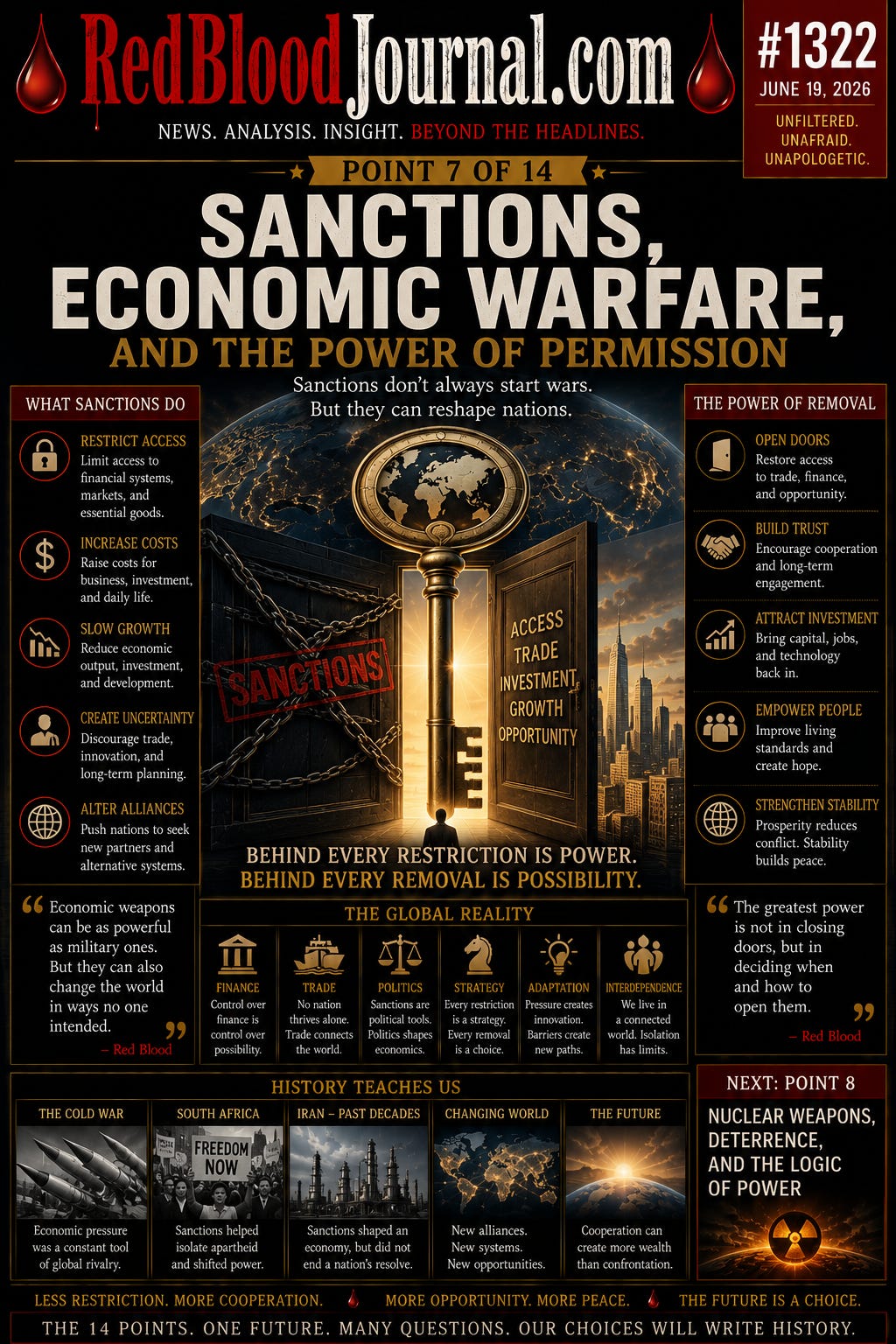
🩸 RedBloodJournal.com #1322 🩸
Point Seven:
Sanctions, Economic Warfare, and the Power of Permission
By Red Blood
The seventh point of the reported fourteen-point agreement may be one of the most consequential.
It concerns sanctions.
To many people, sanctions sound peaceful.
No missiles.
No bombs.
No armies crossing borders.
No tanks rolling through cities.
Just signatures.
Regulations.
Restrictions.
Financial rules.
Administrative orders.
Yet sanctions have become one of the most powerful weapons of the modern age.
Point Seven reportedly calls for the termination of sanctions against Iran according to an agreed schedule.
Whether one supports that outcome or opposes it, the point forces a larger conversation.
What exactly are sanctions?
And how much power do they really hold?
The Weapon Nobody Sees
Traditional warfare is visible.
People can see military equipment.
They can see destruction.
They can see conflict unfold.
Economic warfare operates differently.
Its effects are often delayed.
Indirect.
Distributed.
Invisible.
The damage does not always arrive in dramatic headlines.
Instead it appears gradually.
Reduced investment.
Restricted trade.
Higher costs.
Limited access to financial systems.
Difficulty obtaining technology.
Difficulty obtaining capital.
The impact accumulates over time.
Like water wearing down stone.
The Age of Economic Power
Throughout history, nations projected power through armies and navies.
Modern power increasingly flows through economics.
Banking systems.
Reserve currencies.
Payment networks.
Insurance markets.
Trade agreements.
Financial institutions.
Access itself becomes leverage.
The ability to grant access.
The ability to deny access.
The ability to restrict access.
Point Seven sits at the center of this reality.
The Power of Permission
Modern economies depend on permission.
Permission to trade.
Permission to finance.
Permission to insure.
Permission to transfer funds.
Permission to access markets.
Permission to participate.
Most people rarely think about permission because it exists in the background.
Like electricity.
Invisible until interrupted.
Sanctions transform permission into policy.
The question becomes:
Who decides who may participate?
And under what conditions?
The Cost of Isolation
Isolation affects different nations differently.
Some adapt.
Some struggle.
Most do both simultaneously.
New trade routes emerge.
Alternative financial systems appear.
Domestic industries adjust.
At the same time, opportunities may be lost.
Costs may rise.
Growth may slow.
Foreign investment may hesitate.
The longer isolation persists, the more permanent its effects can become.
History demonstrates that economic systems often reshape themselves in response to pressure.
Sometimes in ways nobody anticipated.
The Intended Goal
Supporters of sanctions usually present them as alternatives to war.
A method of applying pressure without direct military confrontation.
The theory is straightforward.
Change behavior through economic incentives.
Create consequences.
Encourage negotiation.
Avoid violence.
The logic is understandable.
Yet history presents a mixed record.
Some sanctions have achieved objectives.
Others have failed.
Some have strengthened governments rather than weakened them.
Some have encouraged adaptation instead of compliance.
Reality rarely follows theory perfectly.
The Unintended Consequences
Every policy creates intended consequences.
And unintended consequences.
Economic restrictions can accelerate innovation.
Pressure can encourage self-sufficiency.
Isolation can create new partnerships.
Barriers can inspire alternative systems.
History repeatedly demonstrates this pattern.
When one door closes, human beings search for another.
Sometimes the alternative becomes stronger than the original system.
The Currency Question
Sanctions are ultimately connected to something deeper.
Trust.
Global financial systems function because participants trust them.
Currencies derive power from confidence.
Markets derive power from credibility.
Institutions derive power from predictability.
The widespread use of sanctions has raised questions throughout the world.
How permanent is access?
How neutral are financial systems?
Can economics remain separate from politics?
These questions extend far beyond any single country.
Point Seven touches them indirectly.
The Psychology of Opening Doors
If sanctions represent closed doors, their removal represents opening doors.
The psychology matters.
Businesses notice.
Investors notice.
Governments notice.
Markets notice.
Possibility itself becomes an economic force.
Sometimes expectations begin changing before reality changes.
The belief that barriers may disappear can influence decisions long before the barriers are actually removed.
The Door Behind the Door
Perhaps Point Seven is not truly about sanctions.
Perhaps it is about participation.
Who belongs inside the system?
Who remains outside?
Who decides?
And for how long?
Modern civilization is increasingly interconnected.
The power to include may eventually become greater than the power to exclude.
That possibility lies beneath Point Seven.
The first six points addressed war, recognition, time, presence, trade, and reconstruction.
Point Seven addresses access.
Because before a nation can fully participate in the global economy, it must first be allowed through the gate.
The next point moves to the issue that dominated headlines for decades.
The issue many believed was the reason for the conflict itself.
Nuclear weapons.
And Point Eight asks a question that has shaped global politics for generations.
Who gets to possess ultimate deterrence?
The Ocean of Love and Positivity awaits.
Next: 🩸 RedBloodJournal.com #1323 — Point Eight: Nuclear Weapons, Deterrence, and the Logic of Power
🔓 The Architecture of Economic Warfare and the Power of Permission
Jun 19, 2026
The provided text examines Point Seven of a proposed international agreement, which focuses on the gradual removal of economic sanctions against Iran.
The author characterizes these financial restrictions as a modern form of invisible warfare that exerts pressure by denying nations the permission to participate in global trade and banking.
While sanctions are often presented as peaceful alternatives to military conflict, the source argues they have profound, long-term effects on a country’s infrastructure and economic growth.
The narrative suggests that reopening market access is not just a policy shift but a fundamental change in global interconnectedness and trust.
Ultimately, the text highlights how the power to exclude or include a nation in the financial system has become a primary tool of geopolitical leverage.


