


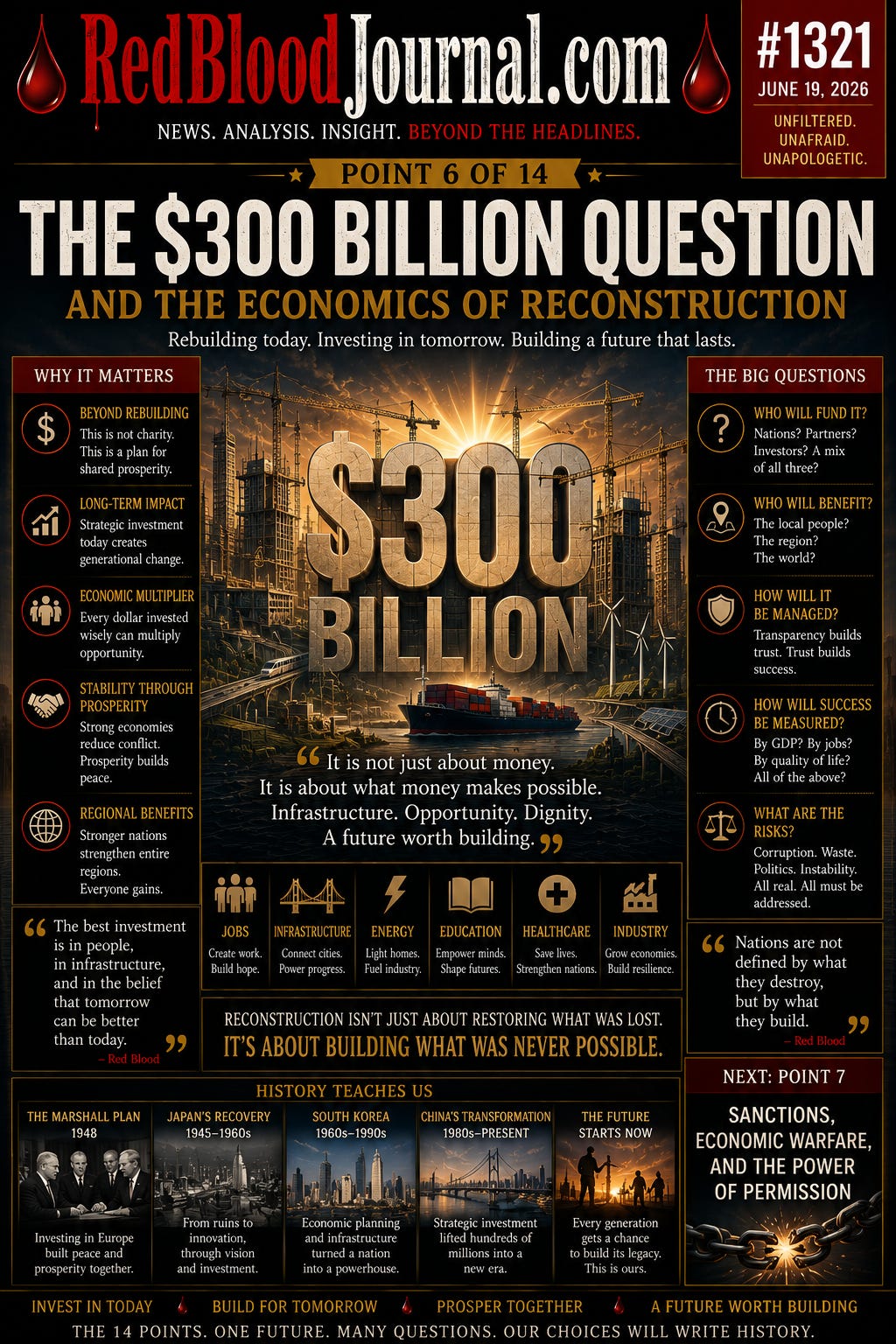
🩸 RedBloodJournal.com #1321 🩸
Point Six:
The $300 Billion Question and the Economics of Reconstruction
By Red Blood
The sixth point of the reported fourteen-point agreement may be the number that captured more attention than any other.
Three hundred billion dollars.
Not three hundred million.
Not thirty billion.
Three hundred billion.
The reported language speaks of a reconstruction and economic development plan involving at least $300 billion.
The moment that figure appeared, reactions followed immediately.
Some called it impossible.
Others called it compensation.
Some called it investment.
Others called it surrender.
But before asking who pays, it may be useful to ask a more fundamental question:
Why is reconstruction necessary in the first place?
The Price Tag of Conflict
Wars are expensive.
Everyone knows this.
What is less understood is how difficult it becomes to calculate the true cost.
The visible damage is easy to photograph.
Destroyed buildings.
Damaged infrastructure.
Power stations.
Roads.
Ports.
Industrial facilities.
The invisible damage is harder to measure.
Delayed investment.
Lost productivity.
Missed opportunities.
Human capital.
Brain drain.
Lost confidence.
Economic uncertainty.
Often the invisible damage exceeds the visible damage.
The Number That Commands Attention
Large numbers have power.
A thousand dollars feels different from ten thousand.
Ten thousand feels different from a million.
A million feels different from a billion.
A billion feels different from three hundred billion.
At some point the average mind struggles to visualize the scale.
The number itself becomes symbolic.
A figure this large immediately transforms a discussion.
People stop debating details.
They begin debating meaning.
What does such a number represent?
What message does it send?
What future is being imagined?
The Difference Between Reconstruction and Development
The reported language does not only mention reconstruction.
It also mentions development.
That distinction matters.
Reconstruction attempts to restore what existed before.
Development attempts to create something new.
One looks backward.
The other looks forward.
One repairs.
The other expands.
History shows that these goals often become intertwined.
Countries recovering from conflict frequently face a choice.
Rebuild yesterday.
Or build tomorrow.
The answer usually determines the next generation.
The Investment Perspective
Not everyone sees large spending plans the same way.
Some view them as costs.
Others view them as investments.
A bridge can be an expense.
Or it can be an investment.
A power plant can be an expense.
Or it can be an investment.
Education can be an expense.
Or it can be an investment.
The difference often depends on the time horizon being considered.
Those focused on today see costs.
Those focused on decades see possibilities.
Both perspectives contain truth.
The Strategic Question
Major powers have long understood a simple principle.
Economic influence can sometimes achieve what military influence cannot.
History contains countless examples.
Roads.
Ports.
Railways.
Factories.
Power grids.
Technology transfers.
Financial systems.
Development projects often become instruments of long-term influence.
This reality is neither new nor controversial.
The question is not whether economics influences geopolitics.
The question is how much.
Point Six raises that question directly.
The Reconstruction Paradox
There is an irony present in many reconstruction efforts.
The same conflicts that destroy wealth often create opportunities for investment.
The same crisis that damages infrastructure creates demand for rebuilding.
The same disruption that scares capital away eventually attracts capital back.
History repeatedly follows this pattern.
The challenge lies in determining who benefits most from the rebuilding process.
The local population?
Foreign investors?
Governments?
Corporations?
Ideally all of them.
Reality is rarely ideal.
The Human Dimension
Large numbers can obscure human realities.
Three hundred billion dollars is ultimately not about money.
It is about roads people travel.
Electricity people use.
Hospitals people visit.
Schools people attend.
Businesses people create.
Jobs people hold.
Communities people build.
Money itself has little value.
Its value comes from what it enables.
Every economic figure eventually translates into human outcomes.
Positive or negative.
Visible or invisible.
The Psychology of Prosperity
Conflict creates uncertainty.
Prosperity often begins with confidence.
People invest when they believe tomorrow exists.
Businesses expand when they trust the future.
Families plan when they see opportunity.
Development is as much psychological as financial.
A nation’s greatest asset is frequently not its resources.
It is the confidence of its people.
Point Six indirectly acknowledges this truth.
The Door Behind the Door
Perhaps Point Six is not really about three hundred billion dollars.
Perhaps it is about imagination.
The ability to envision a future different from the present.
Wars focus attention on destruction.
Development focuses attention on creation.
One asks:
“What has been lost?”
The other asks:
“What can be built?”
The first five points addressed war, recognition, time, presence, and trade.
Point Six introduces economics.
Because every peace eventually encounters a practical question.
Who will finance the future?
The next point moves even deeper into that question.
Because before wealth can flow freely, barriers must be removed.
And Point Seven addresses one of the most powerful economic tools of the modern era.
Sanctions.
The Ocean of Love and Positivity awaits.
Next: 🩸 RedBloodJournal.com #1322 — Point Seven: Sanctions, Economic Warfare, and the Power of Permission
🏗️ The Three Hundred Billion Dollar Blueprint for Peace
Jun 19, 2026
This article examines the sixteenth point of a fourteen-part agreement, which proposes a massive $300 billion plan for economic recovery.
The author explores the profound difference between reconstruction, which restores the past, and development, which builds a new future.
Beyond the staggering financial figure, the text highlights the invisible costs of war, such as lost human potential and the destruction of public confidence.
It suggests that such a large investment serves as a strategic instrument for long-term geopolitical influence while addressing the practical needs of a rebuilding society.
Ultimately, the narrative shifts the focus from military destruction to the psychological and financial foundations required to finance a lasting peace.


