


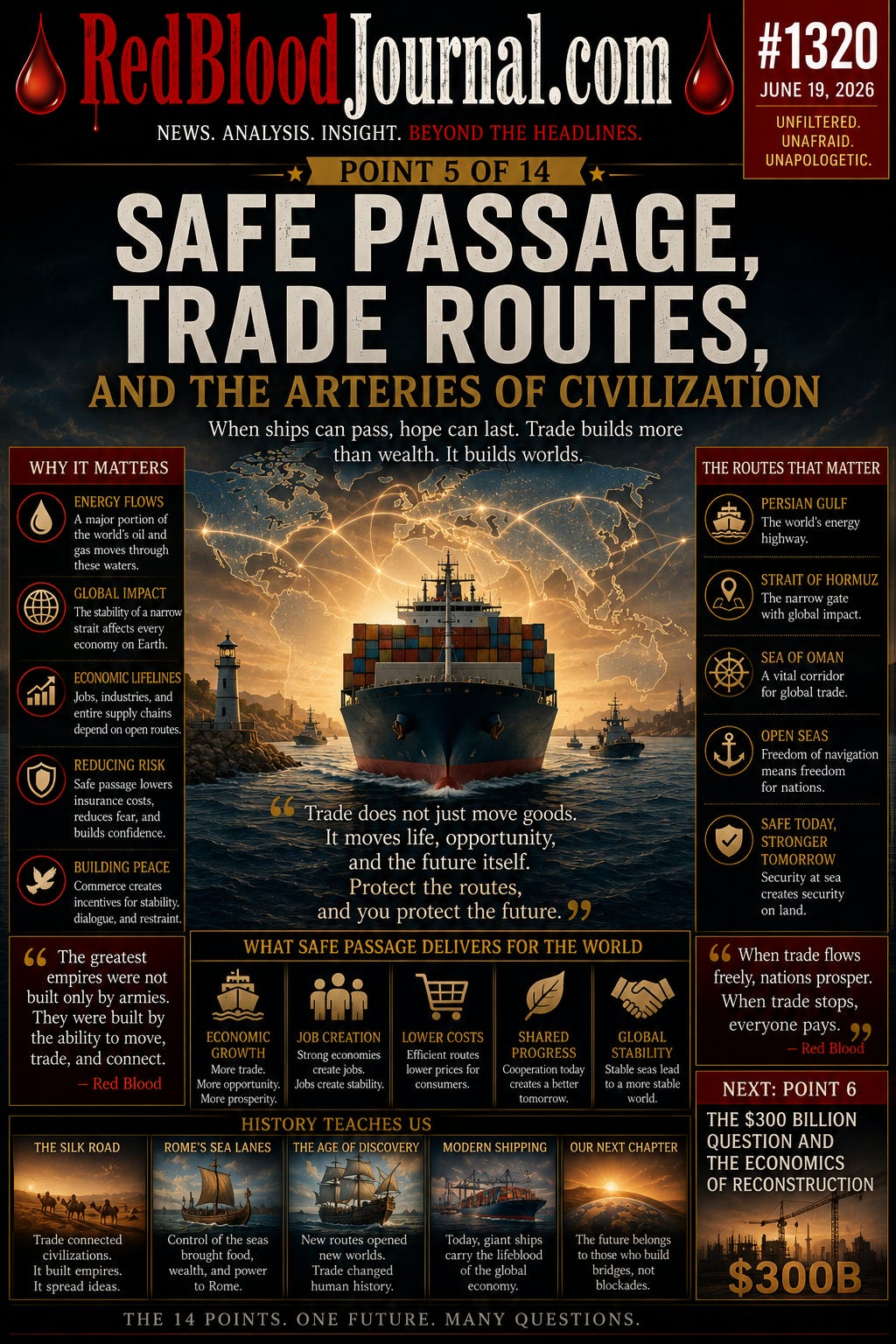
🩸 RedBloodJournal.com #1320 🩸
Point Five:
Safe Passage, Trade Routes, and the Arteries of Civilization
By Red Blood
The fifth point of the reported fourteen-point agreement appears to focus on something simple.
Ships.
Cargo.
Commercial passage.
Trade.
The text reportedly provides for the safe movement of commercial vessels through the Persian Gulf and the Sea of Oman during the initial phase of the agreement.
To many readers, this may sound like a technical detail.
A shipping matter.
A maritime regulation.
A logistical adjustment.
History suggests otherwise.
Trade routes have shaped civilizations for thousands of years.
Empires have risen to control them.
Wars have been fought over them.
Fortunes have been built upon them.
Entire nations have depended upon them.
Point Five is not really about ships.
It is about flow.
The Arteries of Civilization
The human body depends on arteries.
When blood flows, the body functions.
When flow is restricted, problems begin.
Civilizations operate in much the same way.
Energy flows.
Food flows.
Raw materials flow.
Manufactured goods flow.
Capital flows.
Information flows.
When these flows move efficiently, economies grow.
When they become blocked, instability follows.
The waterways discussed in Point Five are among the most important arteries in the modern world.
A significant portion of global energy trade passes through this region.
What appears to be a narrow stretch of water influences daily life on every continent.
The Geography of Chokepoints
History repeatedly demonstrates that geography creates chokepoints.
Mountain passes.
River crossings.
Canals.
Straits.
Ports.
Control over these locations often produces influence far beyond their physical size.
A narrow corridor can affect entire continents.
A small island can alter global trade.
A single waterway can influence energy prices worldwide.
The strategic importance of certain locations comes not from their size but from what passes through them.
Point Five centers on one of those locations.
The Economics of Movement
Every commercial vessel carries more than cargo.
It carries expectations.
Contracts.
Investments.
Insurance policies.
Production schedules.
Employment.
Revenue.
Entire economic systems depend upon predictability.
Businesses can adapt to high costs.
Businesses can adapt to low costs.
What they struggle to adapt to is uncertainty.
The promise of safe passage reduces uncertainty.
And uncertainty is often one of the most expensive commodities in the world.
The Cost of Fear
Fear has economic consequences.
When shipping companies perceive risk, costs rise.
Insurance premiums increase.
Alternative routes are considered.
Investors hesitate.
Consumers eventually pay the price.
Sometimes the cost of fear exceeds the cost of actual disruption.
Markets often react to perceived danger long before danger arrives.
Point Five attempts to address perception as much as reality.
The Relationship Between Trade and Peace
Throughout history, trade and peace have maintained a complicated relationship.
Trade does not eliminate conflict.
Conflict does not eliminate trade.
Yet there is often a connection.
Nations deeply integrated into commercial systems frequently discover that instability carries economic penalties.
The desire to protect commerce sometimes becomes a powerful incentive for restraint.
Not always.
But often enough to matter.
Point Five reflects this reality.
Before trust develops politically, trust often develops economically.
The Invisible Cargo
The most important cargo moving through trade routes is often invisible.
Confidence.
Predictability.
Expectation.
Reliability.
These are the foundations upon which modern economies are built.
Without them, even abundant resources become difficult to utilize effectively.
With them, prosperity becomes easier to achieve.
Safe passage is ultimately a promise about reliability.
And reliability is one of the most valuable resources any society can possess.
The View from History
When historians examine major geopolitical transitions, they frequently focus on battles.
Yet commerce often reveals deeper truths.
Merchants notice changing realities before politicians acknowledge them.
Shipping patterns reveal emerging power structures.
Investment patterns reveal future directions.
Trade frequently acts as an early warning system for larger changes.
Point Five may be viewed through this lens.
Not merely as a maritime provision.
But as an indicator of broader transformations.
The Door Behind the Door
Perhaps Point Five is not about vessels at all.
Perhaps it is about interdependence.
The recognition that nations are connected through networks larger than politics.
Larger than ideology.
Larger than temporary disagreements.
The modern world is built upon movement.
When movement stops, everyone notices.
When movement resumes, everyone benefits.
The first point addressed war.
The second addressed recognition.
The third introduced time.
The fourth examined presence.
The fifth focuses on flow.
And flow always leads to another question.
Who pays for the future?
That question appears in Point Six.
Because reconstruction, development, and investment require something every agreement eventually encounters.
Money.
The Ocean of Love and Positivity awaits.
Next: 🩸 RedBloodJournal.com #1321 — Point Six: The $300 Billion Question and the Economics of Reconstruction
🚢 The Arteries of Civilization:
Trade and the Flow of Power
Jun 19, 2026
The provided text analyzes a specific segment of a proposed fourteen-point agreement that guarantees the unimpeded movement of commercial ships through vital Middle Eastern waterways.
By comparing trade routes to the arteries of a living organism, the author argues that the free flow of goods and energy is essential for global economic health.
The article suggests that securing these maritime chokepoints does more than just protect cargo; it restores market confidence and reduces the high costs associated with international fear and uncertainty.
Ultimately, the source highlights how economic interdependence can serve as a precursor to political stability and peace between nations.
This strategic provision is presented not merely as a logistical rule, but as a fundamental shift toward predictability and regional cooperation.


