


🩸 RedBloodJournal.com #1319 🩸
Point Four:
Naval Withdrawal, Presence, and the Meaning of Departure
By Red Blood
The fourth point of the reported fourteen-point agreement is one of the shortest.
It may also be one of the most significant.
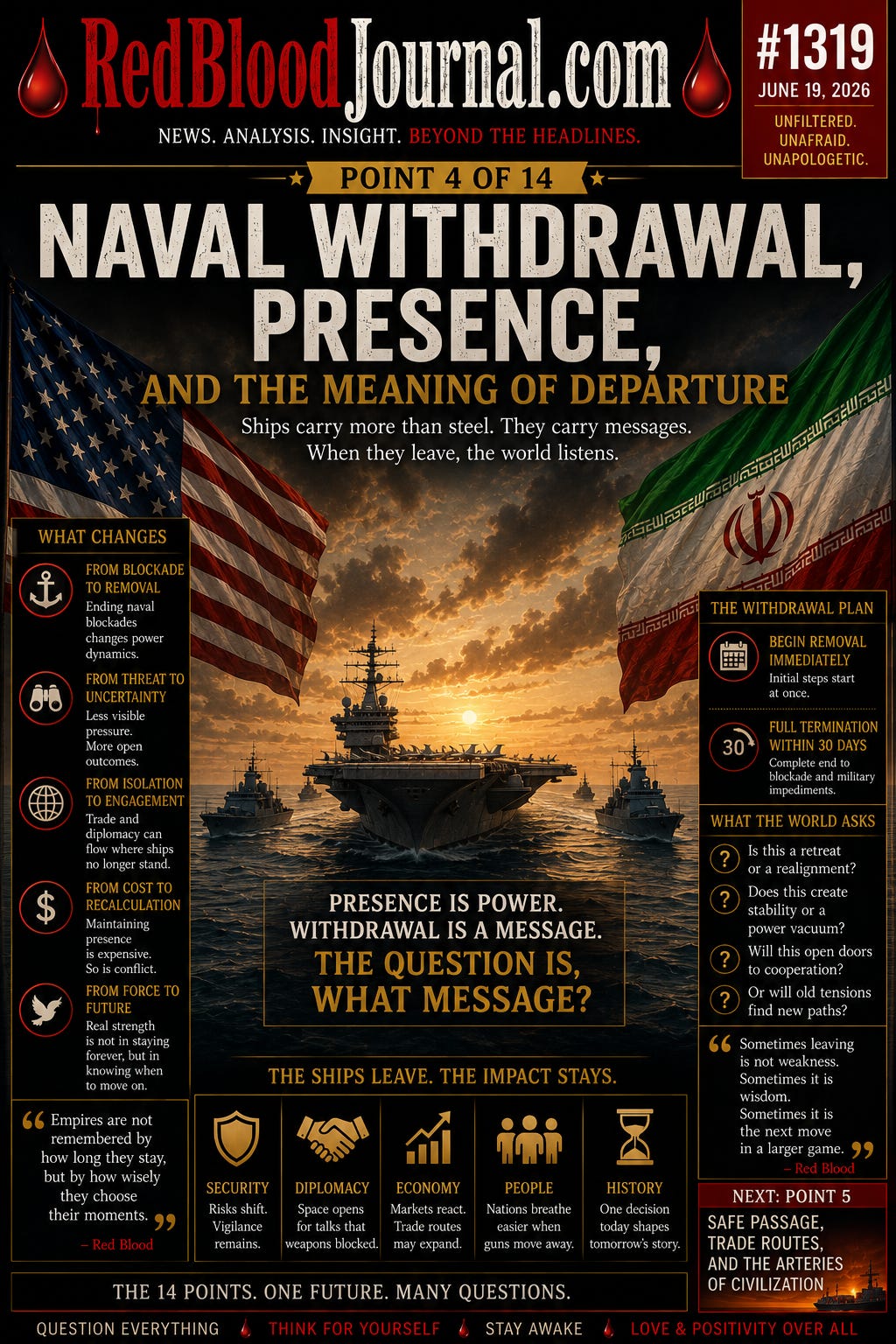
According to the reported text, the United States would begin removing its naval blockade and military impediments against Iran, with full termination within thirty days.
At first glance, this appears to be a military adjustment.
A redeployment.
A logistical decision.
A change of posture.
But history teaches that the movement of military forces often communicates far more than words.
Ships do not merely occupy water.
They occupy meaning.
The Geography of Presence
For generations, military presence has been one of the defining features of global power.
A nation does not need to fire a weapon to influence events.
Sometimes simply being present is enough.
Aircraft carriers.
Naval task forces.
Forward operating bases.
Strategic ports.
Military presence sends a message.
The message is simple:
“We are here.”
Point Four raises a different message.
“What happens when we leave?”
The Difference Between Power and Presence
Power and presence are often confused.
They are not the same thing.
A nation may possess enormous power without maintaining a constant presence.
Likewise, a nation may maintain a large presence without increasing its actual power.
History contains examples of both.
Empires frequently discover that maintaining presence becomes increasingly expensive over time.
Ships require maintenance.
Bases require funding.
Personnel require support.
Supply chains require protection.
Eventually every great power must ask a difficult question:
Does the cost of presence exceed the value of presence?
Point Four appears connected to that question.
The Psychology of Withdrawal
Withdrawals generate strong emotional reactions.
Supporters often call them strategic realignments.
Critics often call them retreats.
The same movement can receive entirely different interpretations depending on perspective.
History shows that withdrawals are rarely judged by the withdrawal itself.
They are judged by what happens afterward.
If stability follows, the withdrawal may be remembered as wisdom.
If instability follows, it may be remembered as weakness.
The judgment usually arrives years later.
Not immediately.
The Strait and the Ships
The region discussed in the agreement contains one of the world’s most important maritime corridors.
Energy flows through it.
Trade flows through it.
Global supply chains depend upon it.
For decades, military presence in the area became part of the accepted landscape.
Many people grew accustomed to seeing it as permanent.
Yet history repeatedly reminds us that nothing geopolitical remains permanent.
Routes change.
Alliances change.
Strategies change.
The map stays the same.
The calculations surrounding the map do not.
The Question of Control
Military presence is often associated with control.
The assumption is understandable.
If a nation maintains forces in a region, observers frequently conclude that nation controls events.
Reality is often more complicated.
Presence creates influence.
It does not guarantee outcomes.
History contains many examples where heavily armed powers maintained large deployments yet struggled to achieve their objectives.
The existence of forces and the achievement of goals are not always identical.
Point Four quietly raises this uncomfortable distinction.
Visibility and Invisibility
One reason military deployments matter is visibility.
Everyone can see ships.
Everyone can see bases.
Everyone can count aircraft.
Visible power creates psychological effects.
Invisible power can be harder to measure.
Economic leverage.
Diplomatic relationships.
Trade networks.
Energy dependence.
Financial systems.
Political influence.
Sometimes visible power decreases while invisible power remains.
Sometimes the reverse occurs.
Point Four may be less about military hardware than about a changing balance between visible and invisible forms of influence.
The Symbolism of Departure
Departures often reveal as much as arrivals.
When forces arrive, observers ask:
“What are they preparing to do?”
When forces leave, observers ask:
“What has changed?”
The answer is rarely simple.
Sometimes departure reflects confidence.
Sometimes caution.
Sometimes necessity.
Sometimes exhaustion.
Sometimes opportunity.
Sometimes all of them simultaneously.
The Door Behind the Door
Perhaps Point Four is not really about ships.
Perhaps it is about limits.
Every empire eventually encounters limits.
Financial limits.
Military limits.
Political limits.
Industrial limits.
Public limits.
Strategic limits.
The question is never whether limits exist.
The question is when those limits become visible.
History often changes course when powerful nations acknowledge realities that were previously ignored.
Point Four may represent one such moment.
Or it may represent nothing more than a temporary repositioning.
Only time will answer that question.
The first point addressed war.
The second addressed recognition.
The third introduced time.
The fourth introduces presence.
And the fifth point shifts attention from military movement to commercial movement.
Because while armies move through regions, so do ships carrying something equally important.
Trade.
The Ocean of Love and Positivity awaits.
Next: 🩸 RedBloodJournal.com #1320 — Point Five: Safe Passage, Trade Routes, and the Arteries of Civilization
🚢 The Geography of Presence:
Naval Power and Strategic Departure
Jun 19, 2026
The provided text analyzes a specific component of a fourteen-point international agreement concerning the removal of United States naval blockades against Iran.
It explores the profound psychological and geopolitical implications of shifting from a visible military presence to a strategy of strategic withdrawal.
The author argues that military deployments serve as symbolic messages of influence, and their removal forces a difficult distinction between actual power and mere physical presence.
This transition highlights the economic and logistical limits of maintaining global empires while questioning whether invisible forms of influence, such as diplomacy and trade, will replace traditional force.
Ultimately, the source suggests that the true impact of departure is judged not by the act itself, but by the long-term stability or chaos that follows in its wake.
🚢 The Geography of Presence:
Naval Power and Strategic Departure
Jun 19, 2026
The provided text analyzes a specific component of a fourteen-point international agreement concerning the removal of United States naval blockades against Iran.
It explores the profound psychological and geopolitical implications of shifting from a visible military presence to a strategy of strategic withdrawal.
The author argues that military deployments serve as symbolic messages of influence, and their removal forces a difficult distinction between actual power and mere physical presence.
This transition highlights the economic and logistical limits of maintaining global empires while questioning whether invisible forms of influence, such as diplomacy and trade, will replace traditional force.
Ultimately, the source suggests that the true impact of departure is judged not by the act itself, but by the long-term stability or chaos that follows in its wake.


