


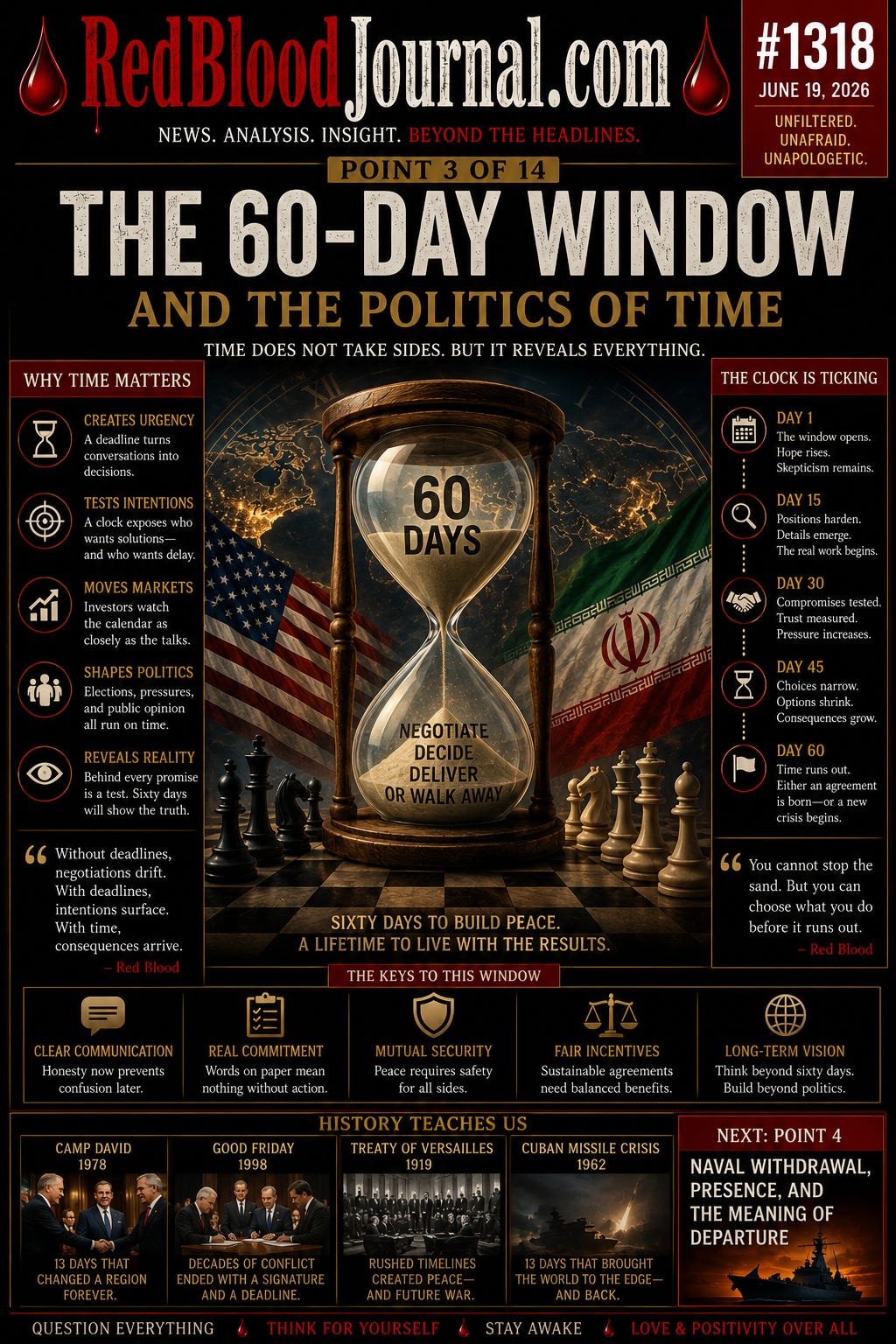
🩸 RedBloodJournal.com #1318 🩸
Point Three:
The 60-Day Window and the Politics of Time
By Red Blood
The third point of the reported fourteen-point agreement appears deceptively simple.
It establishes a sixty-day period during which the parties are expected to negotiate the details of a final agreement.
At first glance, sixty days may seem like an administrative detail.
A scheduling matter.
A bureaucratic formality.
A calendar entry.
Yet history suggests that time itself is often one of the most powerful forces in politics.
Wars are fought with weapons.
Empires are built with money.
But agreements frequently succeed or fail because of clocks.
Point Three is not merely about sixty days.
Point Three is about time.
The Invisible Participant
Most negotiations involve visible participants.
Governments.
Diplomats.
Military leaders.
Financial institutions.
Intelligence services.
But there is always another participant sitting quietly in the room.
Time.
Time pressures leaders.
Time changes public opinion.
Time moves markets.
Time reveals weaknesses.
Time creates opportunities.
Time forces decisions.
Every side enters negotiations believing time favors them.
Often they are both wrong.
The Meaning of Sixty Days
Why sixty days?
Why not thirty?
Why not ninety?
Why not six months?
The exact number matters less than what the number represents.
A limited window creates urgency.
Without deadlines, negotiations can drift endlessly.
Meetings multiply.
Committees expand.
Documents grow longer.
Decisions become delayed.
A clock prevents permanent postponement.
The clock reminds every participant that eventually choices must be made.
And choices create consequences.
The Market Clock
Financial markets pay close attention to time.
Investors do not simply analyze agreements.
They analyze probability.
The shorter the timeline, the faster capital reacts.
Businesses considering future investments need signals.
Banks need certainty.
Energy markets need predictability.
Insurance companies need risk calculations.
The sixty-day window functions as a signal.
It tells the world that uncertainty may soon be replaced by clarity.
Whether that clarity proves positive or negative is another matter.
Markets often prefer certainty over perfection.
The Political Clock
Governments also operate under deadlines.
Election cycles.
Budget cycles.
Legislative calendars.
Public attention spans.
Leaders may speak about long-term strategy.
Politics often forces short-term decisions.
Every day that passes changes the political environment.
New events emerge.
New crises appear.
New headlines replace old ones.
A sixty-day clock limits how many variables can enter the equation before decisions must be made.
The Strategic Pause
History shows that temporary pauses can become permanent arrangements.
History also shows that temporary pauses can become preparation periods for future conflict.
Both outcomes are possible.
This is why observers often watch what happens during negotiation periods more closely than the negotiations themselves.
Words matter.
Actions matter more.
What happens during those sixty days may reveal more than any official statement.
Trust is not built by signatures.
Trust is built by behavior.
The Test of Intentions
Deadlines perform another function.
They test intentions.
It is easy to support negotiations in theory.
It is harder to produce results under a deadline.
A clock forces priorities to emerge.
Participants who genuinely seek resolution often behave differently than participants seeking delay.
The calendar exposes those differences.
Eventually every negotiation encounters a moment when intentions become visible.
The countdown creates that moment.
The Psychology of Waiting
Humans rarely enjoy uncertainty.
People prefer answers.
Even difficult answers.
The waiting period becomes a psychological battlefield of its own.
Rumors spread.
Predictions multiply.
Experts appear.
Commentators debate.
Supporters celebrate prematurely.
Critics condemn prematurely.
Yet the reality remains unchanged.
The clock continues.
One day at a time.
The patience required during negotiations is often more difficult than the negotiations themselves.
History’s Countdown Timers
Many historic turning points contained deadlines.
Armistices.
Ceasefires.
Trade agreements.
Peace conferences.
Summits.
Constitutions.
Referendums.
Some deadlines produced breakthroughs.
Others produced collapse.
The outcome was never determined by the clock alone.
The clock merely revealed whether sufficient political will existed behind the promises.
Point Three serves a similar purpose.
The Door Behind the Door
Perhaps Point Three is not truly about sixty days.
Perhaps it is about accountability.
A promise without a timeline can survive indefinitely.
A promise attached to a countdown eventually faces judgment.
Success becomes measurable.
Failure becomes visible.
Reality becomes unavoidable.
The first point stopped the fighting.
The second point addressed recognition.
The third point introduces accountability through time.
The clock has started.
The countdown has begun.
And every participant now moves under its shadow.
The next point shifts from time to power.
Because Point Four addresses something that every empire, every military alliance, and every great power understands.
Presence.
Who stays.
Who leaves.
And what that departure means.
The Ocean of Love and Positivity awaits.
Next: 🩸 RedBloodJournal.com #1319 — Point Four: Naval Withdrawal, Presence, and the Meaning of Departure
⌛️ The Sixty-Day Clock:
Time as a Political Force
Jun 19, 2026
This text examines the critical role of time within political negotiations, specifically focusing on a sixty-day deadline established in a fourteen-point agreement.
Rather than viewing the window as a mere administrative detail, the author argues that clocks create urgency and force participants to prioritize results over endless delays.
This specific timeframe serves as a test of intentions, revealing whether leaders truly seek resolution or are simply stalling for tactical advantages.
The countdown also impacts financial markets and political stability by demanding clarity and reducing the period in which new crises can disrupt the process.
Ultimately, the source highlights that while treaties are signed by diplomats, their success or failure is often determined by the accountability imposed by a deadline.
This chronological pressure acts as a psychological battlefield that eventually exposes the reality of every political promise.


