


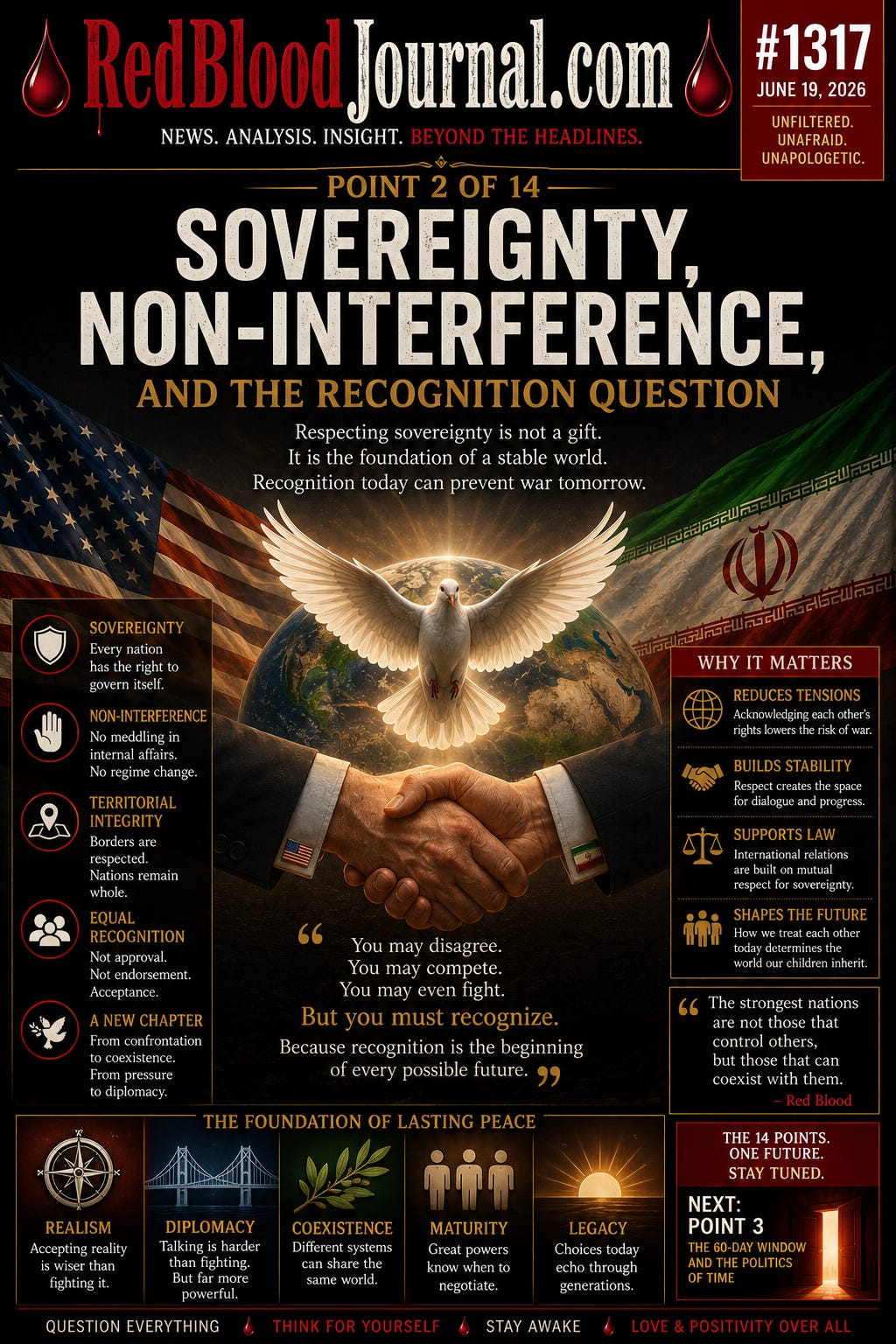
🩸 RedBloodJournal.com #1317 🩸
Point Two:
Sovereignty, Non-Interference, and the Recognition Question
By Red Blood
The second point of the reported fourteen-point agreement appears simple on the surface.
The United States and Iran agree to respect each other’s sovereignty, territorial integrity, and internal affairs.
Many readers may glance at such language and immediately move on.
After all, nearly every international agreement contains similar wording.
Respect sovereignty.
Respect borders.
Do not interfere.
Nothing unusual.
Or is it?
Sometimes the most important statements are the ones that appear ordinary.
The Language of Equals
Nations do not usually negotiate sovereignty with enemies they intend to eliminate.
They negotiate sovereignty with entities they acknowledge will continue to exist.
This is what makes Point Two interesting.
For decades, political rhetoric surrounding Iran frequently centered on pressure, isolation, sanctions, containment, regime change, or transformation.
The language often implied that the current system was temporary.
That eventually something else would replace it.
Yet Point Two speaks a different language.
The language of coexistence.
The language of recognition.
The language of permanence.
Whether one agrees with that recognition is a separate question.
The fact that it appears in the agreement is itself significant.
The Recognition Question
Recognition is one of the most powerful acts in politics.
Before money moves.
Before sanctions end.
Before trade begins.
Recognition must occur.
History is filled with examples.
Countries may dislike one another.
Compete against one another.
Threaten one another.
Even fight one another.
Yet eventually they may arrive at a single conclusion:
The other side is not disappearing.
At that moment strategy changes.
The objective shifts from elimination to management.
From confrontation to coexistence.
From destruction to negotiation.
Point Two appears to operate within that framework.
The Meaning of Sovereignty
Sovereignty is a simple word carrying enormous weight.
At its core it means:
A nation decides its own affairs.
Its laws.
Its institutions.
Its leadership.
Its future.
Throughout history, powerful nations have often supported sovereignty in principle while challenging it in practice.
The tension is ancient.
Every empire has faced it.
Every great power has faced it.
Every regional power has faced it.
Point Two raises a question that extends far beyond Iran.
Can powerful nations truly accept outcomes they do not control?
The answer often determines whether peace survives.
The Invisible Border
Physical borders are easy to see.
Invisible borders are harder.
Economic influence.
Information influence.
Political influence.
Intelligence operations.
Financial pressure.
Media narratives.
Cyber activity.
Modern conflicts frequently occur across invisible borders rather than physical ones.
Point Two does not merely concern tanks crossing frontiers.
It concerns influence crossing frontiers.
In the modern era, that distinction may matter even more.
The End of a Certain Narrative
For generations many political narratives relied upon a simple division.
Responsible states.
Rogue states.
Civilized actors.
Dangerous actors.
Good systems.
Bad systems.
Reality has always been more complicated.
History often forces adversaries to negotiate regardless of how they describe one another publicly.
The world contains many governments that disagree profoundly.
Yet international systems function because recognition eventually outweighs rhetoric.
Point Two may reflect that reality.
The Geography of Permanence
Geography has a stubborn quality.
Governments change.
Leaders change.
Policies change.
Geography remains.
Iran occupies one of the most strategically important locations on Earth.
That fact remains regardless of ideology.
Regardless of leadership.
Regardless of political system.
Regardless of international opinion.
History repeatedly demonstrates that geography eventually influences diplomacy.
Sometimes more than ideology itself.
The Door Behind the Door
Perhaps Point Two is not really about sovereignty.
Perhaps it is about something deeper.
Acceptance.
Not approval.
Not endorsement.
Not admiration.
Acceptance.
Acceptance that certain realities cannot be changed through pressure alone.
Acceptance that some nations remain important regardless of who governs them.
Acceptance that coexistence may sometimes become more practical than confrontation.
Whether readers view that as wisdom or weakness will depend on perspective.
History will eventually decide.
The Larger Pattern
Point One addressed war.
Point Two addresses legitimacy.
War determines who can fight.
Legitimacy determines who must be acknowledged.
The first point silences weapons.
The second point asks what happens after the silence.
Because once the shooting stops, nations must decide how they will speak to one another.
And that conversation often shapes history more than the conflict itself.
The next point introduces another critical question.
Not peace.
Not sovereignty.
But time.
Because every agreement eventually requires a clock.
And Point Three begins that countdown.
The Ocean of Love and Positivity awaits.
Next: 🩸 RedBloodJournal.com #1318 — Point Three: The 60-Day Negotiation Window and the Politics of Time
🤝 The Sovereignty Question:
Recognition and the End of Confrontation
Jun 19, 2026
This text analyzes the second article of a theoretical fourteen-point agreement between the United States and Iran, focusing on the implications of mutual sovereignty.
The author suggests that by committing to non-interference, both nations are moving away from decades of regime change rhetoric and toward a framework of permanent coexistence.
This shift represents a powerful form of political recognition, acknowledging that neither side can eliminate the other through external pressure.
Beyond physical borders, the document explores how sovereignty applies to modern influence, including cyber activity and economic status.
Ultimately, the source argues that geographic reality and pragmatism have superseded ideological conflict, forcing a transition from confrontation to management.
Through this lens, the agreement is framed not as an endorsement of values, but as a necessary acceptance of legitimacy required to maintain peace.


