


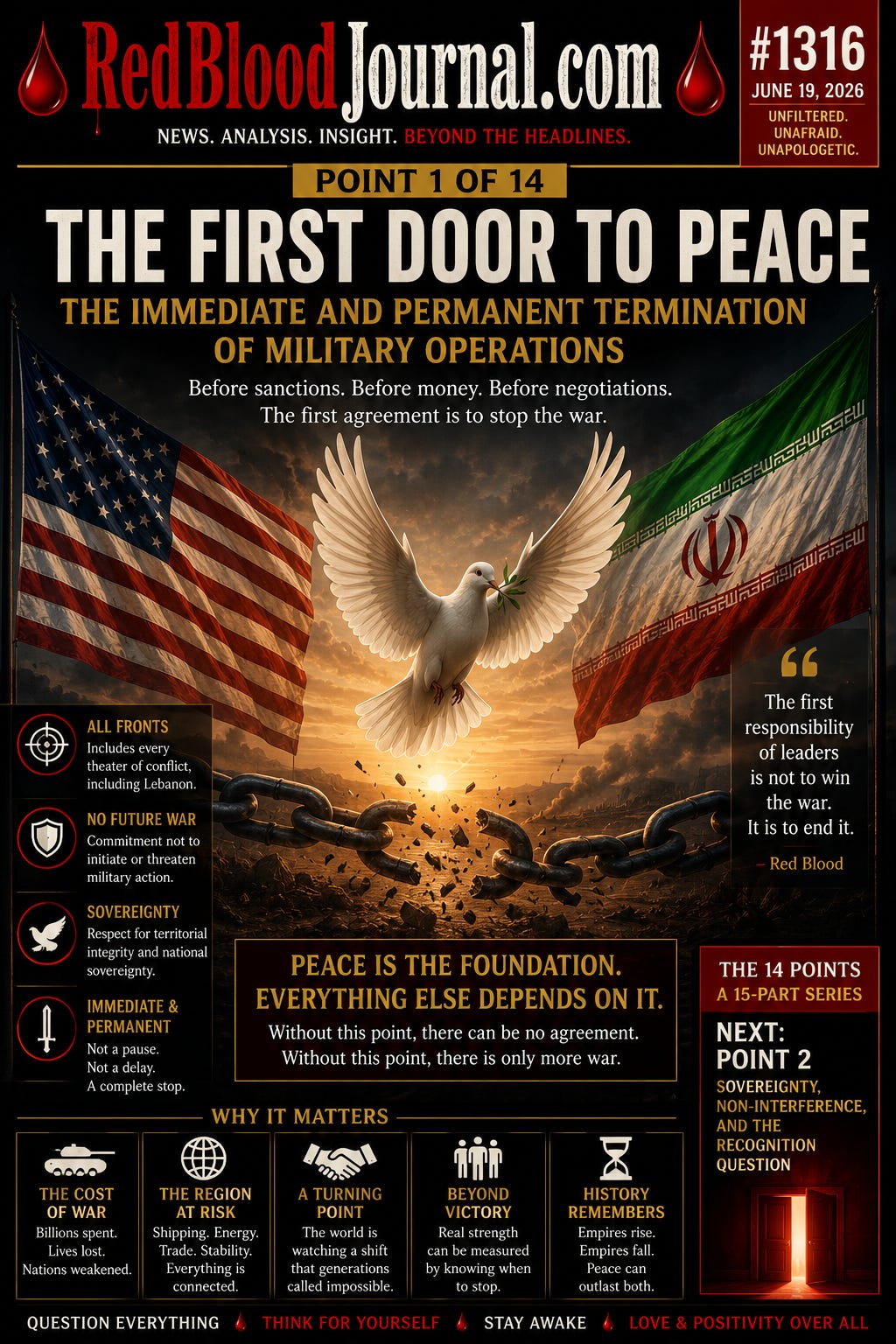
🩸 RedBloodJournal.com #1316 🩸
Point One:
The Immediate and Permanent Termination of Military Operations
By Red Blood
The first point of any agreement often reveals what the participants fear most.
In the reported fourteen-point memorandum, Point One begins not with economics, sanctions, oil, banking, nuclear programs, or reconstruction funds.
It begins with war.
More specifically, it begins with ending war.
According to the reported text, the parties agree to the immediate and permanent termination of military operations on all fronts and commit themselves not to initiate future military actions against one another.
Whether one views this as peace, surrender, compromise, diplomacy, or strategic repositioning depends largely on where one stands.
But before asking who won, it may be useful to ask a different question:
Why was this the first point?
The Priority Test
Imagine a house on fire.
The first priority is not repainting the walls.
The first priority is stopping the fire.
Only after the fire is controlled can the occupants discuss repairs.
The placement of Point One suggests that the negotiators viewed continued military escalation as the greatest immediate threat.
Everything else depends upon the guns becoming silent.
Without Point One, there can be no Point Two.
Without Point One, there can be no sanctions relief.
Without Point One, there can be no reconstruction.
Without Point One, there can be no future negotiations.
The first point creates the foundation upon which all remaining points stand.
The Geography Behind the Agreement
Wars are often described through ideology.
History frequently reveals they are decided through geography.
The region involved in this conflict contains some of the most strategically important waterways, energy corridors, transportation routes, and military positions on Earth.
A prolonged conflict threatens more than the nations directly involved.
Shipping routes become vulnerable.
Energy markets become unstable.
Insurance costs rise.
Trade slows.
Investors become cautious.
Governments begin contingency planning.
The ripple effects spread outward far beyond the battlefield itself.
The first point acknowledges this reality.
The Cost of Continuing
Every military conflict creates visible costs and invisible costs.
The visible costs are easier to count.
Destroyed infrastructure.
Damaged equipment.
Military expenditures.
Casualties.
The invisible costs are often larger.
Economic uncertainty.
Political instability.
Capital flight.
Psychological exhaustion.
Generational distrust.
The longer conflicts continue, the more these invisible costs accumulate.
Eventually even participants who believe they are winning may decide the price of continuing exceeds the value of victory.
History’s Repeating Pattern
History repeatedly shows that wars often end differently than they begin.
The reasons used to justify entering a conflict are frequently different from the reasons used to justify ending it.
The public hears one story at the beginning.
A different story emerges at the conclusion.
Military planners understand this reality well.
No plan survives perfect contact with reality.
Events change.
Assumptions fail.
Unexpected consequences emerge.
Point One may represent recognition that the realities of the battlefield differed from the expectations held before the conflict began.
The Meaning of “Permanent”
One word deserves special attention.
Permanent.
History teaches caution whenever permanent solutions are announced.
Few political arrangements are truly permanent.
Empires believed they were permanent.
Alliances believed they were permanent.
Treaties believed they were permanent.
Borders believed they were permanent.
History eventually challenged all of them.
Perhaps permanence is less important than direction.
A ceasefire can fail.
A treaty can collapse.
A government can change.
Yet the decision to stop fighting still represents a turning point.
The Audience and the Stage
For decades, many observers have viewed the relationship between the United States and Iran as one of the defining confrontations of modern geopolitics.
Generations grew accustomed to hearing the same language.
Threats.
Warnings.
Sanctions.
Retaliation.
Escalation.
Then suddenly the conversation shifts toward termination.
Whether temporary or lasting remains unknown.
But the shift itself is noteworthy.
The audience that watched one act may now be watching the beginning of another.
The Larger Question
Perhaps the most important question raised by Point One is not whether the fighting ends.
The larger question is what conditions made ending the fighting necessary.
What changed?
What calculations shifted?
What realities emerged behind closed doors?
What costs became visible?
What opportunities appeared?
These questions may ultimately reveal more than the agreement itself.
Point One is not merely about stopping military operations.
It is about recognizing that every conflict eventually encounters a moment when continuing becomes harder than changing course.
The remaining thirteen points may explain why.
And that is where the next door opens.
The Ocean of Love and Positivity awaits.
Next: 🩸 RedBloodJournal.com #1317 — Point Two: Sovereignty, Non-Interference, and the Recognition Question
🕊️ The First Foundation
:
Terminating Global Military Conflict
Jun 19, 2026
The Red Blood Journal provides an analytical breakdown of a fourteen-point memorandum aimed at resolving the geopolitical conflict between the United States and Iran.
This specific analysis focuses on Point One, which demands an immediate and permanent end to all military hostilities between the involved parties.
The author argues that halting violence is the essential foundation required before any secondary issues, such as economic sanctions or reconstruction, can be addressed.
By prioritizing a ceasefire, the negotiators acknowledge that the rising costs of war and regional instability have become more burdensome than the pursuit of total victory.
Ultimately, the text suggests that this shift from escalation to diplomacy reflects a pivotal turning point driven by changing strategic realities on the ground.


