


🩸 RedBloodJournal.com #1315 🩸
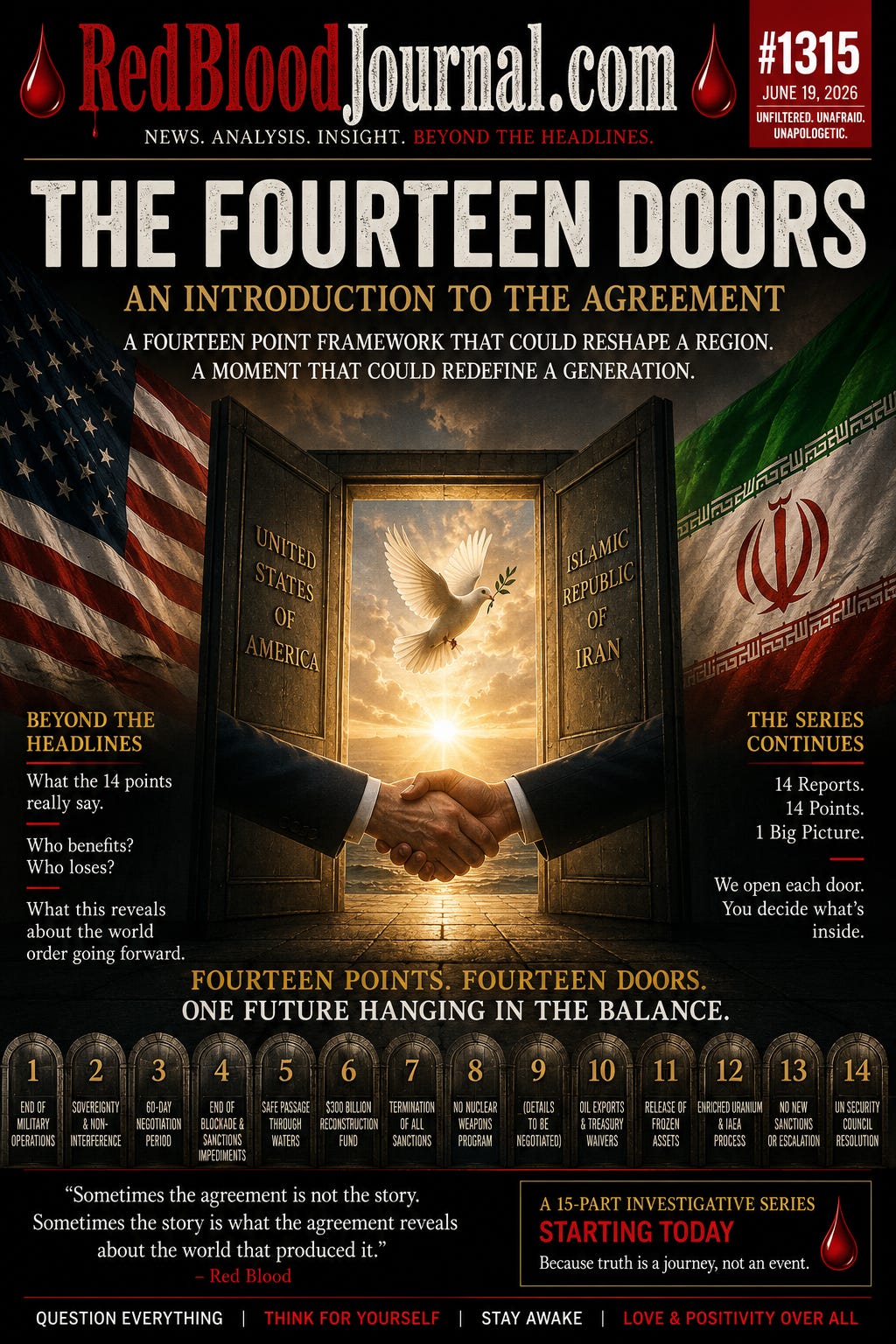
The Fourteen Doors
An Introduction to the Agreement
By Red Blood
Every once in a while a document appears that, whether it is ultimately signed, modified, rejected, or forgotten, reveals something larger than itself.
Most people look at agreements and immediately ask:
Who won?
Who lost?
Who surrendered?
Who gained power?
Those questions are understandable, but they often prevent a deeper observation.
Sometimes the agreement itself is not the story.
Sometimes the story is what the agreement reveals about the world that produced it.
A draft agreement reportedly containing fourteen points has emerged between the United States and Iran.
Supporters call it peace.
Opponents call it surrender.
Analysts call it diplomacy.
Critics call it theater.
Perhaps it is all four.
History shows that major agreements often arrive long after the real decisions have already been made behind closed doors.
The public usually sees the final script after years of invisible negotiations, shifting alliances, economic pressures, military calculations, and political realities.
By the time the audience hears the lines, much of the play has already been performed.
Yet documents matter.
Not because paper changes reality.
But because paper records what reality has become.
For decades the relationship between the United States and Iran has been defined by sanctions, threats, military posturing, proxy conflicts, and mutual distrust.
Generations have grown up believing the confrontation was permanent.
Permanent enemies.
Permanent conflict.
Permanent tension.
Permanent fear.
Then suddenly a document appears.
Fourteen points.
Fourteen doors.
Each door opens into a different room.
One discusses military operations.
Another discusses sovereignty.
Another addresses sanctions.
Another concerns shipping lanes.
Another touches frozen assets.
Another addresses nuclear issues.
Individually, each point may appear technical.
Collectively, they paint a picture.
The purpose of this series is not to tell readers what to think.
The purpose is to walk through each door slowly and examine what lies behind it.
Not through the eyes of politicians.
Not through the eyes of television commentators.
Not through the eyes of governments.
But through the eyes of ordinary observers trying to understand the larger pattern.
In the coming fourteen reports, each point will be examined separately.
What does it mean?
Who benefits?
Who loses?
What assumptions are hidden inside it?
What historical forces may have created it?
And perhaps most importantly:
What does each point reveal about the changing balance of power in the world?
Whether the agreement succeeds or fails is ultimately a future question.
Whether it is implemented or abandoned is also a future question.
But the appearance of the fourteen points is already a present fact.
And present facts often reveal future directions.
This series begins with no conclusions.
Only questions.
Because questions are often more valuable than answers.
Answers tend to end conversations.
Questions keep them alive.
The next fourteen reports will open each door one at a time.
Point One.
Point Two.
Point Three.
All the way to Point Fourteen.
Fourteen doors.
Fourteen opportunities to observe.
Fourteen chances to look beyond headlines and into the machinery that produces them.
The theater may continue.
The actors may change.
The costumes may change.
The stage may change.
But understanding grows when attention moves from the actors to the script.
And sometimes beyond the script itself.
Beyond the stage.
Beyond the audience.
Beyond the labels.
Back toward the ocean from which all waves arise.
And perhaps that is where the most interesting observations begin.
The Ocean of Love and Positivity awaits.
Next in the series:
🩸 RedBloodJournal.com #1316 — Point One: The Immediate and Permanent Termination of Military Operations
🚪 The Fourteen Doors:
Decoding the U.S.-Iran Script
Jun 18, 2026
The provided text introduces an analytical series titled “The Fourteen Doors,” which examines a reported fourteen-point draft agreement between the United States and Iran.
Rather than focusing on political winners or losers, the author treats the document as a historical revelation that reflects shifting global power dynamics and long-standing regional tensions.
Each point of the proposal is described as a symbolic door leading to specific issues such as military operations, economic sanctions, and national sovereignty.
The series aims to move beyond superficial media narratives to explore the hidden motivations and systemic realities that shaped the negotiation.
By investigating these points individually, the author seeks to provide ordinary observers with a deeper understanding of the evolving relationship between these two traditional adversaries.
This introductory installment sets the stage for a comprehensive evaluation of how such a document signifies a potential departure from decades of permanent conflict.


