


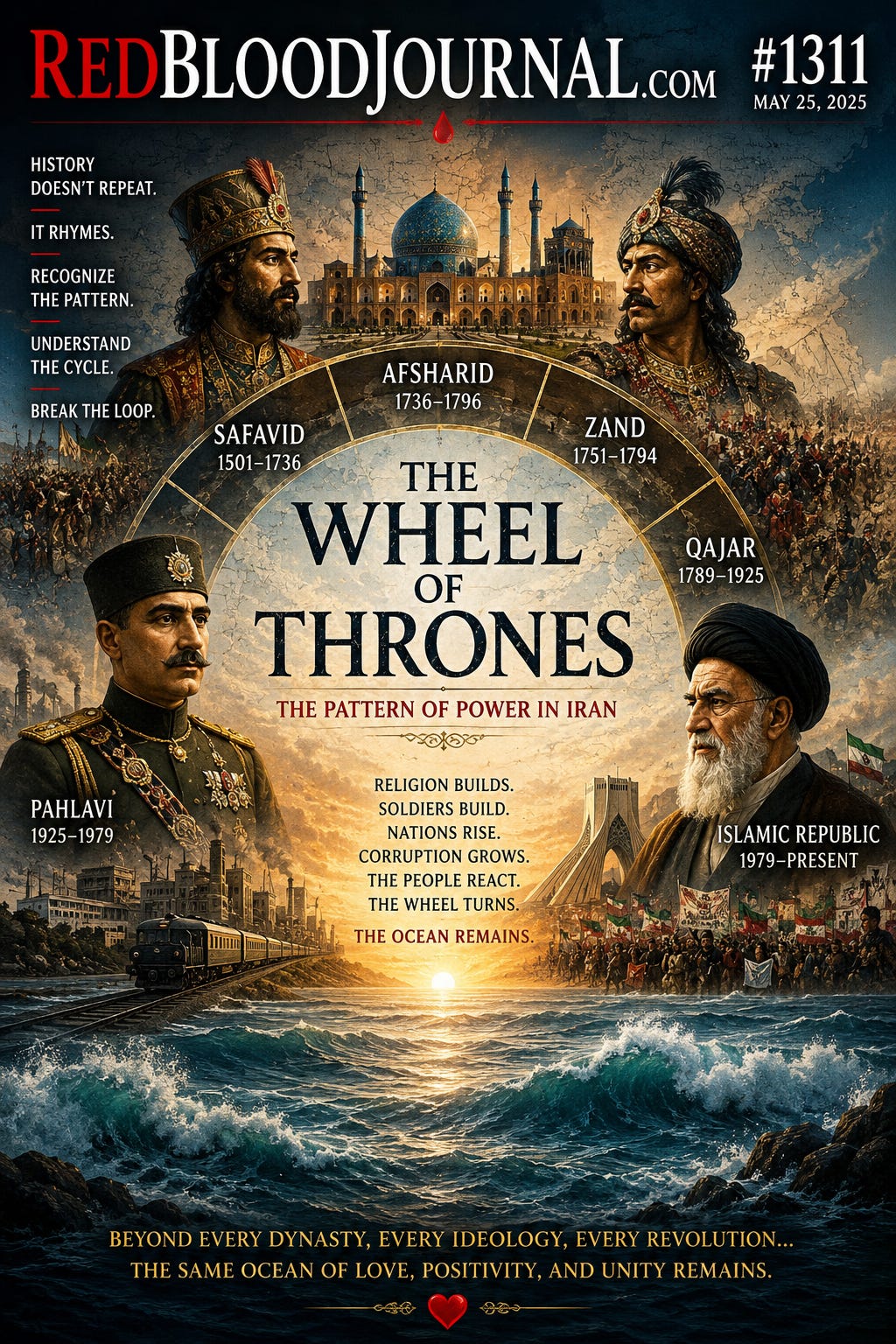
🩸 🔄 RedBloodJournal.com #1311
The Wheel of Thrones: Remembering the Pattern Behind Iran’s Dynasties
History has a peculiar habit.
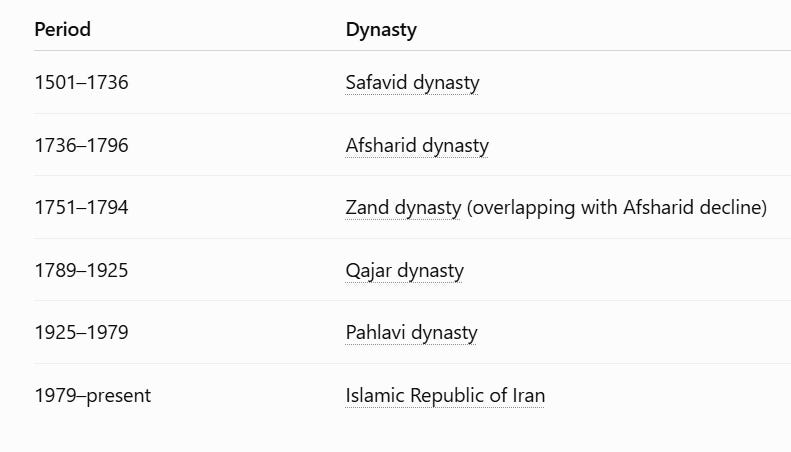
It rarely repeats exactly, but it often echoes loudly enough that those paying attention begin to recognize the melody before the next verse arrives.
When people look at Iran’s last century, many focus on the latest actors, the latest governments, the latest headlines, and the latest crises. Yet when the lens is pulled back further, a longer pattern begins to emerge.
Not a perfect pattern.
Not a guaranteed prediction.
But a rhythm.
The Safavid Foundation
More than five hundred years ago, the rise of the Safavid dynasty transformed Persia.
The Safavids combined military strength with religious legitimacy. They established Twelver Shi’a Islam as the state’s official faith and built a centralized government that would shape Iranian identity for centuries.
The sword and the sermon worked together.
The state expanded.
Cities flourished.
Trade grew.
Culture blossomed.
Then, like many empires before it, the structure weakened.
The Soldier Arrives
After the collapse came chaos.
Into that chaos stepped Nader Shah.
A military commander.
A warrior.
A builder.
He reunited fractured territories, restored order, and projected power across vast regions.
The state became strong again.
Yet strength built around a single figure rarely survives that figure’s departure.
After his death, the empire fractured.
The wheel turned again.
Stability and Transition
The Zand dynasty brought a period of relative calm under Karim Khan Zand.
Rather than endless conquest, the focus shifted toward internal stability.
But stability itself is temporary.
Eventually the Qajars emerged.
Then the Qajars weakened.
Then another soldier appeared.
Reza Shah and Modernization
In the early twentieth century, Reza Shah Pahlavi rose from a military background and established a new dynasty.
Roads.
Railways.
Industry.
Government institutions.
Modernization accelerated.
The nation was reorganized.
The builder phase had returned.
But every system creates its own pressures.
The stronger the structure becomes, the greater the tension when people feel disconnected from it.
The Return of Religious Authority
In 1979, the Iranian Revolution replaced the monarchy with a religiously guided state led by Ruhollah Khomeini.
The cycle appeared to swing once again.
What one generation viewed as modernization, another viewed as corruption.
What one generation viewed as order, another viewed as oppression.
What one generation viewed as faith, another viewed as control.
The actors changed.
The language changed.
The costumes changed.
The stage remained.
The Question of Prediction
Many people attempt to predict the future by focusing on today’s headlines.
Others attempt to predict it by studying yesterday’s patterns.
Neither approach is perfect.
History is not a machine.
It does not produce identical outcomes.
But understanding previous transitions helps reveal possibilities.
When economic stress rises, when trust declines, when institutions weaken, when competing factions struggle for influence, history often begins to rhyme.
The names differ.
The script evolves.
The emotions remain familiar.
Looking Beyond the Actors
Perhaps the most important lesson is not whether the next chapter will be written by a soldier, a cleric, a technocrat, a businessman, or someone entirely unexpected.
The deeper lesson may be that populations often focus on the actor while overlooking the conditions that place the actor on stage.
When the audience only watches the performance, every transition appears surprising.
When the audience studies the stage itself, the next act often becomes easier to anticipate.
History does not hand out certainty.
It offers clues.
And sometimes the greatest clue is realizing that every dynasty, every ideology, every ruler, every movement, and every revolution eventually becomes another wave passing across the surface.
Beneath those waves remains something much older than kings, governments, religions, armies, or political parties.
The same ocean that existed before the Safavids.
The same ocean that existed before the Qajars.
The same ocean that existed before every throne and every crown.
The waves rise.
The waves fall.
The ocean remains.
And perhaps the purpose of remembering history is not to become trapped in its cycles, but to recognize that beyond every cycle waits the same endless ocean of love, positivity, and unity from which all drops emerge and to which all drops eventually return.
🌊❤️ The Ocean Remains. ❤️🌊
— 🩸 RedBloodJournal.com 🩸
🔄 The Wheel of Thrones:
Iran’s Rhythms of Power and Continuity
Jun 18, 2026
This text examines Iranian history as a recurring cycle of power shifts rather than a series of isolated events.
The provided text examines the cyclical nature of Iranian history, illustrating how power has transitioned between religious authorities and military leaders over several centuries.
By tracing the lineage from the Safavid dynasty to the modern Islamic Republic, the author illustrates a rhythmic transition between periods of religious authority and military strength.
By tracing the lineage of the Safavid, Qajar, and Pahlavi dynasties through to the current era, the author identifies a recurring rhythm of unification, institutional building, and eventual collapse.
The narrative suggests that while specific leaders and ideologies change, the underlying societal conditions that drive these transformations remain constant.
The narrative posits that understanding these historical patterns is more valuable for anticipating the future than focusing solely on modern headlines.
Rather than focusing on daily news, the source encourages readers to observe the long-term patterns that signal the rise and fall of regimes.
This historical overview suggests that while specific political actors and ideologies change, the underlying societal pressures and structural conditions remain remarkably consistent.
Ultimately, it posits that these political “waves” are temporary movements atop an enduring human essence defined by unity.
The source encourages readers to look beyond temporary political transitions to recognize a deeper, enduring human connection that persists regardless of who holds the throne.
This perspective invites a deeper understanding of the historical stage to better anticipate future transitions.
This perspective frames history not as a series of random events, but as a predictable tide of rising and falling regimes.


