


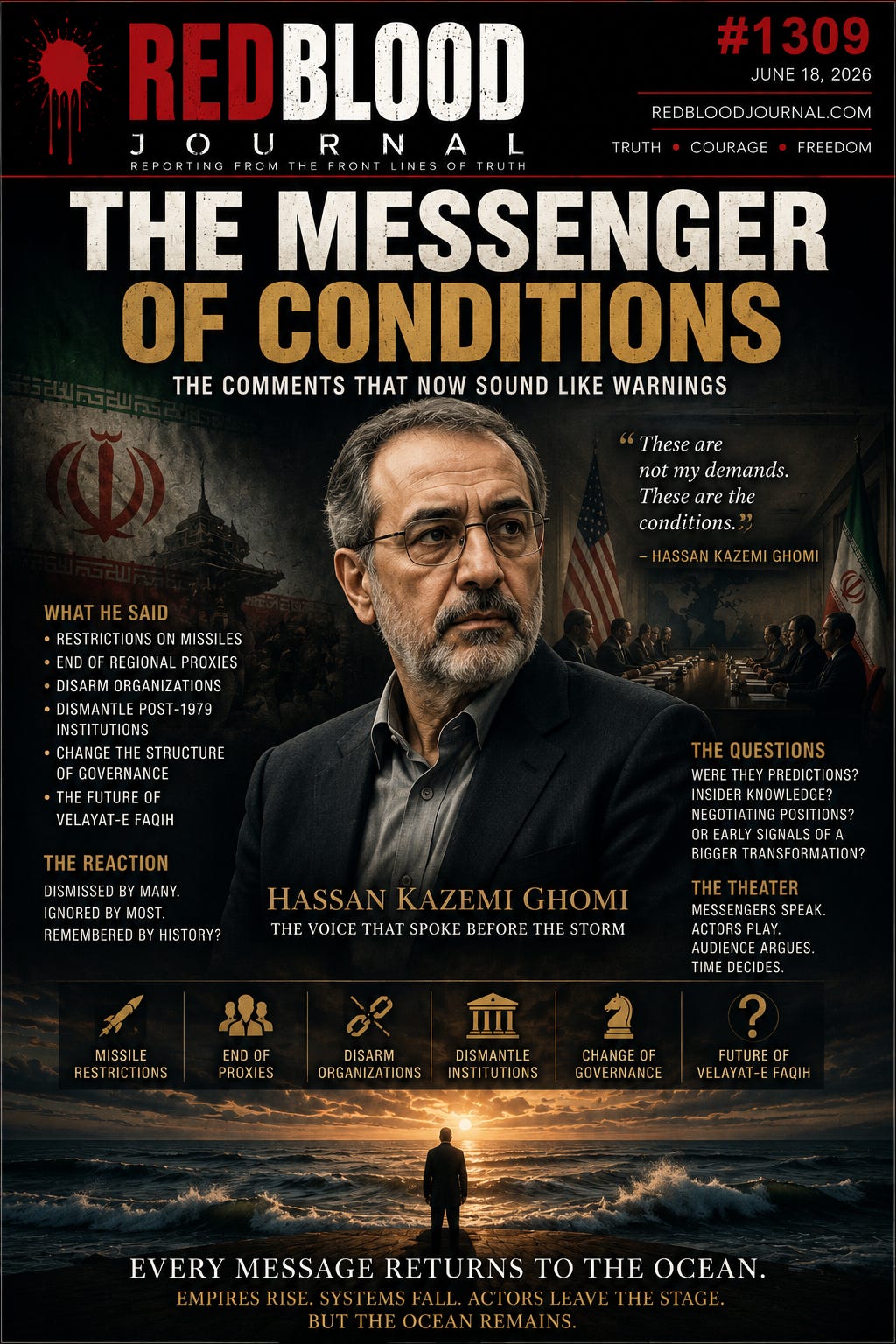
🩸 RedBloodJournal.com #1309
The Messenger of Conditions
When Warnings Become Clues in the Theater
By Red Blood
Every theater has its messengers.
They are not always the stars.
They are not always standing under the brightest lights.
Sometimes they appear briefly, deliver a message, and disappear into the shadows.
Years later, the audience suddenly remembers their words.
One such figure in the Iranian political theater is Hassan Kazemi Ghomi.
His comments, once dismissed by many as routine political talk, have attracted renewed attention because they appear to describe conditions that some observers now believe are unfolding before their eyes.
Whether his statements were predictions, warnings, insider knowledge, or simply political analysis remains open to interpretation.
But the words were spoken.
And now people are looking back.
The Conditions
According to the discussion surrounding recent events, Kazemi Ghomi described what he believed were major American demands regarding Iran.
The reported conditions included:
Restrictions on missile capabilities.
Ending regional proxy structures.
Disarmament of organizations viewed as extensions of Iranian influence.
Dismantling institutions created after the 1979 Revolution.
Fundamental changes to the structure of governance.
Questions surrounding the future role of the doctrine of Velayat-e Faqih.
At the time, many considered such demands unrealistic.
Some viewed them as impossible.
Others viewed them as propaganda.
Still others saw them as a negotiating position that would never be accepted.
Yet the statements remained.
Waiting.
The Return of Old Words
Political statements often have short lives.
News cycles move on.
Attention shifts.
People forget.
Then history changes direction.
Suddenly an old interview resurfaces.
An old speech is replayed.
An old warning sounds different.
This is what happened with Kazemi Ghomi’s comments.
Observers who believe Iran is entering a period of transformation now revisit those statements and ask:
Were those conditions merely theoretical?
Or were they early signals of a much larger process?
The Theater of Negotiation
The public sees negotiations as meetings.
Documents.
Press conferences.
Photographs.
Handshakes.
But negotiations often begin long before any camera arrives.
Ideas appear first.
Conditions appear second.
Agreements appear last.
The audience usually sees only the final act.
Kazemi Ghomi’s comments are now being interpreted by some as part of an earlier act.
A glimpse of the script before the curtains opened.
Whether that interpretation is correct remains uncertain.
Yet uncertainty has never prevented speculation.
The Launchers
One of the most discussed themes connected to these comments involves missiles and military infrastructure.
The debate is not merely about weapons.
It is about power.
Who controls power?
Who gives power?
Who takes power away?
When political actors begin speaking about removing launchers, reducing military influence, or changing long-established structures, many listeners hear something larger than military policy.
They hear the possibility of a new chapter.
Some welcome it.
Some fear it.
Some refuse to believe it.
The Revolutionary Institutions
Kazemi Ghomi’s remarks were also remembered because they touched upon institutions that many assumed would remain permanent.
History teaches otherwise.
No institution believes it is temporary.
Every empire believes it will last forever.
Every system believes it has solved history.
Every generation thinks the stage will remain exactly as it appears today.
Then the scenery changes.
Sometimes slowly.
Sometimes overnight.
And the audience suddenly realizes that permanence was only another costume.
The Audience Reaction
The reactions reveal as much as the comments themselves.
Supporters of the existing order viewed such discussions as threats.
Critics viewed them as signs of inevitable change.
Others simply watched.
They understood that politics often resembles a chessboard where many pieces move long before the final move becomes visible.
The messenger speaks.
The audience argues.
Time decides.
The Bigger Question
Perhaps the most important lesson is not whether Kazemi Ghomi was right.
Perhaps the lesson is how quickly certainty disappears.
What seems impossible one year becomes inevitable the next.
What seems permanent becomes temporary.
What seems powerful becomes fragile.
And what seems fragile sometimes survives far longer than anyone expects.
The theater repeatedly teaches the same lesson.
Nothing on the stage is guaranteed.
Not the actors.
Not the costumes.
Not the scenery.
Not the script.
Beyond the Messenger
The audience often becomes attached to messengers.
Some become heroes.
Some become villains.
Some become prophets.
Some become fools.
Yet every messenger eventually leaves the stage.
The message remains.
And even the message eventually fades.
Beyond politics.
Beyond negotiations.
Beyond conditions.
Beyond revolutions.
Beyond governments.
Beyond victories and defeats.
There remains something larger.
The Ocean.
The Ocean that does not demand loyalty.
The Ocean that does not negotiate treaties.
The Ocean that does not seek power.
The Ocean that waits patiently while actors argue about control of the stage.
Every empire rises.
Every system transforms.
Every messenger departs.
Every prediction eventually becomes history.
And when the curtains finally close, the actors, the audience, and the stage itself return to the same place they always belonged.
Back to the Ocean.
The place where no labels exist.
The place where no sides exist.
The place where every drop discovers it was never separate from the whole.
🩸
🎭 The Messenger of Conditions:
Shadows of the Iranian Stage
Jun 18, 2026
This text analyzes the re-emergence of political commentary by Hassan Kazemi Ghomi, a figure whose past statements regarding Iranian governance and military restructuring are being re-examined today.
These past assertions detailed significant external demands, including the dismantling of revolutionary institutions and the reduction of missile capabilities, which many initially dismissed as impossible.
The author uses a theatrical metaphor to suggest that such political warnings often serve as a hidden script for future systemic transformations.
Ultimately, the source reflects on the transient nature of power, arguing that even the most established regimes are subject to the inevitable flow of history.
The narrative concludes by framing these geopolitical shifts as minor ripples compared to an eternal, universal perspective that transcends human conflict.


