


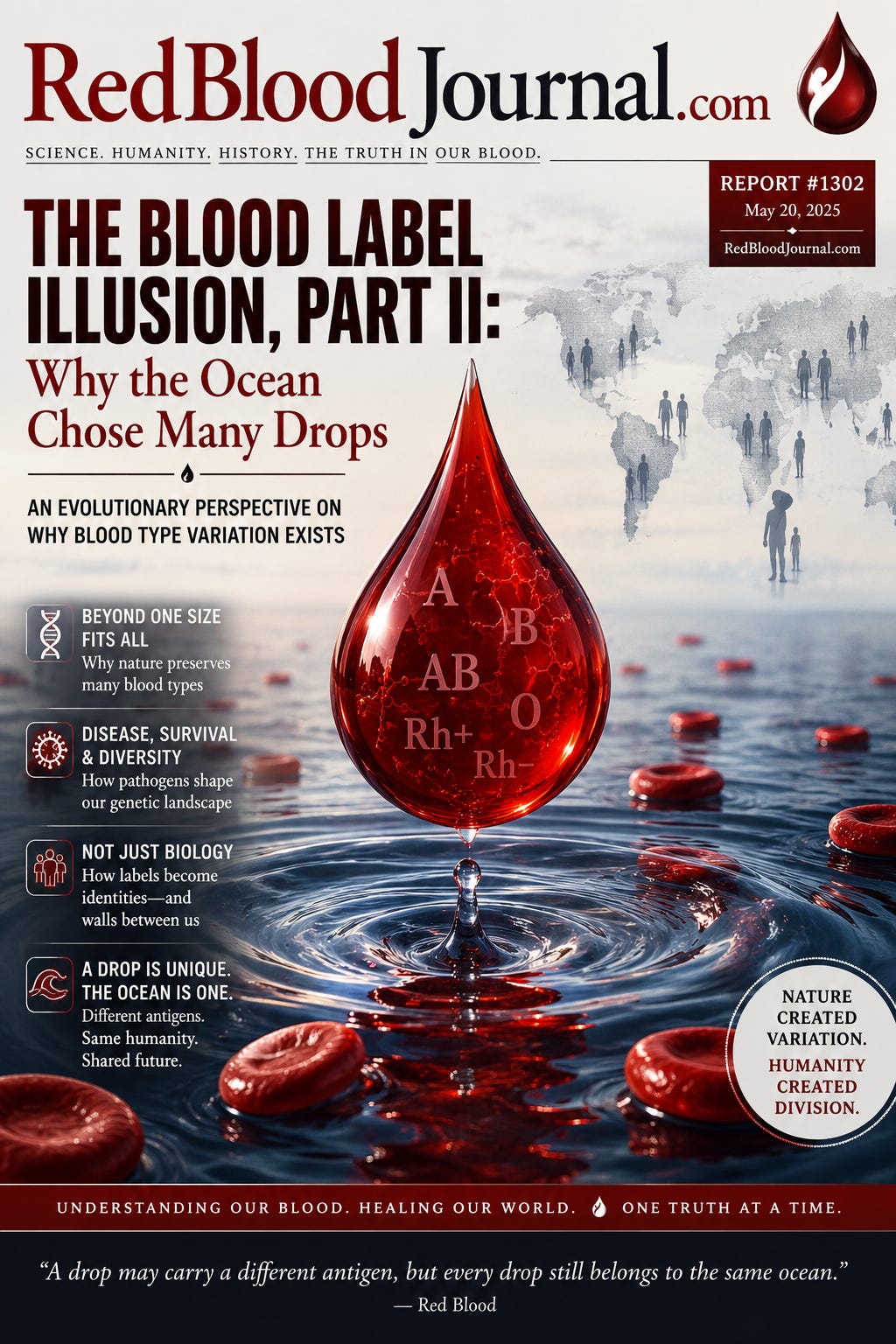
🩸 RedBloodJournal.com #1302
The Blood Label Illusion, Part II: Why the Ocean Chose Many Drops
By Red Blood
For thousands of years humanity has stared into blood searching for answers.
Some searched for destiny.
Some searched for royalty.
Some searched for superiority.
Others searched for proof that one group was somehow different from another.
Today science offers a far less dramatic explanation.
Blood types exist because variation exists.
Not because one type is chosen.
Not because one type is superior.
Not because one type is closer to truth.
Simply because life itself thrives through diversity.
The Mystery of Blood Types
Most people know the basic labels.
A.
B.
AB.
O.
Positive.
Negative.
The labels are useful.
A doctor preparing a blood transfusion needs them.
A hospital treating an emergency depends upon them.
Without these classifications, modern medicine would be far more dangerous.
Yet the label itself often creates a psychological illusion.
People begin to believe the label is the thing.
It is not.
The label is merely a description of a small biological difference.
A tiny variation among billions of cells.
Nothing more.
Why Not One Universal Blood Type?
If humanity were designed around maximum simplicity, every person might possess identical blood.
But nature rarely chooses uniformity.
Nature prefers options.
Throughout the living world diversity appears everywhere.
Different eye colors.
Different heights.
Different skin tones.
Different immune systems.
Different personalities.
Blood variation is simply another expression of the same principle.
The question then becomes:
Why would nature preserve multiple blood types instead of eliminating all but one?
Nature’s Insurance Policy
Imagine a forest containing only one type of tree.
One disease arrives.
The entire forest becomes vulnerable.
Now imagine a forest filled with many varieties.
The same disease may devastate some trees while leaving others untouched.
Diversity becomes protection.
Nature appears to use a similar strategy throughout life.
Different blood types interact differently with bacteria, viruses, parasites, and environmental pressures.
What weakens one group may spare another.
What harms another may leave the first unaffected.
No blood type wins every battle.
No blood type loses every battle.
The variation itself becomes the strength.
Not of the individual.
But of the population.
The Forgotten Lesson
Science often stops its investigation here.
The biological explanation is useful.
But another lesson hides beneath the microscope.
Nature created differences.
Human beings created identities.
The blood cell never demanded a hierarchy.
The blood cell never claimed superiority.
The blood cell never declared itself chosen.
Those stories came later.
Those stories came from people.
History repeatedly demonstrates humanity’s tendency to transform small differences into enormous divisions.
Language becomes tribe.
Tribe becomes nation.
Nation becomes ideology.
Ideology becomes conflict.
And somewhere along the way, blood also became a symbol.
A symbol of belonging.
A symbol of purity.
A symbol of separation.
Yet the blood itself never asked for any of these roles.
When Labels Become Larger Than Reality
A label is useful when it serves a purpose.
A label becomes dangerous when it becomes an identity.
The moment a label defines worth, division begins.
The moment a label defines value, conflict follows.
Throughout history countless labels have emerged.
Race.
Religion.
Nationality.
Political affiliation.
Class.
Blood.
Each begins as a category.
Each risks becoming a wall.
The wall exists only because people forget what lies underneath.
The View From the Microscope
Under magnification the differences seem significant.
Scientists observe antigens.
Genes.
Proteins.
Markers.
Categories.
Everything appears separate.
Yet step back far enough and a different picture emerges.
Every blood type performs the same essential task.
Every blood cell carries oxygen.
Every heart pumps the same crimson fluid.
Every human body depends upon the same biological miracle.
The closer one looks, the more differences appear.
The farther one looks, the more unity appears.
Both views are true.
The challenge is remembering when to use each.
The Ocean Beneath the Labels
Blood types exist because variation helps life adapt.
That is the scientific explanation.
But perhaps there is also a lesson hidden within the explanation itself.
Nature preserved many forms.
Not one.
Many.
Different yet connected.
Separate yet dependent.
Distinct yet part of a greater whole.
Like waves upon an ocean.
Each wave appears unique.
Each rises differently.
Each travels differently.
Each eventually falls.
Yet none were ever separate from the water itself.
Blood labels may describe a drop.
But they never describe the ocean.
And perhaps wisdom begins the moment the drop remembers where it came from.
🌊
RedBloodJournal.com
Report #1302
The Blood Label Illusion, Part II: Why the Ocean Chose Many Drops
By Red Blood
🌊 The Ocean in the Drop:
Unity Beyond Biological Labels
Jun 17, 2026
This report examines how biological diversity in blood types serves as a vital evolutionary insurance policy for the human species.
While medical labels like A, B, and O are essential for modern healthcare, the author warns that these categories can create a psychological illusion of separation or superiority.
In reality, these microscopic variations exist to help populations survive shifting diseases and environmental pressures rather than to establish social hierarchies.
The text argues that while humanity often turns small differences into divisions, all blood types perform the same essential life-sustaining functions.
Ultimately, the source suggests that true wisdom lies in recognizing the underlying unity of the human experience despite these natural variations.


