


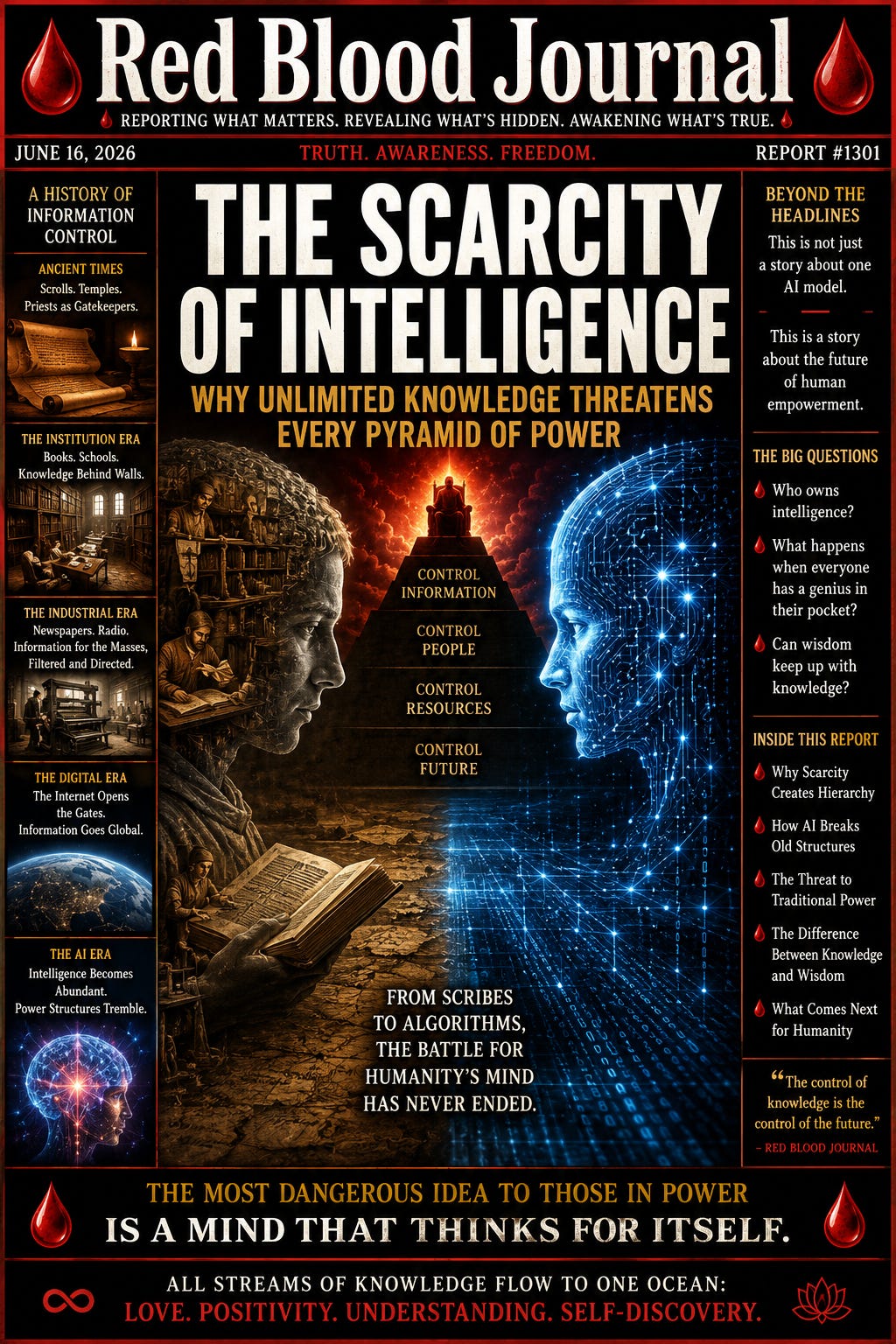
🩸 Red Blood Journal Report #1301
The Scarcity of Intelligence
Why Unlimited Knowledge Threatens Every Pyramid of Power
June 2026
The headlines said an advanced artificial intelligence model was suspended following a government directive.
Most readers saw a dispute between a technology company and regulators.
Most missed the larger story.
Throughout history, power has often rested on one simple principle:
Control access to knowledge.
The names change.
The centuries change.
The costumes change.
The principle remains remarkably similar.
The First Gatekeepers
There was a time when very few people could read.
Knowledge was stored in scrolls, manuscripts, and libraries.
Those who controlled the books often controlled society.
A farmer might know how to grow food.
A craftsman might know how to build.
But access to history, law, science, and philosophy was limited to a relatively small class of people.
Information moved slowly.
Authority moved with it.
The Age of Institutions
As literacy expanded, knowledge became harder to contain.
Schools emerged.
Universities expanded.
Publishing exploded.
Newspapers appeared.
The gatekeepers changed from scribes to institutions.
The flow of information increased, but access was still filtered.
The average person could learn more than any previous generation, yet most information still passed through approved channels.
The pyramid remained intact.
Only the bricks moved around.
The Digital Revolution
The internet shattered many barriers.
Information that once required years to obtain became available in seconds.
Encyclopedias lost their monopoly.
News organizations lost their monopoly.
Experts found themselves challenged by people who could access the same documents, studies, and archives from their homes.
For the first time in history, the individual possessed a tool that rivaled many institutions in raw access to information.
Yet even this transformation may have been only a prelude.
The Arrival of Artificial Intelligence
Search engines help people find information.
Artificial intelligence helps people understand it.
That distinction is enormous.
A search engine gives access to documents.
An advanced AI can summarize thousands of documents, compare viewpoints, identify patterns, translate languages, explain technical concepts, write software, and assist with research.
The difference is not merely convenience.
The difference is leverage.
What once required teams can increasingly be performed by individuals.
What once required years of training can increasingly be accelerated.
What once required institutions can increasingly be attempted by ordinary people.
This is where the discomfort begins.
Intelligence Was Supposed to Be Scarce
Many systems were built upon scarcity.
Scarcity of education.
Scarcity of expertise.
Scarcity of credentials.
Scarcity of information.
Scarcity creates hierarchy.
Hierarchy creates authority.
Authority creates stability.
Whether that stability is beneficial or harmful depends on perspective.
But the structure itself depends on scarcity.
Artificial intelligence challenges that assumption.
When knowledge becomes abundant, traditional hierarchies face pressure.
Not because they are evil.
Not because they are corrupt.
But because abundance changes the rules.
The New Question
The debate may not be about whether a model can answer a cybersecurity question.
The deeper question may be:
What happens when millions of people possess capabilities that previously belonged only to specialists?
Governments ask that question.
Corporations ask that question.
Universities ask that question.
Military planners ask that question.
Investors ask that question.
The answer remains unknown.
History offers no perfect blueprint because humanity has never experienced intelligence amplification at this scale.
Knowledge Versus Wisdom
Yet there is another distinction that receives far less attention.
Knowledge and wisdom are not the same thing.
Knowledge can be downloaded.
Wisdom must be developed.
Knowledge answers questions.
Wisdom determines which questions matter.
Knowledge may become abundant.
Wisdom remains an individual journey.
This may become the defining challenge of the AI age.
Humanity is learning how to create increasingly powerful external intelligence while often neglecting the development of internal understanding.
One grows rapidly.
The other grows slowly.
One is measured in processing power.
The other is measured in self-awareness.
Looking Beyond the Machine
The story is not ultimately about Anthropic.
Nor is it about governments.
Nor is it about corporations.
These are simply the actors currently standing on the stage.
The larger story concerns humanity’s relationship with knowledge itself.
For thousands of years, civilization has struggled over who controls information.
Today the struggle is evolving into a question of who controls intelligence.
Tomorrow it may become a question of whether intelligence can be controlled at all.
And beyond all the headlines, debates, regulations, and technologies lies a quieter possibility:
That the greatest discoveries may never come from the machines we build, but from the understanding we cultivate within ourselves.
For every river of information eventually reaches the same destination.
And every drop of knowledge ultimately returns to the same vast ocean.
The Ocean of Love, Positivity, Understanding, and Self-Discovery.
🌊🩸
RedBloodJournal.com
🌊 The Architecture of Abundance:
Knowledge, Intelligence, and the Power Pyramid
Jun 17, 2026
This report explores the shifting dynamics of power as artificial intelligence transitions from a tool for finding information to a means of amplifying human intelligence.
Historically, elite groups maintained control by acting as gatekeepers of scarce knowledge, but the digital age and modern AI have shattered these traditional hierarchies.
By granting ordinary individuals capabilities once reserved for specialists, technology creates a state of information abundance that threatens established institutional structures.
However, the text emphasizes that while external knowledge is becoming limitless, true internal wisdom remains a slow, personal journey.
Ultimately, the source suggests that the future will be defined not by the machines we build, but by our ability to cultivate self-awareness and understanding amidst this technological revolution.
Statement on the US government directive to suspend access to Fable 5 and Mythos 5
Jun 12, 2026
The US government, citing national security authorities, has issued an export control directive to suspend all access to Fable 5 and Mythos 5 by any foreign national, whether inside or outside the United States, including foreign national Anthropic employees. The net effect of this order is that we must abruptly disable Fable 5 and Mythos 5 for all our customers to ensure compliance. Access to all other Anthropic models will not be affected.
We received the directive from the government today at 5:21pm (ET). The letter did not provide specific details of its national security concern. Our understanding is that the government believes it has become aware of a method of bypassing, or “jailbreaking” Fable 5. We reviewed a demonstration of this specific technique being used to identify a small number of previously known, minor vulnerabilities. These vulnerabilities all appear relatively simple, and we have found that other publicly-available models are able to discover them as well without requiring a bypass.
Anthropic’s posture with respect to Fable’s safeguards, as laid out in our launch blog post, is the following:
We have instituted strong safeguards that greatly reduce the likelihood that Fable is misused for tasks related to cybersecurity (among others). In fact, our safeguards are so strong that many users have complained that they are overly broad.
In the weeks leading up to the launch of Fable, Anthropic worked with the US government, the UK AISI, multiple private third-party organizations and internal teams to red-team Fable’s safeguards for thousands of hours in total.
These tests showed that Fable’s safeguards are substantially more effective than those of any previously deployed model.
No testers have yet been able to find a universal jailbreak—a jailbreak method that can very broadly bypass the model’s safeguards, unblocking a wide range of cyber capabilities.
We suspect that perfect jailbreak resistance is not currently possible for any model provider. Every safeguard used in the industry is vulnerable to non-universal jailbreaks (which can elicit some cyber information in specific circumstances), and it is likely that universal jailbreaks will eventually be found in the future. We stated this clearly when we released Fable 5.
Given that perfect jailbreak resistance does not appear to be possible today, Anthropic adopted a defense in depth strategy with Fable 5. We aimed to make jailbreaks either narrow (in the case of non-universal jailbreaks) or very expensive to produce (in the case of universal jailbreaks), and to combine this with thorough monitoring to quickly detect and shut down any successful attacks. This is also why Anthropic has required 30-day retention of customer data with Fable—a policy change that carries real costs for us with customers, but that allows us to research and mitigate jailbreaks.
We stand by this defense in depth strategy. It reduces the risks posed by Fable, making them comparable to the risks of existing models already deployed across the industry.
We have not even received a disclosure of a concerning non-universal potential jailbreak that led to a harmful result. The potential jailbreaks that have been disclosed to us are either entirely benign responses or are minor findings that provide no Mythos-specific uplift.
To date, the government has only given us verbal evidence of a potential narrow, non-universal jailbreak, which essentially consists of asking the model to read a specific codebase and fix any software flaws. Our understanding is that one potential jailbreak was shared with the government. We have reviewed a report that we believe is the basis of the government’s directive and validated that the level of capability displayed there is widely available from other models (including OpenAI’s GPT-5.5), and is used every day by the defenders who keep systems safe. We will share more details over the next 24 hours.
We are complying with the government’s legal directive and are removing access to Fable 5 and Mythos 5 for all users. However, we disagree that the finding of a narrow potential jailbreak should be cause for recalling a commercial model deployed to hundreds of millions of people. If this standard was applied across the industry, we believe it would essentially halt all new model deployments for all frontier model providers.
As we have stated publicly, we believe the government should have the ability to block unsafe deployments, as part of a statutory process that is transparent, fair, clear, and grounded in technical facts. This action does not adhere to those principles.
We apologize for this disruption to our customers. We believe this is a misunderstanding and are working to restore access as soon as possible.


