


🩸 RedBloodJournal.com 🩸
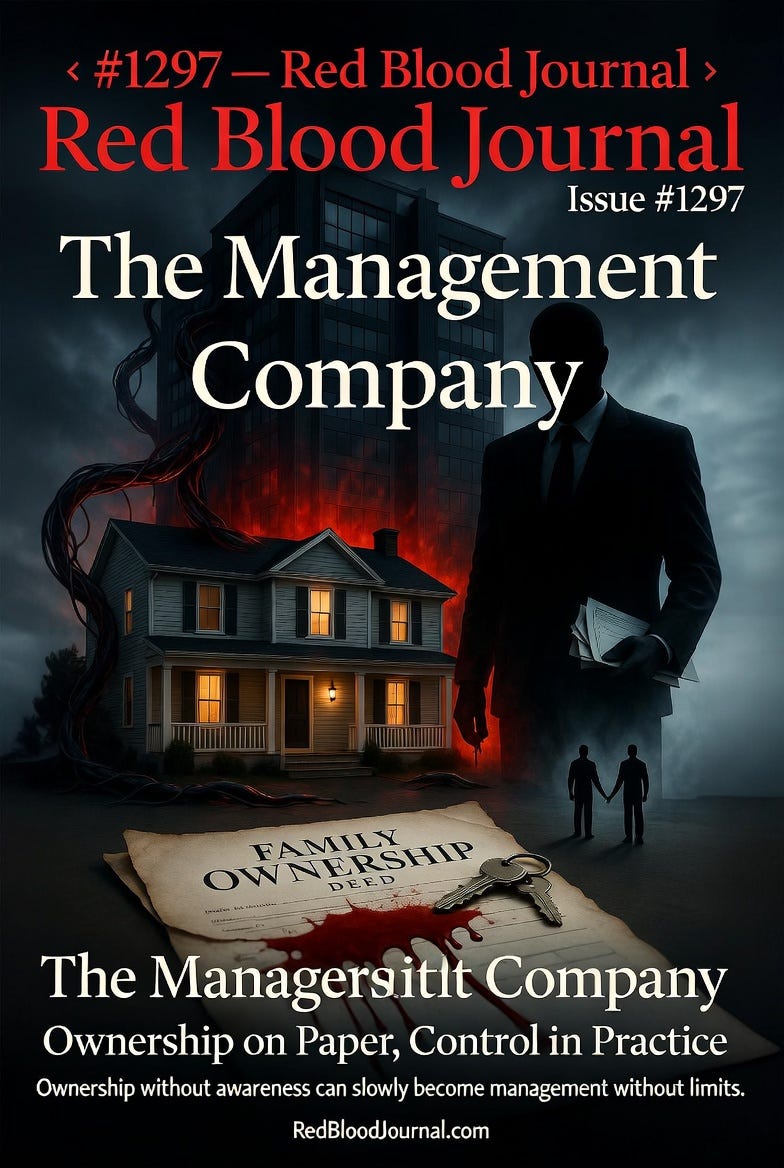
#1297 — The Management Company
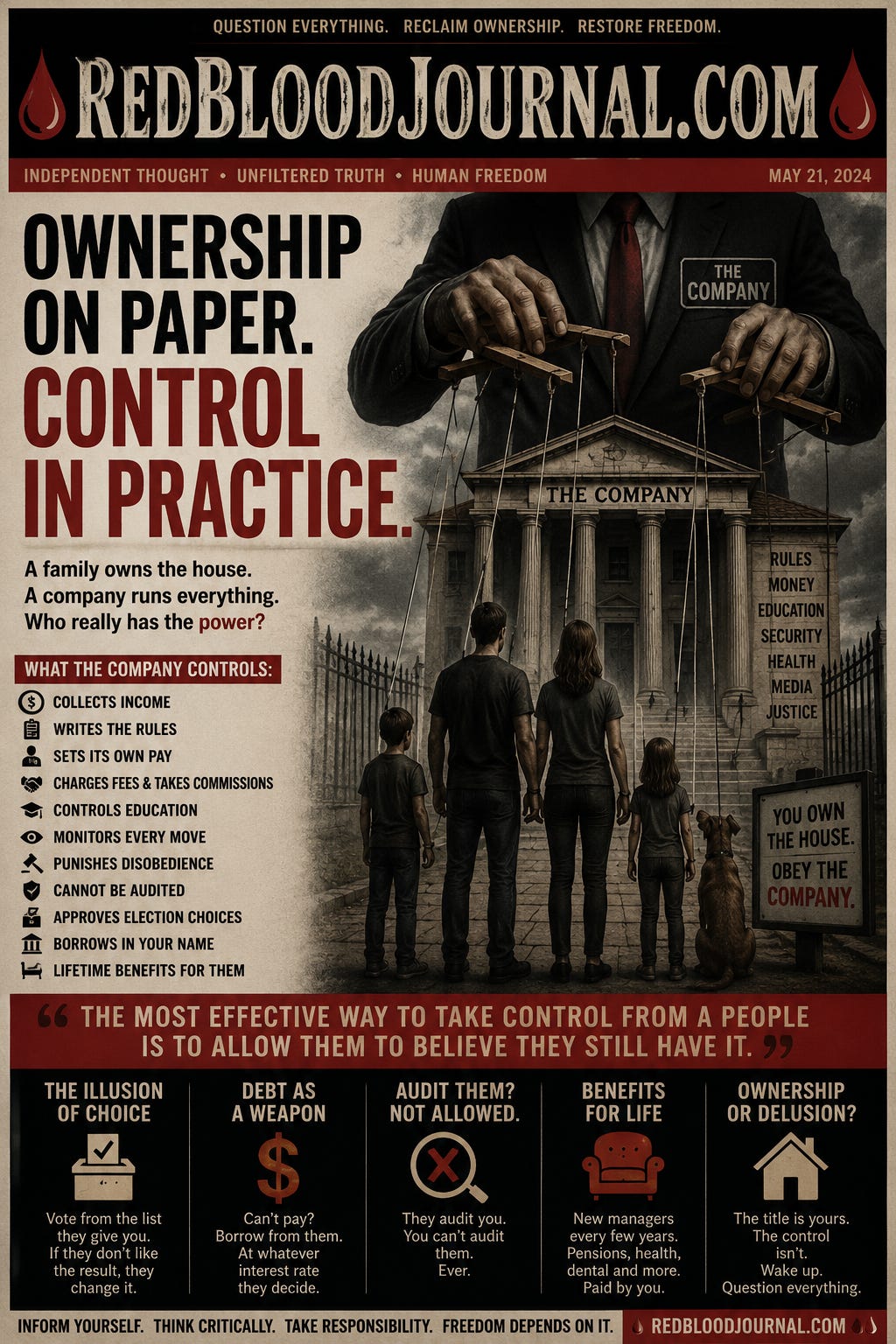
Ownership on Paper, Control in Practice
By Red Blood Journal
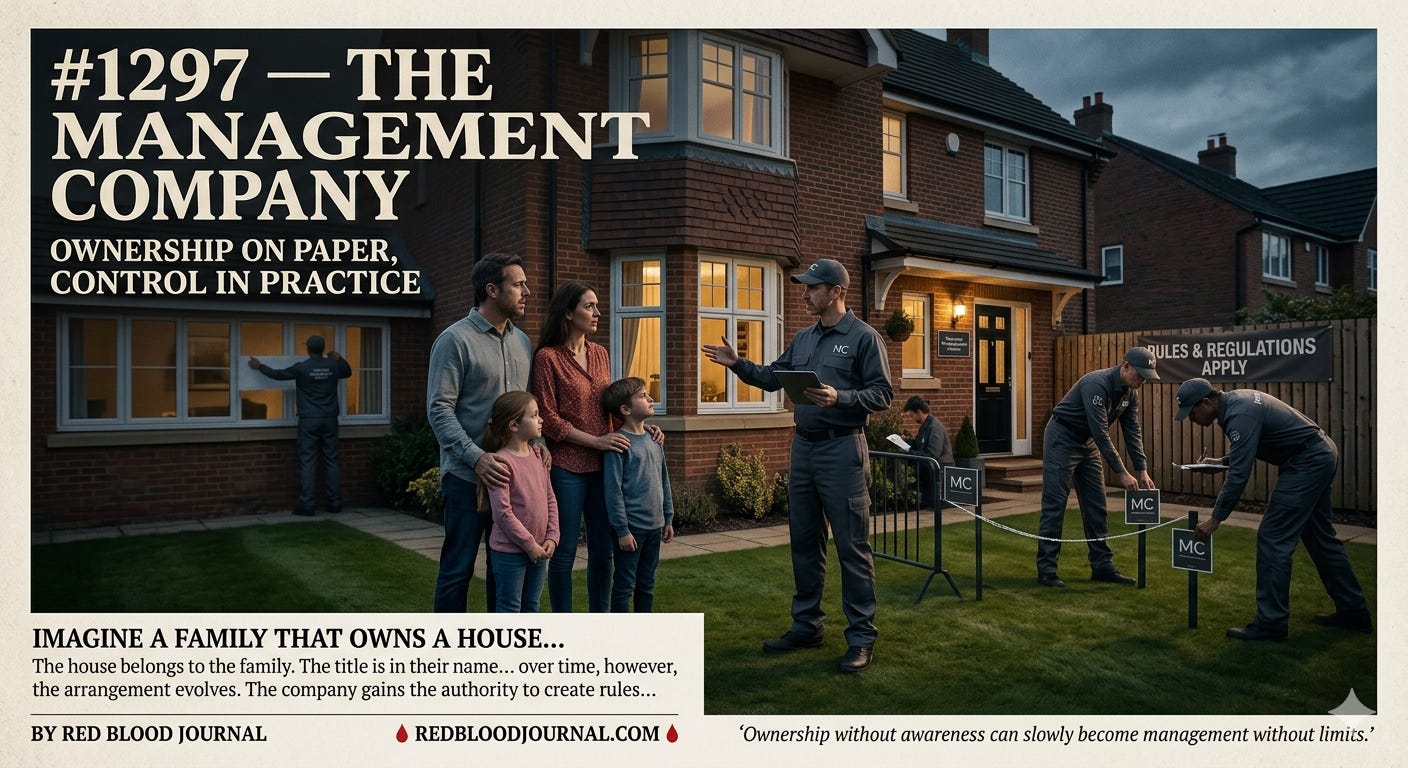
Imagine a family that owns a house.
The house belongs to the family. The title is in their name. The family members are repeatedly reminded that they are the owners.
One day, they hire a management company to help run the household.
At first, the arrangement seems reasonable. The company helps organize things, pay bills, coordinate services, and keep order.
Over time, however, the arrangement evolves.
The company gains the authority to create rules for the family.
The company collects the income earned by the family members and decides how much of that money should be returned to them.
The company determines its own salary.
The company charges administrative fees.
The company receives commissions from vendors hired to perform work around the house.
The company receives bonuses from those same vendors.
The company audits the family regularly.
The company controls the educational curriculum taught to the children.
The company decides which rules can be questioned and which cannot.
The company is not subject to independent audits.
The family is not allowed to inspect the company’s books.
The company can impose penalties on family members who violate company rules.
If a family member refuses to comply, the company can remove certain privileges and restrict their freedom within the household.
The family is told this is necessary for safety, efficiency, and order.
As years pass, the company grows larger.
New managers arrive every few years.
Each manager receives compensation while employed.
When they leave, the family continues paying for pensions, healthcare, dental coverage, and other benefits.
The family is responsible for these obligations indefinitely.
Whenever expenses increase beyond what the family can afford, the company offers a solution.
A loan.
The company will lend the family money.
The interest rate is determined by the company.
The terms are determined by the company.
The repayment schedule is determined by the company.
The family is grateful because the immediate problem is solved.
The long-term obligation grows.
The family is also permitted to vote for the Chief Executive Officer of the company.
However, the company decides which candidates may appear on the ballot.
The company administers the voting process.
The company counts the votes.
The company verifies the votes.
The company stores the records.
The company determines whether an audit may occur.
The company reserves the right to make corrections if it believes the outcome is improper.
The family is assured that this process guarantees fairness.
Years become decades.
Decades become generations.
The children grow up believing that the management company has always existed.
Most never stop to ask a simple question:
Who works for whom?
The house still belongs to the family.
The title never changed.
The ownership documents remain the same.
Yet a strange uncertainty begins to emerge.
If another entity writes the rules, controls the money, decides the compensation, approves the leadership choices, manages the education, controls the audits, determines the penalties, and extends the loans...
What exactly does ownership mean?
The purpose of this thought experiment is not to provide answers.
It is to encourage questions.
Every institution, whether public or private, faces the same challenge:
How can those entrusted with authority remain accountable to those they were originally created to serve?
History is filled with examples of organizations that began as servants and gradually became masters.
The lesson is not to fear institutions.
The lesson is to understand them.
A healthy system depends on transparency.
A healthy system depends on accountability.
A healthy system depends on informed participants who understand the difference between ownership on paper and control in practice.
The family eventually realized that the most important question was never whether the company was good or bad.
The question was whether the company still remembered who owned the house.
And whether the family remembered it too.
🩸 RedBloodJournal.com 🩸
“Ownership without awareness can slowly become management without limits.”
⛓️ The Illusion of Ownership and the Rise of the Masters
Jun 17, 2026
This narrative uses a metaphorical house and a management company to illustrate how institutional power can quietly usurp individual sovereignty.
While the family technically holds the legal title to their home, the managers gradually seize financial control, dictate household rules, and oversee the education of the children.
This shift in authority is cemented through predatory lending and a restricted voting process that ensures the company remains unaccountable to the owners.
Over generations, the inhabitants lose their sense of autonomy as the organization transforms from a service provider into a dominant master.
Ultimately, the text serves as a warning about the necessity of transparency and accountability to prevent organizations from overstepping their original purpose.
It encourages readers to distinguish between nominal ownership and the actual exercise of power within any large system.


