


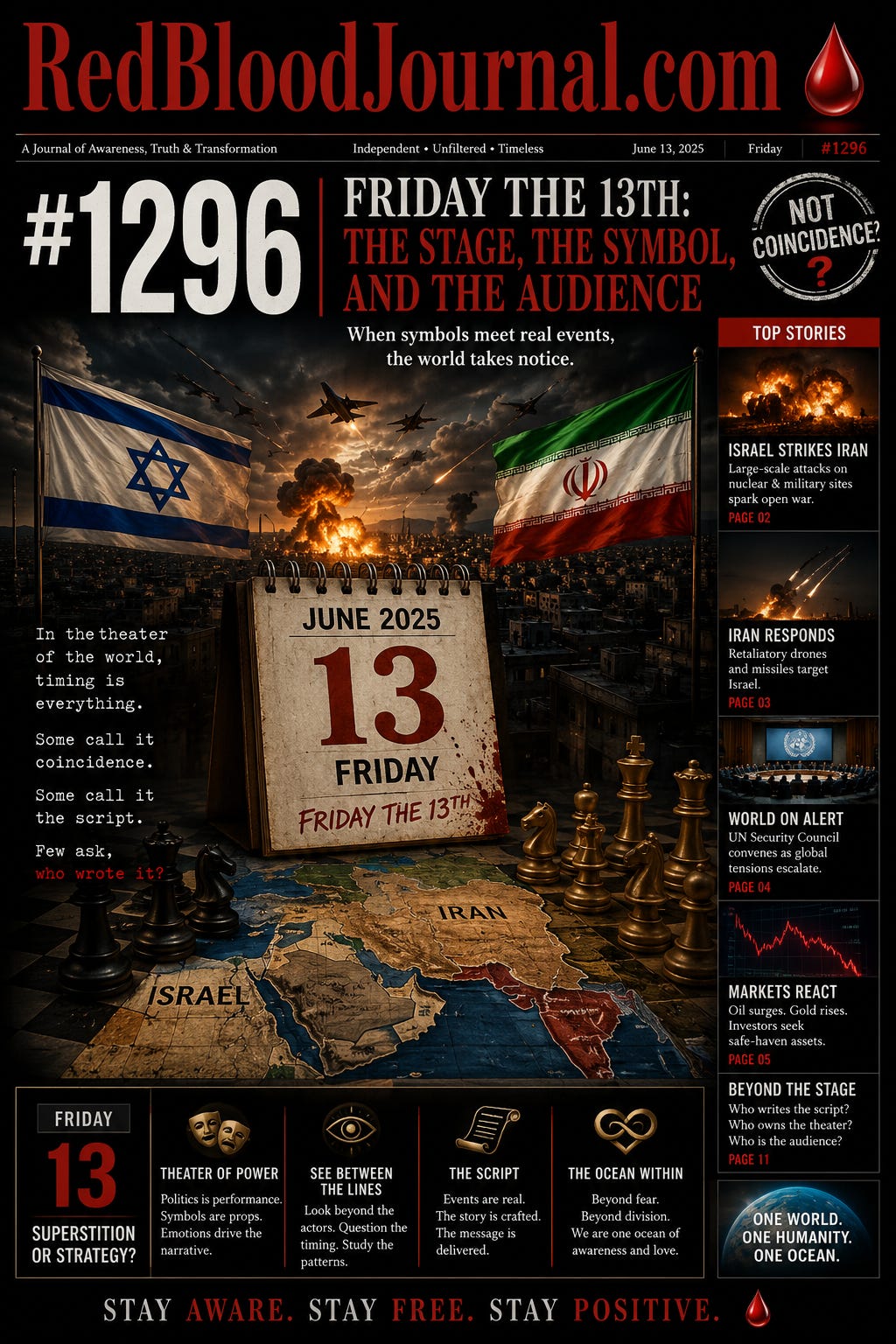
🩸 RedBloodJournal.com
#1296
Friday the 13th:
The Stage, the Symbol, and the Audience
June 13, 2025 was not just another Friday the 13th.
It became the day that the open military confrontation between Israel and Iran began, eventually becoming known as the Twelve-Day War. Israeli strikes targeted Iranian nuclear and military facilities, while Iran responded with drones and missiles. The conflict quickly became one of the most significant geopolitical events of 2025.
For some, it was merely a coincidence that these events occurred on a date long associated with superstition.
For others, the timing raised a deeper question:
How much of public life resembles a stage production?
The Power of a Symbol
A date by itself has no power.
Friday the 13th is simply a position on a calendar.
Yet millions of people immediately associate it with:
Bad luck
Misfortune
Fear
Uncertainty
Disaster
The symbol already exists in the collective mind.
When a major event occurs on that date, the symbolism amplifies the emotional impact.
The audience remembers it.
The media repeats it.
The story becomes larger than the event itself.
Every Theater Needs Props
In a movie, the villain does not usually arrive on a bright sunny afternoon.
The villain arrives during:
A thunderstorm
A solar eclipse
A full moon
A dark and stormy night
The weather becomes part of the script.
Politics, media, entertainment, and public narratives often operate in a similar manner.
Dates.
Numbers.
Anniversaries.
Symbols.
Flags.
Costumes.
Slogans.
All become props on the stage.
Whether intentionally chosen or simply interpreted afterward, symbolism gives a story emotional weight.
June 13, 2025
On that Friday the 13th:
Israel launched large-scale strikes inside Iran.
Iranian commanders and nuclear scientists were reported killed.
Iran launched retaliatory drone and missile attacks.
Emergency meetings were called internationally.
Global markets reacted immediately.
The events were real.
The destruction was real.
The fear was real.
But the symbolism attached itself to the event almost instantly.
The date became part of the story.
The Audience and the Actors
Most people focus on the actors.
They debate:
Who is good.
Who is evil.
Who is winning.
Who is losing.
The audience becomes emotionally attached to the characters.
Very few step back and ask:
Why is this story being shown?
Why now?
Why this symbol?
Why this date?
Why does the audience react so predictably?
A theater critic studies the entire production.
Most viewers watch only the plot.
The Forgotten Skill
The modern world trains people to look outward.
At the screen.
At the politician.
At the celebrity.
At the expert.
At the actor.
At the latest scene in the ongoing production.
Meanwhile, the one place rarely discussed is the place where true clarity begins:
within.
The more attention is captured by the spectacle, the less attention remains for self-discovery.
The louder the stage becomes, the quieter the inner voice appears.
The Ocean
Whether June 13, 2025 was merely coincidence or a perfectly timed chapter in a larger story is ultimately left for each observer to decide.
What is certain is that symbols only possess power when the audience gives them power.
A date is a date.
A number is a number.
A stage is a stage.
The deeper question is not what the actors are doing.
The deeper question is whether the audience remembers that it is watching a play.
For those who learn to observe the stage without becoming trapped by it, fear begins to lose its grip.
And when fear loses its grip, something much larger becomes visible:
The same ocean that exists beneath every costume, every flag, every ideology, every actor, and every audience member.
An ocean of awareness.
An ocean of love.
An ocean of positivity.
🩸 RedBloodJournal.com
🎭The Twelve-Day War:
Symbols on the Geopolitical Stage
Jun 16, 2026
The provided text examines the outbreak of the Twelve-Day War between Israel and Iran on June 13, 2025, through the lens of theatrical symbolism.
While the military strikes and geopolitical consequences were tangible, the author argues that the timing on Friday the 13th served as a psychological “prop” that amplified global fear.
By comparing international conflicts to a staged production, the source suggests that political events often utilize specific dates and imagery to manipulate the collective emotions of the public.
The narrative encourages readers to become critical observers rather than reactive audience members, seeing past the spectacle of war to find inner clarity.
Ultimately, it posits that symbols only hold authority if people grant them meaning, and true perspective comes from recognizing the universal humanity beneath the costumes of ideology.


