


🩸 RedBloodJournal.com
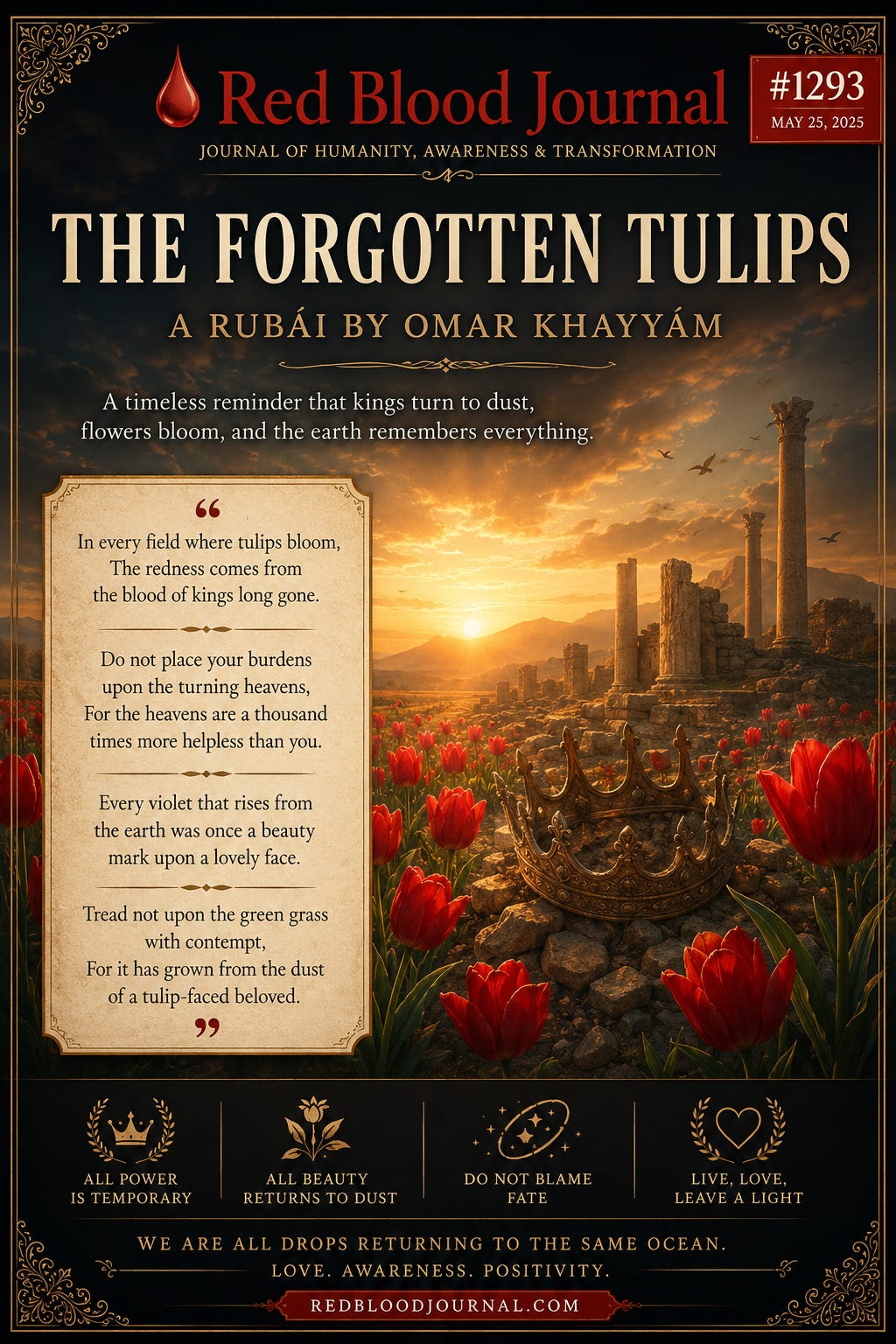
#1293 — The Forgotten Tulips
When Flowers Hide History
In one of his most famous quatrains, Omar Khayyam invites the reader to look at nature—but not in the way most people do.
He gazes upon a field of tulips and sees something beyond beauty. He sees the past. He sees traces of people who once walked the earth and have since become part of the very soil beneath our feet.
In every field where tulips bloom,
The redness comes from the blood of kings long gone.
For Khayyam, the earth is not merely dirt. It is a living archive that carries centuries of memories, ambitions, victories, defeats, love, and war.
Where Did the Kings Go?
Every power that once appeared permanent has vanished.
The rulers who commanded armies, the wealthy who believed they possessed everything, and the politicians who imagined they could shape the future forever have all arrived at the same destination.
Dust.
The same dust from which flowers now grow.
Khayyam reminds us that nature preserves no title, no throne, and no fortune forever. Everything eventually returns to the great cycle of life.
Do Not Blame the Heavens
Another part of the quatrain challenges one of humanity’s oldest habits:
Blaming fate.
Do not place your burdens upon the turning heavens,
For the heavens are a thousand times more helpless than you.
People often blame destiny, circumstances, governments, time, luck, or others for their suffering.
Yet Khayyam raises an important question:
If everything is the fault of fate, where does personal responsibility begin?
Perhaps much of human suffering begins when individuals forget their inner power and focus exclusively on the world outside themselves.
The Flowers That Were Once Human
Perhaps the most beautiful image in the poem is Khayyam’s view of nature itself:
Every violet branch that rises from the earth
Is a beauty mark once worn upon a lovely face.
In his vision, flowers are not merely plants.
They are continuations of stories.
The soil becomes the memory of the earth.
Every flower, every tree, every green meadow, and every stream may contain traces of those who laughed, struggled, loved, dreamed, and departed long before us.
The Hidden Lesson
Khayyam is not teaching despair.
He is teaching perspective.
When viewed against the passage of time, many of the things that consume human attention begin to lose their importance.
If everything is temporary:
What value does hatred truly have?
What value does endless greed possess?
What value do struggles for power ultimately bring?
If the kings of yesterday have become the soil of today, perhaps the most valuable part of life is not what we accumulate, but how we experience it.
The Ocean
Perhaps the deepest message of this quatrain is that nobody takes anything with them.
Not a crown.
Not a throne.
Not wealth.
Not fame.
What remains are the impressions left upon other lives.
The kindness that was shared.
The compassion that was offered.
The light that was passed to another soul.
And perhaps one day, when we too return to the earth, something beautiful may grow from our own footprints—something that reminds a future traveler of the beauty of being alive.
Just as every drop eventually returns to the same vast ocean from which it came,
so too do we return to the great Ocean of Love, Awareness, and Positivity.
#1293
🩸 RedBloodJournal.com
🌷 The Living Archive:
Khayyam’s Lessons from the Dust
Jun 16, 2026
This source examines the poetic philosophy of Omar Khayyam, who viewed the natural world as a living record of human history.
By observing how tulips and violets rise from the ground, the text suggests that all life returns to the soil, transforming the remains of past rulers and beauties into new growth.
This perspective highlights the futility of worldly power and material wealth, as even the most influential figures eventually become part of the earth’s cycle.
Rather than promoting hopelessness, the narrative encourages readers to take personal responsibility for their happiness instead of blaming fate.
Ultimately, the passage argues that acts of kindness and shared light are the only lasting legacies in an otherwise temporary existence.
This philosophy reminds us that every living soul is a fleeting drop destined to return to a universal ocean of awareness.


