


🩸 RED BLOOD JOURNAL
Issue #1289
THE CARDBOARD SUCCESSOR
When Symbols Become More Real Than People
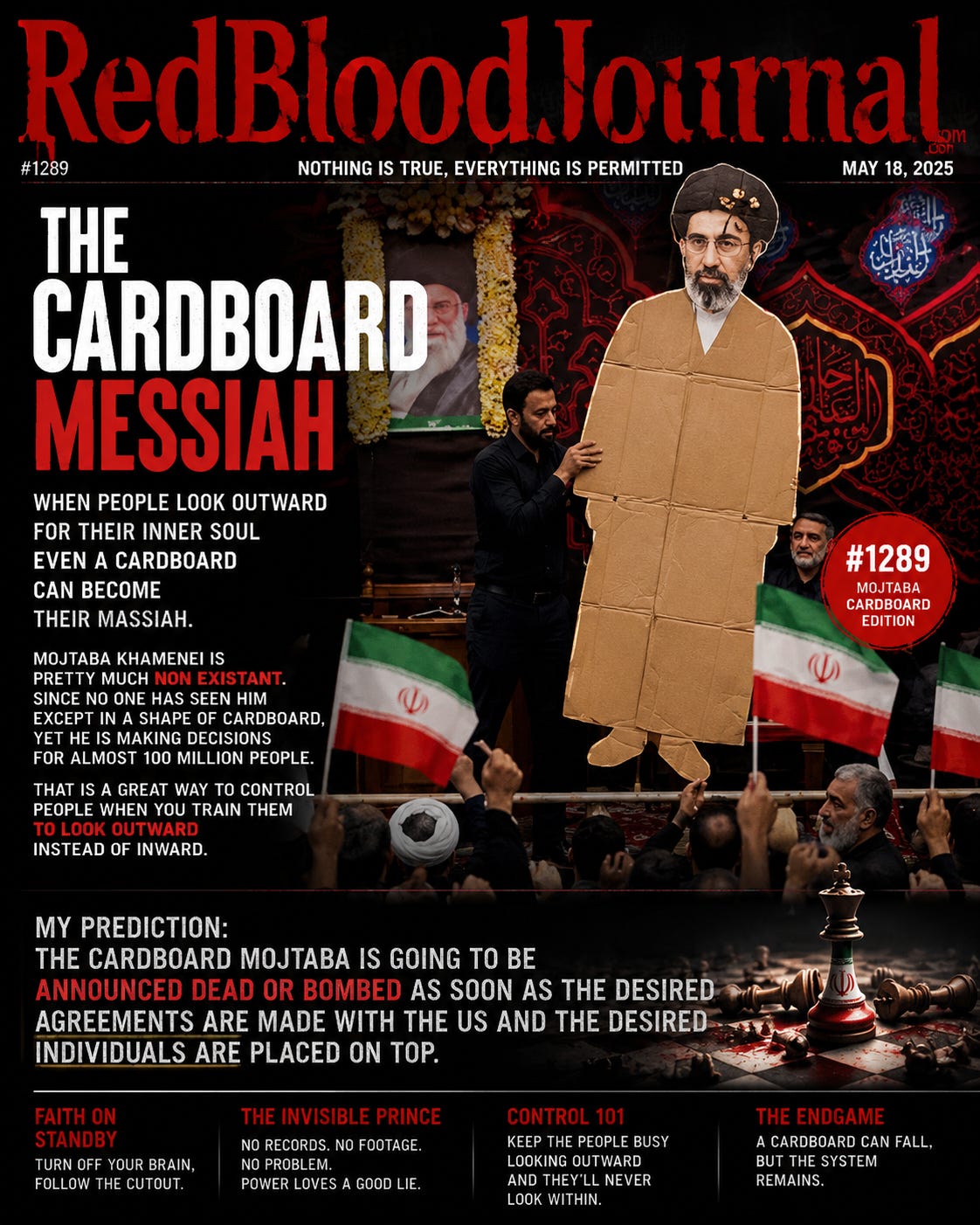
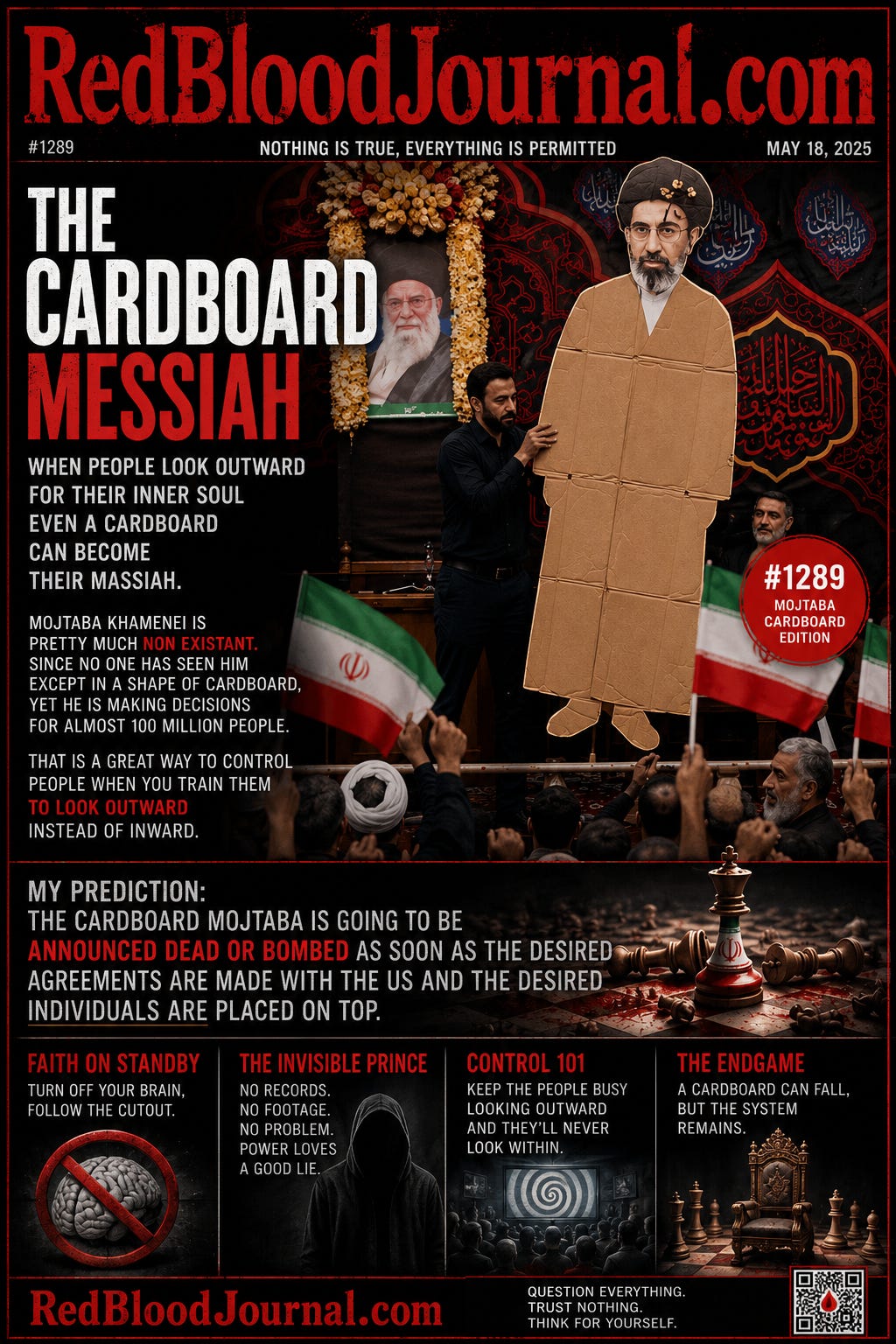
A photograph circulates.
A man stands before a crowd holding a life-sized cardboard cutout.
The image is almost surreal.
Not because cardboard is unusual.
But because in a world dominated by political theater, symbols often become more visible than the individuals they supposedly represent.
For decades, politics has relied on imagery, branding, slogans, portraits, flags, carefully staged appearances, and manufactured narratives.
The public is encouraged to look outward.
Always outward.
Waiting for the next leader.
The next savior.
The next election.
The next revolution.
The next promise.
The next messiah.
And when people spend enough time looking outward, eventually even a cardboard cutout can acquire authority.
THE MOJTABA PARADOX
One of the most unusual political phenomena of modern Iran is the public mystery surrounding Mojtaba Khamenei.
Multiple media reports over the years have described him as an unusually low-profile figure whose public appearances have been rare and whose public speeches have been almost nonexistent compared with other major political figures. Analysts frequently describe him as someone operating largely behind the scenes rather than through public visibility.
Several recent reports have even noted that many ordinary Iranians have never heard his voice directly, despite widespread discussion of his influence within the Iranian system.
Whether one supports him or opposes him is beside the point.
The deeper question is:
How can a political system convince millions to place faith in individuals they barely see?
The answer is simple.
The system trains people to look outward.
THE POWER OF THE INVISIBLE
History is full of rulers who understood that visibility is not always necessary.
Sometimes mystery is more powerful than presence.
When information is limited, imagination fills the gaps.
People begin constructing their own image of the leader.
Supporters see wisdom.
Opponents see manipulation.
Both sides participate in creating a larger-than-life figure.
The less that is known, the easier it becomes for the public to project their hopes and fears onto the symbol.
The cardboard cutout becomes a perfect metaphor.
A blank surface.
A shape.
A silhouette.
A placeholder onto which millions can project their beliefs.
POLITICS AS A RELIGION OF OUTWARD SEARCHING
The greatest achievement of political systems is not controlling armies.
It is convincing people that their salvation exists outside themselves.
One group waits for a king.
Another waits for a president.
Another waits for a supreme leader.
Another waits for a revolution.
Another waits for a foreign power to rescue them.
Everyone waits.
Few look inward.
The endless cycle continues because every generation is taught that the solution is just one more leader away.
One more election.
One more agreement.
One more war.
One more regime.
One more replacement.
PREDICTIONS AND THE THEATER
Many political predictions are made every day.
Some are correct.
Most are wrong.
In opaque political systems where information is tightly controlled, speculation naturally flourishes.
People attempt to fill the gaps left by missing information.
No observer can know with certainty what future political arrangements, leadership transitions, negotiations, or power struggles may occur.
Predictions remain predictions.
Facts remain facts.
The two should never be confused.
Yet the existence of endless predictions reveals something important:
People are searching for answers because they feel they are not being shown the full picture.
THE CARDBOARD LESSON
The photograph is not really about Mojtaba.
It is not really about Iran.
It is not really about politics.
It is about human nature.
When people stop trusting themselves, they begin searching for authority everywhere else.
And once that habit is established, almost anything can become a symbol of power.
A crown.
A title.
A television screen.
A social media account.
A flag.
A photograph.
Or even a piece of cardboard.
FINAL TRANSMISSION
Perhaps the real question is not:
“Who is behind the cardboard?”
Perhaps the more important question is:
“Why do so many people keep looking at the cardboard in the first place?”
The moment a person stops searching for a savior outside themselves and begins searching within, the spell weakens.
The theater loses its grip.
The noise becomes quieter.
The masks become easier to see.
And beyond the stage, beyond the symbols, beyond the cardboard figures and political actors, waits the same destination that has always been there:
The Ocean of Love, Positivity, Self-Knowledge, and Inner Freedom. 🌊🩸
RedBloodJournal.com
🎭The Mojtaba (Moji) Paradox:
Power and the Theater of Symbols
Jun 15, 2026
The provided text explores the psychological impact of political symbols, using the mysterious public profile of Mojtaba Khamenei as a primary case study.
It argues that modern political systems maintain power by encouraging citizens to look for external saviors rather than developing inner self-reliance.
By keeping certain leaders hidden from the public eye, these regimes allow the populace to project their own hopes and fears onto a “blank surface,” effectively turning individuals into cardboard metaphors.
This reliance on imagery and manufactured narratives creates a theatrical environment where symbols eventually hold more authority than actual human beings.
Ultimately, the source suggests that true personal freedom is only achieved when one stops participating in this political spectacle and focuses on self-knowledge.


