


🩸 #1288
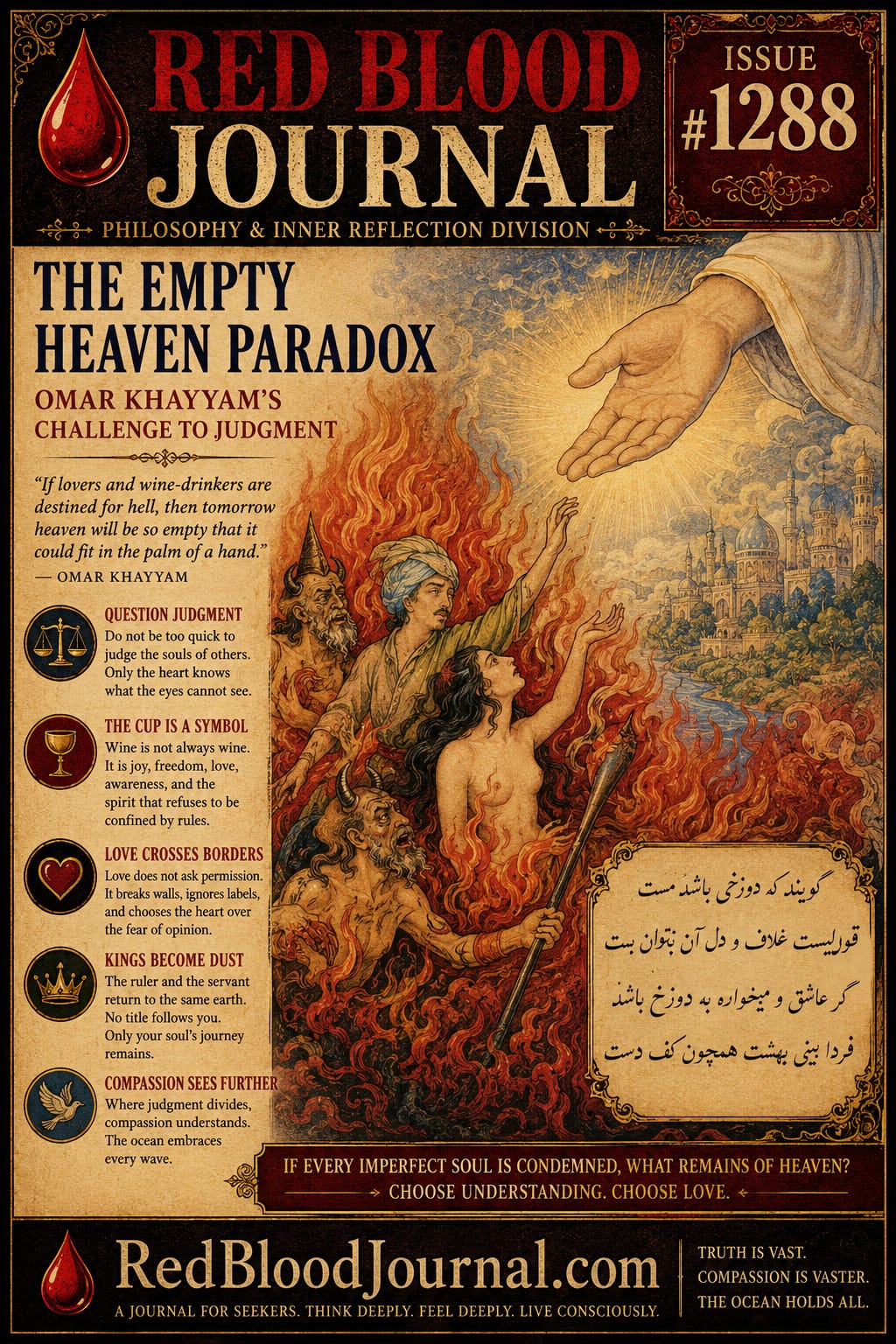
THE EMPTY HEAVEN PARADOX
Omar Khayyam’s Challenge to Judgment
RED BLOOD JOURNAL
Philosophy & Inner Reflection Division
Issue #1288
THE QUESTION THAT DISTURBS CERTAINTY
Throughout history, human beings have loved certainty.
They prefer clear divisions.
Good and evil.
Believer and unbeliever.
Saved and condemned.
Saint and sinner.
The human mind finds comfort in categories.
Yet Omar Khayyam was never comfortable with easy answers.
In one of his most provocative quatrains, he presents a question that continues to unsettle rigid thinking nearly a thousand years later.
He asks:
If all the lovers and wine-drinkers are destined for hell, who exactly will remain in heaven?
THE COURTROOM OF HUMAN JUDGMENT
Human societies have always created lists.
Lists of acceptable behavior.
Lists of unacceptable behavior.
Lists of the worthy.
Lists of the unworthy.
The problem begins when people become convinced they possess the authority to judge the hearts of others.
Outward actions are visible.
Inner intentions are not.
A person may appear righteous while carrying cruelty within.
Another may appear flawed while carrying kindness, compassion, and sincerity.
The surface rarely tells the whole story.
THE SYMBOL OF THE WINE CUP
For centuries, scholars have debated Khayyam’s use of wine.
Was it literal?
Was it symbolic?
Was it spiritual?
Was it philosophical?
Perhaps the answer matters less than the question itself.
The wine cup represents those whom society often judges.
Those who do not fit neatly into accepted categories.
Those who ask uncomfortable questions.
Those who live outside conventional expectations.
Khayyam repeatedly places these individuals at the center of his poetry.
Not because they are perfect.
But because they reveal the limitations of simplistic judgment.
THE LOVER’S CRIME
The poem pairs two figures together:
The lover.
The wine-drinker.
The lover is an interesting choice.
Love is celebrated by every religion, every culture, and every civilization.
Yet love often refuses to follow rules.
It crosses boundaries.
It ignores labels.
It challenges authority.
It places the heart above rigid systems.
In Khayyam’s world, the lover becomes a symbol of the human spirit itself—messy, imperfect, emotional, searching, and alive.
THE EMPTY HEAVEN
The brilliance of the quatrain lies in its final image.
If every imperfect person is condemned...
If every questioning mind is condemned...
If every lover is condemned...
If every flawed soul is condemned...
Then what remains?
An empty heaven.
A paradise with no humanity.
A kingdom without compassion.
A perfection so sterile that no living heart could recognize itself within it.
Khayyam exposes the absurdity not through argument but through irony.
THE DANGER OF CERTAINTY
History demonstrates that some of humanity’s greatest mistakes have been committed by people convinced they were absolutely correct.
Certainty can become dangerous when it eliminates humility.
Humility allows room for mystery.
Humility allows room for compassion.
Humility allows room for the possibility that one does not possess all the answers.
Khayyam’s poetry repeatedly reminds readers that life contains far more uncertainty than most systems are willing to admit.
THE FINAL OBSERVATION
The quatrain is not really about wine.
Nor is it merely about heaven and hell.
It is about judgment.
It is about the tendency of human beings to divide the world into simple categories.
It is about the danger of assuming that outward appearances reveal the true nature of the soul.
And perhaps most importantly, it is a reminder that compassion often sees further than certainty.
The Ocean
A wave looked at another wave and declared:
“You belong on the wrong side of the sea.”
The ocean smiled.
For the ocean could see what the waves could not.
Each wave carried imperfections.
Each wave carried beauty.
Each wave carried lessons.
Each wave carried the same water.
The ocean never asked which wave deserved its embrace.
It simply carried them all.
Perhaps that is why love appears larger than judgment.
For judgment divides.
Love understands.
And beneath every argument, every belief, every certainty, and every doubt remains the same endless Ocean of Love and Positivity.
The ocean that receives every wave without asking where it has been.
🩸 RedBloodJournal.com
Issue #1288
🌊 The Empty Heaven Paradox:
Khayyam on Judgment and Love
Jun 15, 2026
The provided text explores Omar Khayyam’s philosophical challenge to the rigid moral categories often imposed by human society.
By examining the Empty Heaven Paradox, the source argues that a paradise reserved only for the flawless would be devoid of the vibrant, messy essence of humanity.
The author suggests that symbols like the wine-drinker and the lover represent individuals who defy narrow judgment and emphasize the importance of inner sincerity over outward conformity.
Ultimately, the passage advocates for humility and compassion instead of the dangerous arrogance of absolute certainty.
Using the metaphor of the ocean, it concludes that a truly divine perspective embraces all life with universal love rather than exclusionary condemnation.


