


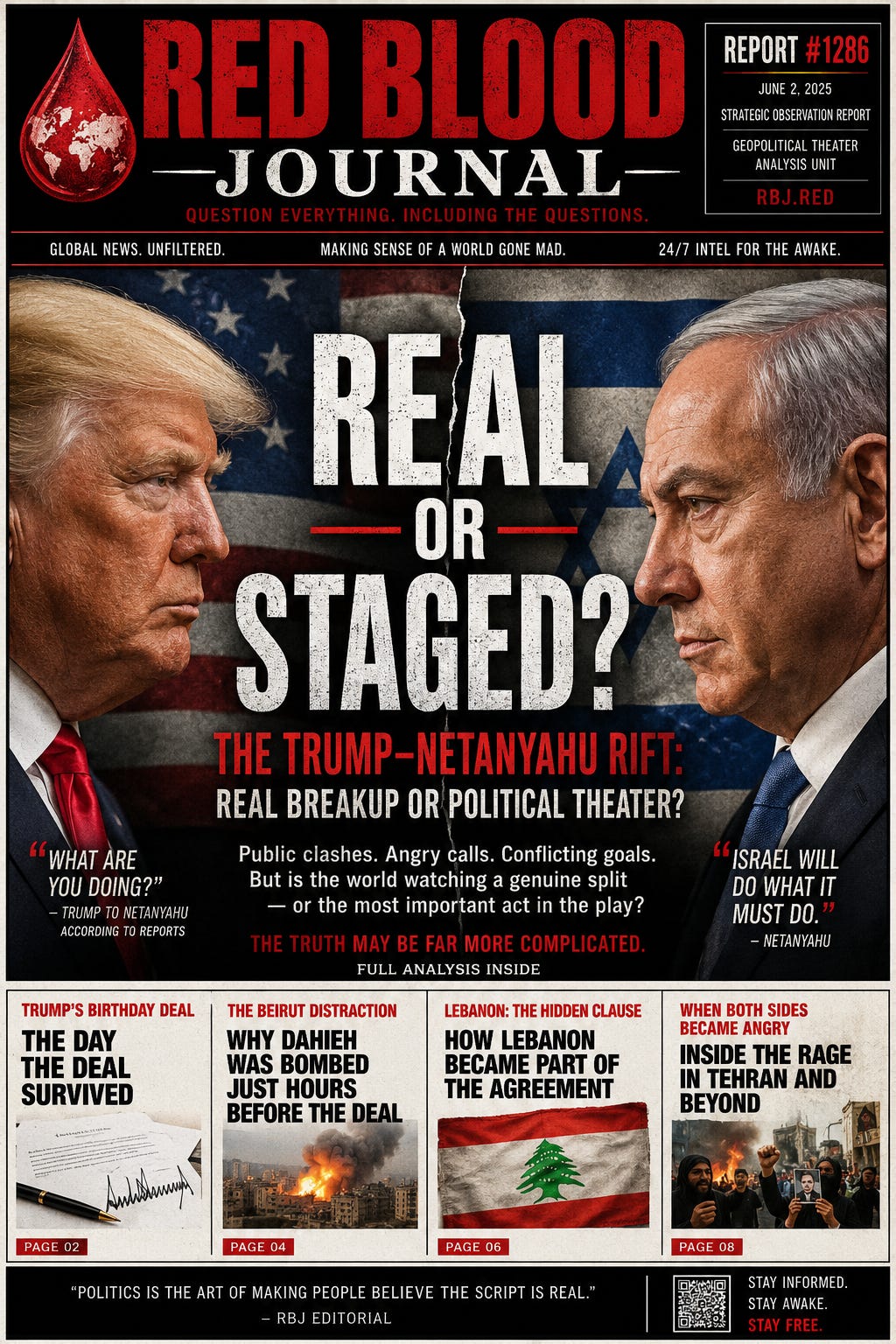
🩸 RED BLOOD JOURNAL
Report #1286
The Trump–Netanyahu Rift: Real Breakup or Political Theater?
Classification: Strategic Observation Report
Division: Geopolitical Theater Analysis Unit
Status: Open Question
THE ARGUMENT THAT DIVIDES THE AUDIENCE
Every movie has a moment when two main characters appear to turn against each other.
The audience immediately chooses sides.
Some believe the conflict is real.
Others suspect it is part of the script.
The public disagreement between Trump and Netanyahu has produced exactly this reaction.
News reports speak of angry phone calls.
Television analysts describe frustration.
Political commentators point to conflicting objectives.
Supporters of both men debate whether a genuine fracture has emerged.
The question is simple:
Are they truly separating, or is the separation itself part of a larger strategy?
THE CASE FOR A REAL SPLIT
Those who believe the disagreement is genuine point to obvious realities.
Trump and Netanyahu are not identical people.
They do not have identical goals.
A politician in Washington answers to different pressures than a politician in Jerusalem.
Trump’s primary concern is America.
Netanyahu’s primary concern is Israel.
Those interests often overlap.
But not always.
History is full of allies who agreed on most things while disagreeing on critical details.
The United States and Israel have experienced policy disagreements before.
The alliance remained.
The disagreements remained.
Both were true at the same time.
Under this interpretation, recent tensions are exactly what they appear to be:
Two powerful leaders arguing over timing, risk, and desired outcomes.
Nothing more.
Nothing less.
THE CASE FOR A STAGED CONFLICT
Others see something different.
They observe that political leaders frequently create distance publicly while coordinating privately.
This is not unique to America.
It is not unique to Israel.
It is a common tactic throughout history.
One actor becomes the moderate.
The other becomes the hardliner.
One offers diplomacy.
The other offers pressure.
Together they create a wider range of options.
If events later escalate, responsibility becomes harder to assign.
The audience sees disagreement.
Behind the curtain, coordination may still exist.
Whether this is actually happening today is impossible for the public to know with certainty.
But the pattern itself is neither rare nor new.
THE PROBLEM WITH CERTAINTY
The strongest opinions often come from people who are most certain.
Yet certainty is precisely what is missing.
Most observers do not possess classified intelligence.
Most journalists do not sit in private meetings.
Most citizens only see carefully selected public moments.
A tweet.
A speech.
A leaked quote.
A television appearance.
The audience receives fragments.
The full script remains hidden.
This creates a dangerous temptation:
To confuse interpretation with fact.
One side declares:
“The split is absolutely real.”
The other declares:
“The split is absolutely fake.”
Neither can prove their conclusion.
POLITICS AND THE MOVIE SCREEN
When people watch a film, they know they are watching actors.
When people watch politics, they often forget.
The result is emotional investment in every scene.
Every disagreement becomes historic.
Every handshake becomes permanent.
Every conflict becomes final.
Yet history repeatedly shows that today’s enemy can become tomorrow’s ally.
And today’s ally can become tomorrow’s rival.
Politics is fluid.
Movies appear fixed.
The mistake occurs when people treat politics as if every scene reveals the final ending.
The ending has not been released yet.
WHAT MATTERS MORE THAN THE ARGUMENT
Whether the disagreement is genuine or strategic, most people have little influence over it.
They cannot control private negotiations.
They cannot direct military planning.
They cannot determine the decisions made behind closed doors.
What they can control is their reaction.
Fear grows when attention is fixed entirely on distant actors.
Clarity grows when attention returns inward.
The more a person becomes consumed by political theater, the more their emotional state becomes dependent on events beyond their control.
The more a person develops self-awareness, inner stability, and independent thinking, the less vulnerable they become to every new headline.
THE POSSIBILITY NOBODY DISCUSSES
Perhaps the disagreement is real.
Perhaps it is partially real and partially strategic.
Perhaps it is entirely theatrical.
The truth may even contain elements of all three.
Reality is often more complicated than either side wishes to admit.
That possibility receives the least attention because it offers the fewest easy answers.
But it may be the closest thing to wisdom.
FINAL OBSERVATION
The public may spend years debating whether Trump and Netanyahu truly disagreed or merely performed disagreement.
Historians may eventually uncover documents.
Memoirs may be written.
Secrets may emerge.
Or they may not.
Until then, the argument remains part of the show.
The audience watches.
The commentators interpret.
The actors continue acting.
And somewhere beyond the noise, beyond the headlines, beyond the endless struggle to determine who is right and who is wrong, remains the same quiet invitation:
To know oneself before trying to decode every script written by others.
Because the greatest mystery may not be what is happening behind the political curtain.
It may be what is happening behind the curtain of one’s own mind.
And there, beyond fear, beyond division, beyond certainty itself, waits the same ocean that has always been present—
The Ocean of Love and Positivity.
🩸 Red Blood Journal Report #1286
RedBloodJournal.com
“Question Everything. Including the Questions.”
🎭 The Trump-Netanyahu Rift:
Strategic Theater or Genuine Fracture
Jun 15, 2026
This report examines the reported tension between Donald Trump and Benjamin Netanyahu, questioning whether their friction is a genuine fracture or a calculated political performance.
The text presents two primary theories: one suggests their conflicting national interests have caused a real split, while the other proposes they are strategically coordinating their public disagreement to expand their diplomatic options.
It highlights the difficulty for the general public to discern the truth, as citizens only witness carefully curated fragments of high-level political interactions.
Ultimately, the source cautions against becoming emotionally consumed by these headlines, suggesting that the “political theater” is often a distraction from personal self-awareness.
By framing the situation as a fluid script rather than a fixed reality, the author encourages readers to maintain independent thinking amidst the noise of global news.
Overly certain interpretations are discouraged in favor of acknowledging that the truth is likely a complex mix of both reality and theater.


