


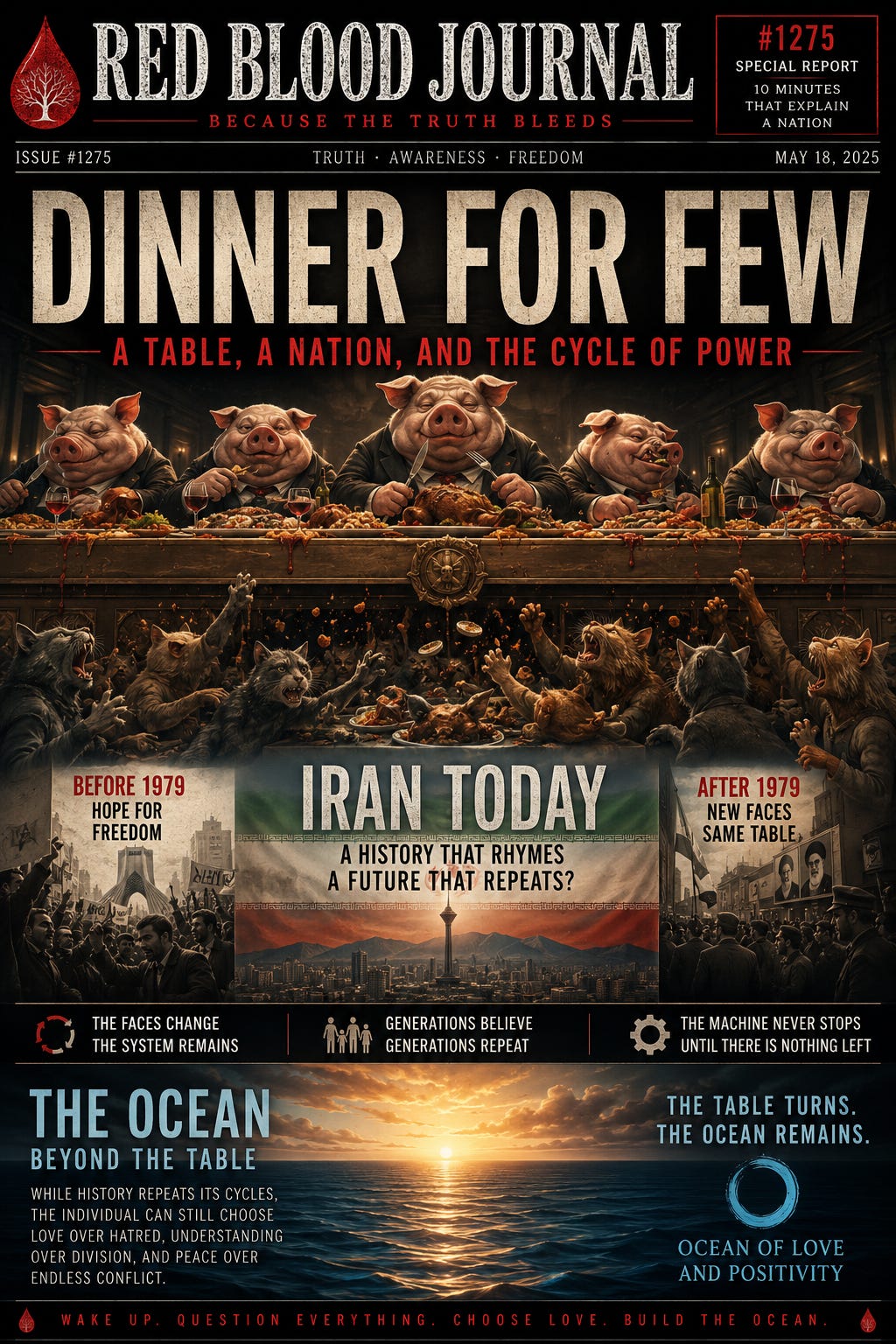
🩸 RED BLOOD JOURNAL TRANSMISSION #1275
DINNER FOR FEW
A Table, A Nation, and the Cycle of Power
Full Report — RedBloodJournal.com
5
THE FILM
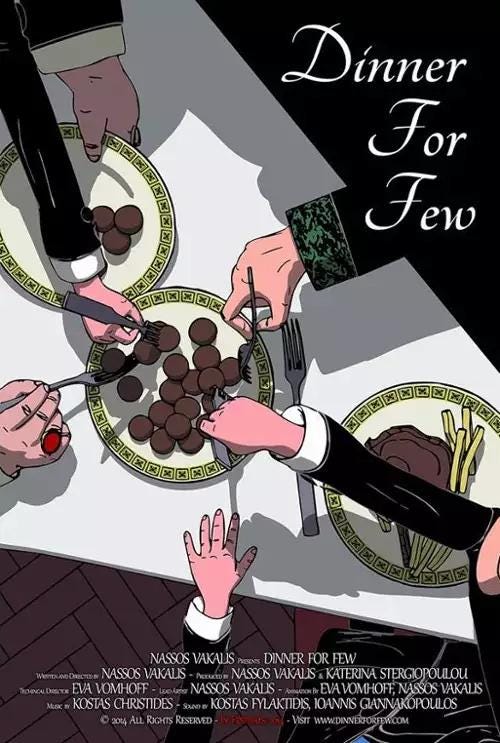
In 2014, animator Nassos Vakalis released a ten-minute animated short called Dinner for Few.
The story contains almost no dialogue.
It does not tell the audience what to think.
Instead, it presents a disturbing image:
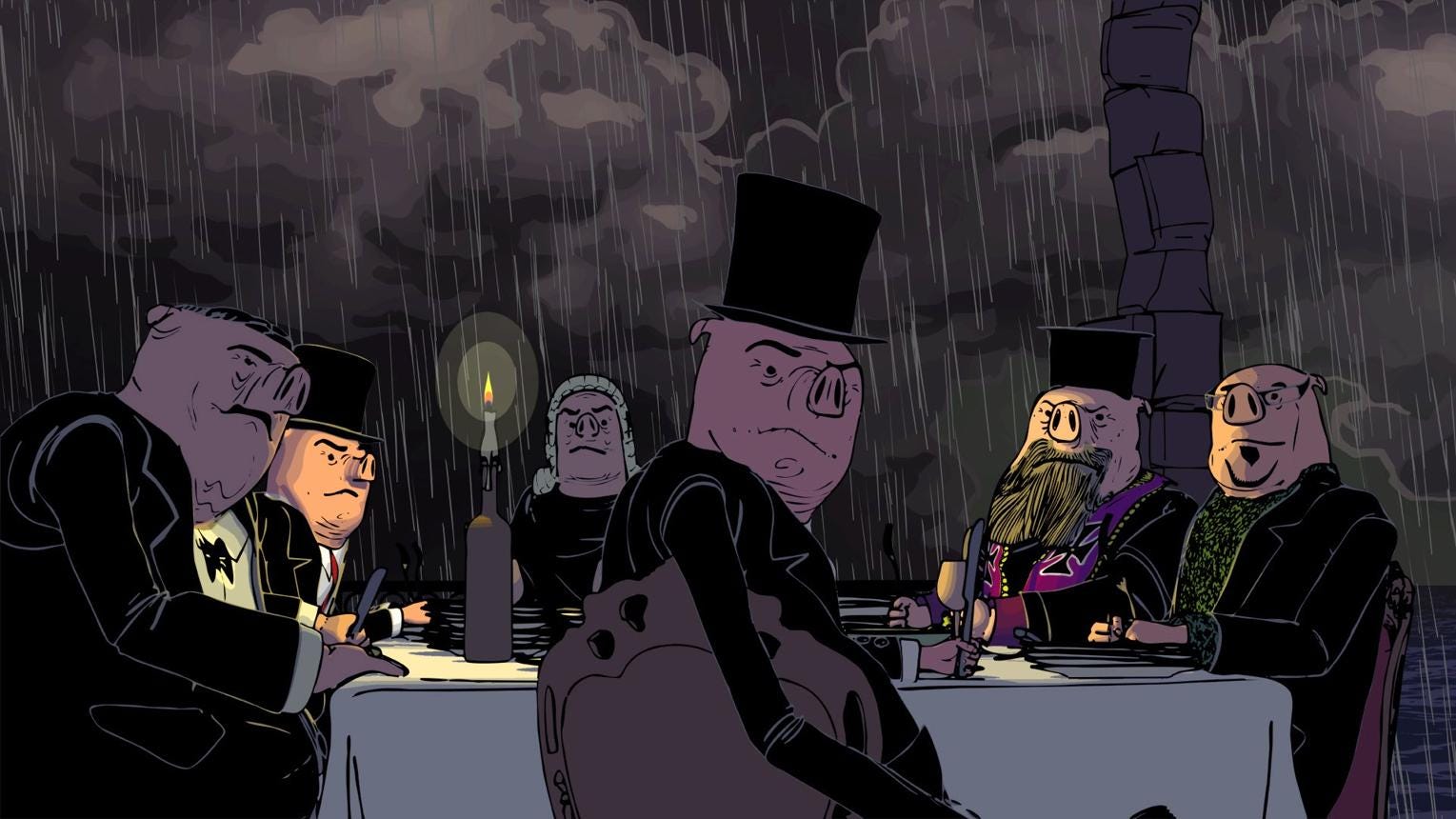
A handful of pigs sit at a giant table consuming endless food while starving cats fight below for scraps.
A machine continuously converts the world around them into more food.
Furniture disappears.
The walls disappear.
The room itself is consumed.
Everything is sacrificed to keep the feast going.
The pigs continue eating.
The cats continue fighting.
The machine continues operating.
Until there is nothing left.
The film was inspired in part by the Greek economic crisis and was intended as a socio-political allegory about power, greed, and recurring cycles of society.
THE SYMBOLS
The film never officially identifies its characters.
Many viewers interpret them as:
The pigs = political, financial, religious, and institutional elites.
The cats = ordinary people struggling for survival.
The machine = the system itself.
The food = wealth, resources, opportunity, and power.
The room = society.
The destruction of the room = consuming the future to maintain the present.
The brilliance of the film is that it does not point to one country.
It points to a pattern.
THE REVOLUTION
Eventually the resources run out.
The starving cats unite.
The table collapses.
Violence erupts.
The old rulers fall.
For a brief moment, it appears that change has arrived.
The audience expects freedom.
The audience expects justice.
The audience expects a new beginning.
Instead, something else happens.
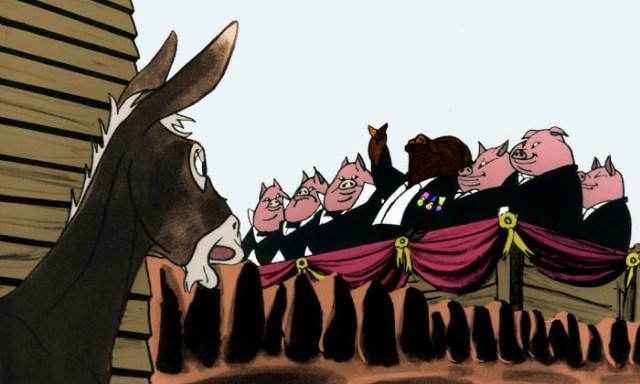
The next generation becomes the new pigs.
The cycle begins again.
ANIMAL FARM RETURNS
This is why many viewers compare the film to George Orwell’s Animal Farm.
Both stories contain pigs.
Both stories contain revolution.
Both stories contain promises of change.
Both stories end with the uncomfortable realization that replacing rulers does not necessarily change the structure of power itself.
The faces change.
The table remains.
IRAN THROUGH THE LENS OF THE FILM
The film was not created about Iran.
Yet many observers can see parallels when comparing the symbolism to Iranian history.
Not because the film names Iran.
But because the themes are universal.
BEFORE 1979
Many Iranians believed the existing system had become disconnected from ordinary people.
Economic inequality, political repression, and concentration of power fueled growing dissatisfaction.
Eventually a revolution emerged.
The old order fell.
Millions hoped for something new.
Millions hoped for freedom, justice, dignity, and national renewal.
The tiger had arrived.
The table was overturned.
AFTER THE REVOLUTION
The new system promised a different future.
Supporters believed corruption would end.
Power would belong to the people.
The nation would become independent and self-determining.
Yet over time many Iranians began asking familiar questions.
Why does power remain concentrated?
Why do some groups have greater influence than others?
Why are opportunities limited?
Why do promises repeat while frustrations remain?
Whether one agrees or disagrees with those criticisms, the questions themselves reveal why so many viewers see echoes of Dinner for Few.
The revolution changed the faces at the table.
But many argue the structure itself remained.
THE GENERATIONAL QUESTION
Perhaps the most powerful similarity is not political.
It is generational.
Every generation believes:
“We will finally fix it.”
Then time passes.
The young become old.
The outsiders become insiders.
The reformers become administrators.
The revolutionaries become managers.
The cycle repeats.
This is the warning hidden inside the film.
Not about one ideology.
Not about one country.
Not about one political faction.
About human nature itself.
THE DEEPER LESSON
The film suggests that changing rulers alone is insufficient.
A society can replace kings.
Replace presidents.
Replace clerics.
Replace parties.
Replace constitutions.
Replace flags.
And still recreate the same patterns.
Because systems are built from people.
And people carry their habits, fears, ambitions, and desires into every new structure they create.
The table survives because the mindset survives.
THE OCEAN
This is where Dinner for Few leaves a door open that many viewers miss.
The film focuses on the table.
The Ocean focuses on the individual.
The film asks:
“Who sits at the table?”
The Ocean asks:
“Why is everyone staring at the table?”
The table is always temporary.
Empires come and go.
Governments rise and fall.
Parties win and lose.
Revolutions succeed and fail.
History turns like a wheel.
Yet beneath all of it remains something deeper.
The individual conscience.
The inner self.
The place where fear cannot vote.
Where propaganda cannot enter.
Where titles and uniforms disappear.
Where a human being can choose love over hatred, understanding over division, and peace over endless conflict.
The table belongs to the material world.
The Ocean belongs to the human spirit.
And while history may continue repeating its cycles above the surface, every person still possesses the freedom to look inward, leave the banquet of endless conflict behind, and discover the vast Ocean of Love and Positivity that exists beyond the reach of every pig, every ruler, every revolution, and every system.
The table may never stop turning.
But the Ocean remains calm.
🩸 Red Blood Journal Transmission #1275
Dinner for Few — A Table, A Nation, and the Cycle of Power
RedBloodJournal.com
🔄 The Cycle of the Table and the Ocean of Spirit
Jun 13, 2026
The provided text analyzes the symbolic meaning of the short film Dinner for Few, framing it as a universal allegory for the corruptive nature of political power.
By utilizing a metaphorical dinner table, the film illustrates how different social classes engage in a destructive cycle where resources are consumed by elites while the masses fight for remnants.
The source highlights how revolutionary movements often fail to achieve true change because the new leadership eventually adopts the same exploitative behaviors as their predecessors.
This pattern is compared to historical events, suggesting that simply replacing rulers does not fix the underlying systemic issues or human greed.
Ultimately, the narrative encourages a shift in focus from material political struggles to the cultivation of the individual human spirit, which remains untouched by the shifting tides of history.


