


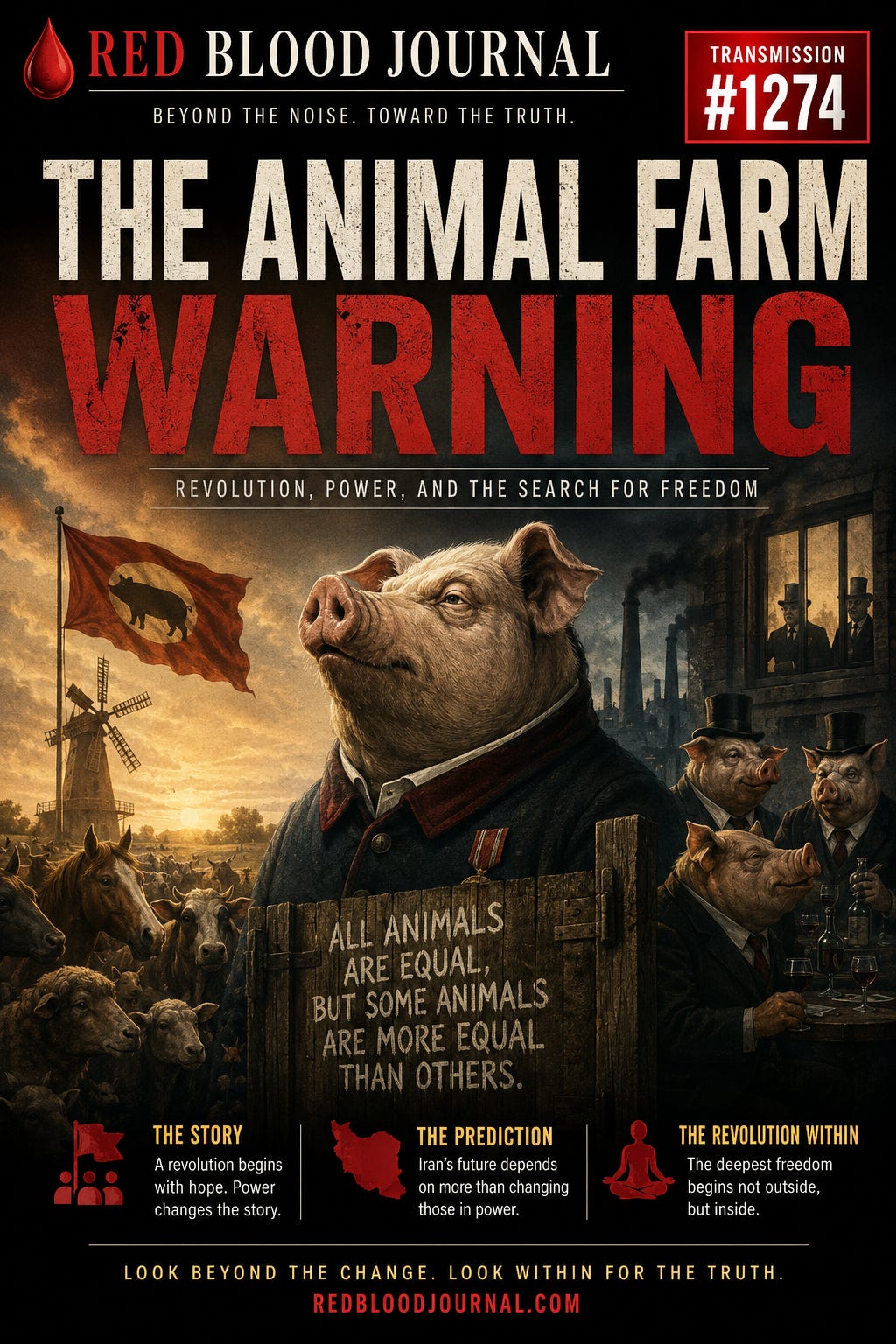
🩸 RED BLOOD JOURNAL TRANSMISSION #1274
THE ANIMAL FARM WARNING
Revolution, Power, and the Search for Freedom
RedBloodJournal.com
EXECUTIVE SUMMARY
In 1945, George Orwell published Animal Farm, a political allegory that has endured for generations because it addresses a timeless question:
What happens after a revolution succeeds?
While the novel was originally written as a critique of the Soviet experience following the Russian Revolution, its central lesson extends far beyond a single nation, ideology, or historical period.
The story explores how populations seeking freedom can sometimes discover that the replacement of one ruling class does not necessarily result in genuine liberation.
As political uncertainty continues across many regions of the world, the lessons of Animal Farm remain relevant to societies contemplating political transformation, including those who hope for significant change in Iran.
This transmission examines Orwell’s warning, explores its possible relevance to the future of Iran, and concludes with a deeper question rarely addressed in political discourse:
Can lasting freedom be achieved through external change alone, or must it begin within the individual?
SECTION I
THE STORY OF ANIMAL FARM
The story begins on a neglected farm where the animals live under the authority of a human farmer whose leadership has become increasingly ineffective and self-serving.
Motivated by a vision of equality and self-governance, the animals unite and successfully overthrow their human owner.
The revolution is celebrated as a historic victory.
For the first time, the animals believe they control their own destiny.
The farm is renamed.
New principles are established.
Old hierarchies are abolished.
Hope fills the air.
The future appears bright.
Yet Orwell’s focus was never the revolution itself.
His focus was what happened afterward.
As time passes, a group of pigs gradually assumes leadership.
What begins as coordination slowly evolves into authority.
Authority evolves into privilege.
Privilege evolves into control.
Control evolves into domination.
The original principles are modified.
Rules are rewritten.
History is revised.
Information becomes centralized.
Dissent becomes dangerous.
Eventually, the animals discover that the leaders who promised liberation have become nearly indistinguishable from the rulers they replaced.
The novel’s most famous line captures the transformation:
“All animals are equal, but some animals are more equal than others.”
The revolution succeeded.
The promise of equality did not.
SECTION II
ORWELL’S WARNING
Many readers mistakenly view Animal Farm as a story about revolution.
It is more accurately a story about power.
Orwell’s central observation was simple:
Removing a ruler does not automatically remove the conditions that create rulers.
History repeatedly demonstrates that populations can become so focused on replacing an existing system that insufficient attention is given to the system that follows.
New leaders often arrive carrying promises.
Promises of justice.
Promises of prosperity.
Promises of accountability.
Promises of freedom.
Yet history shows that power has a tendency to accumulate regardless of ideology.
Different flags.
Different slogans.
Different parties.
Different institutions.
The same human temptation.
The temptation to control.
The temptation to centralize authority.
The temptation to place power above principle.
This is the enduring warning embedded within Orwell’s work.
SECTION III
THE IRAN QUESTION
Many Iranians hope for political change.
Some seek reform.
Others seek transformation.
Many believe that a different political structure could improve the nation’s future.
Those aspirations are understandable.
However, Animal Farm raises a question that extends beyond Iran itself:
What happens the day after the celebration?
What happens when the old system is gone?
What happens when new leaders emerge?
What happens when revolutionary rhetoric encounters political reality?
This transmission presents an interpretation rather than a prediction of certainty.
The concern is that many populations throughout history have looked outward for solutions while overlooking the deeper forces that shape political systems.
A new government may arrive.
A new constitution may be written.
A new movement may gain power.
Yet if the underlying culture of power remains unchanged, the cycle itself may continue.
The names change.
The symbols change.
The language changes.
The structure often remains familiar.
History provides numerous examples where revolutions removed existing authorities only to produce new authorities that gradually adopted similar behaviors.
This possibility does not guarantee a particular future for Iran.
It simply reflects one of the recurring patterns observed throughout human history.
SECTION IV
THE REVOLUTION WITHIN
The deeper significance of Animal Farm may not be political at all.
It may be philosophical.
Political systems encourage attention toward external events.
Citizens are taught to focus on governments.
Parties.
Leaders.
Movements.
Conflicts.
Scandals.
Crises.
The focus remains outward.
Far less attention is given to self-governance.
To self-understanding.
To personal responsibility.
To the cultivation of inner stability.
The outward revolution seeks to change rulers.
The inward revolution seeks to change consciousness.
The outward revolution depends upon institutions.
The inward revolution depends upon the individual.
The outward revolution can be delayed, obstructed, manipulated, or reversed.
The inward revolution remains entirely within one’s control.
Political freedom may expand or contract.
Economic conditions may improve or deteriorate.
Governments may rise or fall.
Yet the search for meaning, peace, clarity, and purpose ultimately takes place within the individual.
No government can provide it.
No government can remove it.
CONCLUSION
THE LESSON BEYOND THE FARM
More than eighty years after its publication, Animal Farm continues to resonate because it addresses a challenge that transcends politics.
It asks whether humanity has learned the difference between changing leaders and changing itself.
The future of Iran remains unwritten.
The future of every nation remains unwritten.
History may repeat.
History may surprise.
History may follow entirely new paths.
Yet Orwell’s warning remains as relevant today as it was in 1945:
The replacement of power is not the same as the transformation of power.
Perhaps the ultimate lesson is that lasting freedom cannot be secured solely through external structures.
It must also emerge from individual awareness.
From personal responsibility.
From self-discovery.
From the courage to look inward rather than endlessly outward.
Beyond politics.
Beyond ideology.
Beyond fear.
Beyond the endless struggle for control.
There exists another path.
A quieter path.
A path of self-mastery.
A path that leads not toward domination of others, but toward understanding of oneself.
And at the end of that journey lies what no revolution can manufacture and no ruler can confiscate:
The Ocean of Love.
The Ocean of Positivity.
The Ocean Within.
RedBloodJournal.com
🐖 The Inward Revolution:
Beyond the Animal Farm Warning
Jun 13, 2026
This text explores the enduring relevance of George Orwell’s Animal Farm, framing the novella as a cautionary tale about the corrupting nature of power rather than just a specific historical critique.
The author argues that political revolutions often fail when they merely replace one ruling class with another, as seen in the story’s progression from liberation to tyranny.
By connecting these themes to the modern political aspirations of Iran, the source suggests that changing a government is insufficient if the underlying structures of control remain.
The narrative emphasizes that true, lasting freedom cannot be granted by external institutions or new leadership.
Instead, the text advocates for an inward revolution focused on individual consciousness, self-mastery, and personal responsibility.
Ultimately, the source posits that genuine transformation begins within the person rather than through the volatile cycles of political upheaval.


