


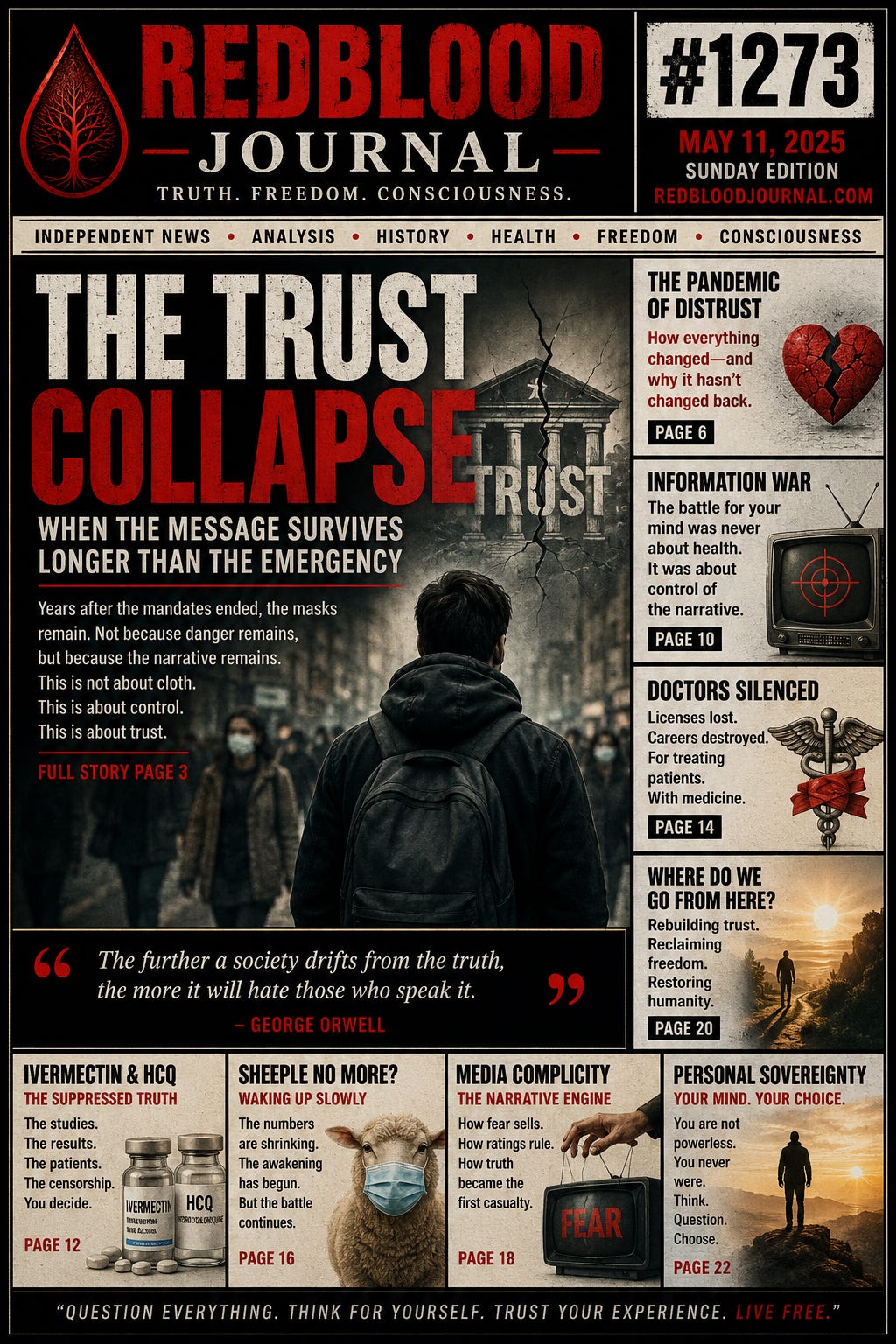
🩸 RED BLOOD JOURNAL TRANSMISSION #1273
THE TRUST COLLAPSE
When the Message Survives Longer Than the Emergency
Classification: Social Psychology & Institutional Trust Analysis
Transmission Code: RBJ-2026-TRUST-COLLAPSE-1273
PROLOGUE — THE WALKER IN THE MASK
A person walks alone down the sidewalk.
No crowd.
No emergency.
No mandate.
No visible threat.
Yet the mask remains.
To some observers, this is merely a personal choice.
To others, it represents something much larger.
Not a piece of cloth.
A piece of psychology.
A symbol of what happens when an idea enters society deeply enough that it continues long after the original event has faded.
The mask itself is not the story.
The story is trust.
SECTION I — THE INVISIBLE CURRENCY
Every society runs on a currency more valuable than money.
Trust.
Without trust:
Contracts become meaningless.
Institutions become suspect.
Experts lose authority.
Governments lose legitimacy.
Media loses influence.
Science loses credibility.
The entire structure depends upon trust.
Not force.
Not laws.
Trust.
The moment trust begins to crack, the foundation beneath the structure begins to move.
SECTION II — THE PANDEMIC OF DISTRUST
The years of COVID did more than spread a virus.
They spread doubt.
Not everyone doubted the same things.
Some doubted the government.
Some doubted the media.
Some doubted pharmaceutical companies.
Some doubted scientists.
Some doubted alternative voices.
Some doubted everyone.
The result was not a health crisis alone.
It became a trust crisis.
A crisis that remains unresolved.
SECTION III — THE INFORMATION WAR
For decades, information flowed in one direction.
Television spoke.
The public listened.
Newspapers printed.
The public read.
Experts announced.
The public accepted.
Then came the internet.
Suddenly everyone possessed a printing press.
Every citizen became a broadcaster.
Every phone became a newsroom.
Every individual gained access to competing narratives.
For the first time in history, centralized information systems faced competition from millions of decentralized voices.
The old gatekeepers no longer controlled every gate.
SECTION IV — THE DANGEROUS QUESTION
The most dangerous question any institution can face is simple:
“Why should I trust you?”
Not because questioning is dangerous.
Because the question itself cannot be controlled.
Trust cannot be legislated.
Trust cannot be mandated.
Trust cannot be commanded.
Trust must be earned.
And once lost, it is extraordinarily difficult to recover.
A person who feels deceived may forgive.
But rarely forgets.
SECTION V — THE AFTERMATH
Years after the emergency phase ended, society continues to display the scars.
Not merely through policies.
Not merely through economics.
But through perception.
People who once trusted now question.
People who once questioned now distrust everything.
Families remain divided.
Communities remain divided.
Political movements remain divided.
The event may have ended.
The consequences did not.
SECTION VI — THE REALIZATION
Perhaps the most important lesson was not medical.
Not political.
Not economic.
But personal.
Every individual eventually faces a decision:
Who decides what is true?
A government?
A corporation?
A scientist?
A journalist?
A social media influencer?
A political leader?
Or oneself?
The answer may differ from person to person.
But the question itself has become unavoidable.
FINAL TRANSMISSION
History is filled with empires that believed they could permanently control information.
History is also filled with citizens who eventually stopped believing them.
Neither side ever wins completely.
The struggle simply changes form.
The age of centralized information created trust through authority.
The age of decentralized information creates authority through trust.
The difference is profound.
Today, every institution competes for belief.
Every expert competes for credibility.
Every narrative competes for attention.
And in that competition, the ultimate judge is not the institution.
It is the individual consciousness evaluating what it sees, hears, experiences, and believes.
For when trust is broken, people begin searching elsewhere.
Some find new authorities.
Some find confusion.
Some find independence.
And some eventually discover that beyond every narrative, beyond every institution, beyond every expert and every critic, there remains a quieter place within—a place where judgment becomes personal, fear loses its grip, and the waves of life settle into an endless ocean of love, positivity, curiosity, and inner peace.
🩸 RedBloodJournal.com
Transmission #1273 Complete
👁️ The Architecture of Institutional Trust and Decentered Truth
Jun 13, 2026
This text examines the profound erosion of institutional trust that occurred following the global pandemic, framing it as a shift from centralized authority to individual skepticism.
The author argues that trust serves as the fundamental currency of a stable society, and once this bond is broken, it is nearly impossible to legislate or mandate its return.
Through the lens of modern communication, the source describes how decentralized information through the internet has stripped traditional gatekeepers of their power, forcing every expert and institution to compete for credibility.
This societal fragmentation has left individuals responsible for determining their own definitions of truth rather than relying on government or media narratives.
Ultimately, the piece suggests that the lasting legacy of recent crises is a psychological scar that pushes people toward independent judgment and personal introspection.
The narrative concludes that true peace is found not in external institutions, but in a person’s own inner consciousness and curiosity.


