


🩸 RED BLOOD JOURNAL TRANSMISSION #1272
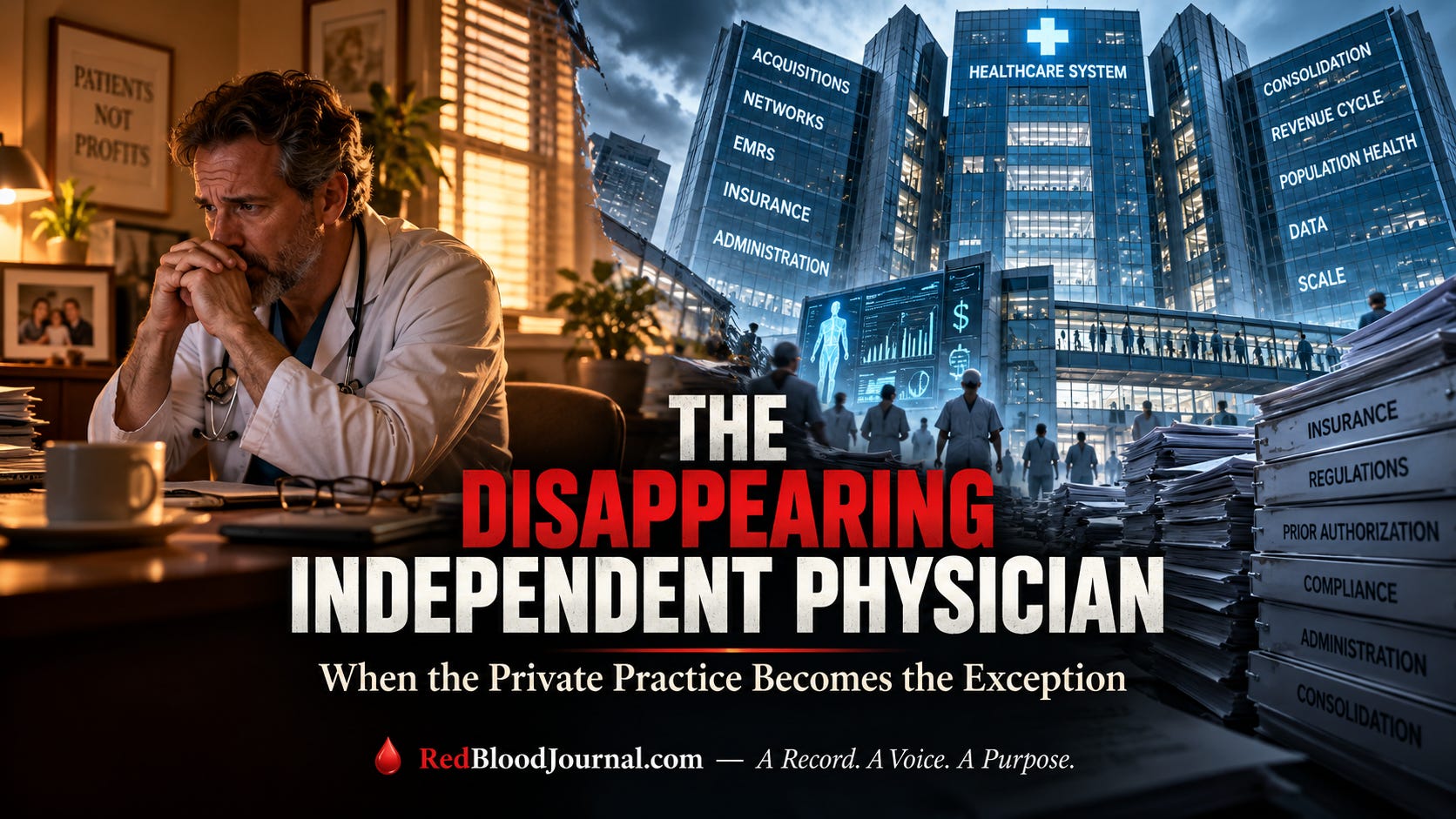
THE DISAPPEARING INDEPENDENT PHYSICIAN
When the Private Practice Becomes the Exception
Classification: Healthcare & Institutional Analysis
Transmission Code: RBJ-2026-MEDICAL-INDEPENDENCE-1272
PROLOGUE — THE DOCTOR WHO OWNED THE PRACTICE
Not long ago, the familiar image of a physician was relatively simple. A doctor completed medical training, opened a practice, built relationships with patients, made clinical decisions, carried the responsibility for those decisions, accepted the financial risks of running the business, and ultimately owned the practice in which medicine was being delivered. The relationship was not free from insurance companies, hospitals, government regulations, or outside influences, but the physician remained much closer to the center of the medical and business decisions surrounding the patient.
That model still exists, but it is increasingly competing with a very different structure. Across the United States, physicians now commonly work inside hospital networks, large medical groups, corporate healthcare organizations, insurance-linked systems, private-equity-backed practices, and other integrated structures. The physician still examines the patient, writes the prescription, interprets the laboratory results, and carries the professional title, but the institution surrounding that physician has become substantially larger.
The question is therefore no longer simply whether the doctor is practicing medicine. The deeper question is whether the doctor still controls the environment in which medicine is practiced.
SECTION I — HOW THE INDEPENDENT PRACTICE BECAME HARDER TO MAINTAIN
Modern medicine requires far more than a physician, an examination room, and a receptionist. A medical practice must now navigate electronic health records, insurance billing systems, credentialing, government reporting, privacy requirements, cybersecurity, malpractice exposure, regulatory compliance, staffing, coding, contracting, prior authorizations, documentation standards, and an increasingly complicated reimbursement system.
Every additional requirement consumes money, time, personnel, and administrative attention. A large healthcare organization can distribute those expenses across hundreds or thousands of physicians, specialists, facilities, and patients. A small independent office must often absorb many of the same administrative burdens with a fraction of the resources.
The economics naturally create pressure toward scale. When the administrative machinery required to operate becomes increasingly expensive, consolidation becomes increasingly attractive. Some physicians voluntarily sell their practices because employment offers predictable compensation, reduced administrative responsibility, access to larger technology systems, and institutional support. Others may feel they have little practical choice because remaining independent becomes progressively more difficult.
The physician does not disappear when the practice is acquired. What changes is the physician’s position inside the structure. The owner gradually becomes the employee.
SECTION II — WHEN THE CENTER OF DECISION-MAKING MOVES
The traditional independent physician theoretically had a relatively direct chain of responsibility. The patient presented a problem, the physician evaluated it, and the physician decided how to proceed within the limits of medical knowledge, law, insurance coverage, and professional ethics.
Inside a large healthcare system, additional considerations enter the room even when they are invisible to the patient. Budgets matter. Reimbursement formulas matter. Insurance contracts matter. productivity targets matter. Scheduling systems matter. organizational policies matter. quality measurements matter. utilization reviews matter. regulatory requirements matter. Standardized protocols and corporate procedures increasingly shape what can be done, how quickly it can be done, and how the encounter is documented.
There are legitimate arguments in favor of these systems. Standardization can reduce certain kinds of errors. Electronic records can improve access to information. Large organizations can coordinate specialists, laboratories, hospitals, pharmacies, and imaging services. Institutional resources may help physicians manage complex cases that would overwhelm a small practice.
But coordination and control are not the same thing. The central question is how much professional judgment remains with the physician when the surrounding institution controls the schedule, reimbursement structure, administrative process, staffing model, computer system, and many of the procedures governing patient care.
The tension is not necessarily between good doctors and bad institutions. It is between professional autonomy and institutional scale.
SECTION III — RESPONSIBILITY CAN REMAIN PERSONAL WHILE POWER BECOMES INSTITUTIONAL
Medicine contains a particularly important contradiction. The physician’s name remains attached to the medical decision, yet many of the conditions surrounding that decision may be established elsewhere.
Large healthcare organizations have legal departments, compliance officers, risk-management teams, contract specialists, insurance resources, administrative executives, billing departments, data systems, and institutional policies designed to manage organizational exposure. An independent physician usually possesses nothing comparable.
This does not mean large healthcare systems are automatically protected from accountability, nor does it mean an individual doctor is automatically more vulnerable in every dispute. Healthcare law varies significantly by jurisdiction, employment relationship, ownership structure, malpractice coverage, and the circumstances of an individual case.
The imbalance is nevertheless worth examining. When decision-making becomes distributed across institutions while professional responsibility remains closely associated with the individual physician, an uncomfortable question emerges: Who truly controls the decision, and who ultimately carries the consequences when something goes wrong?
A system can become large enough that responsibility is dispersed through committees, policies, software, contracts, insurers, administrators, and protocols. Yet when a patient looks across the examination table, there is still one human being wearing the white coat.
SECTION IV — THE MOST IMPORTANT THING BEING LOST MAY NOT BE MONEY
For many physicians, independence is not simply about earning more money. It is about controlling the conditions under which they practice their profession.
An independent physician may decide how many patients can reasonably be seen during a day, how much time should be spent with a complicated patient, which services should remain inside the practice, what kind of staff should be hired, how aggressively the office should expand, and what values should define the relationship between the practice and the patient.
Employment inside a larger structure changes that relationship. The organization may establish appointment lengths, productivity expectations, documentation requirements, approved systems, staffing ratios, referral procedures, and financial targets. Each requirement may be defensible individually. Taken together, however, they can gradually transform the physician from an independent professional into one component of a much larger production system.
That distinction matters because ownership affects psychology. A person who owns the work often experiences responsibility differently from a person who performs the work inside somebody else’s structure. The physician may still care deeply about the patient, but the surrounding institution increasingly determines the boundaries within which that care must operate.
The transformation is subtle because the title remains unchanged. The person is still called “doctor.” What may have changed is the amount of control behind the title.
SECTION V — THE PATIENT ALSO EXPERIENCES THE CONSOLIDATION
The disappearance of independent medicine is not only a physician story. Patients experience the transformation as well.
In the traditional practice, the patient might have known the doctor, receptionist, nurse, and office manager for years. The physician might have known several generations of the same family. The patient called the office rather than a centralized scheduling center and often dealt with people physically located in the practice itself.
Large systems can offer broader networks, sophisticated technology, integrated records, specialized services, and access to major facilities. At the same time, the patient may increasingly interact with call centers, portals, automated messages, rotating clinicians, centralized billing departments, authorization systems, and standardized scheduling structures.
Healthcare becomes more technologically connected while sometimes becoming more personally distant.
This does not prove that the older model was always better. Small practices could also be inefficient, poorly managed, financially unstable, inaccessible, or resistant to modern technology. The relevant question is not whether medicine should return to some idealized past. The question is whether modernization necessarily requires removing meaningful human independence from the center of the system.
SECTION VI — THE PHYSICIAN IS PART OF A MUCH LARGER PATTERN
The transformation occurring in medicine resembles changes occurring throughout the economy.
The independent driver becomes dependent on a digital platform that determines access to passengers, pricing, visibility, and sometimes the conditions of the work. The independent retailer becomes dependent on an online marketplace that controls search ranking, customer access, payment systems, and account rules. The independent journalist becomes dependent on social-media algorithms and distribution platforms. The local merchant competes with national chains. The independent contractor enters gig platforms. The small property owner competes with large investment groups. The family business increasingly operates inside financial, technological, and regulatory systems larger than itself.
The industries are different, but the structural movement is similar. The individual remains present while the surrounding system becomes more powerful.
Modern society often describes this process using the language of efficiency, integration, scale, convenience, compliance, and optimization. Those benefits can be real. But another question deserves equal attention: How much independence can disappear before the individual ceases to meaningfully control the work?
A society composed almost entirely of employees, contractors, platform participants, subscribers, tenants, and users may remain economically productive while becoming increasingly dependent on institutions that ordinary individuals do not control.
Medicine may simply be one of the clearest places where this transformation can be observed.
🩸 THE RED BLOOD PERSPECTIVE
The important question is not whether large healthcare systems should exist. Complex societies require large organizations, and modern medicine sometimes demands levels of coordination, technology, specialization, and capital that a small independent practice cannot provide.
The more important question is whether scale must always require surrendering independence.
An institution can provide infrastructure without attempting to replace professional judgment. Technology can assist the physician without becoming the physician’s master. Administrative systems can support medical care without forcing every human encounter into an efficiency metric. Standardization can protect patients while still leaving room for judgment, experience, and individual responsibility.
The danger begins when society becomes so impressed with scale that it forgets what scale is supposed to serve.
Hospitals exist because human beings need care. Insurance exists because human beings need financial protection against medical catastrophe. Technology exists because human beings need better tools. Administrative systems exist because complicated organizations require coordination. None of those structures should become more important than the human beings they were created to serve.
The physician should therefore be examined not merely as a healthcare worker but as another example of a larger struggle over ownership, autonomy, and institutional power.
When ownership disappears, something more than a business model can disappear with it. Responsibility becomes divided. Decision-making becomes distant. Purpose becomes harder to locate. Eventually the individual may discover that almost everything surrounding the work is controlled by somebody else.
That is when independence stops being an economic question and becomes a human one.
🌊✨ OCEAN OF LOVE AND POSITIVITY PERSPECTIVE
The answer does not have to be hostility toward hospitals, corporations, governments, technology, or organizations. Replacing one controlling structure with another would simply recreate the same problem under a different name.
The deeper response begins inside the individual.
A physician can work inside a massive healthcare system and still remember that the patient sitting across the room is not a metric, a billing code, or a productivity unit. A patient can move through an enormous medical institution and still remember that personal responsibility for health, questions, choices, and understanding cannot be entirely handed to an institution. An employee can work inside a corporation without surrendering the ownership of conscience. A citizen can live inside a complicated society without allowing the system to become the definition of the self.
Institutions can own buildings, contracts, databases, equipment, schedules, and networks. They cannot own the inner human space from which compassion, judgment, integrity, purpose, and love emerge unless the individual voluntarily surrenders it.
Perhaps that is where independence ultimately survives.
Not merely in owning the office, but in owning the self.
The world outside may continue consolidating. Systems may grow larger, algorithms may become more powerful, organizations may become more centralized, and professional life may continue moving into structures that no single individual controls. The inner task remains different: to understand what belongs to the system and what must never be surrendered to it.
Purpose cannot be automated. Compassion cannot be standardized into existence. Integrity cannot be outsourced. Meaning cannot be issued by an employer.
The physician who remembers why medicine mattered in the first place may therefore preserve something deeper than private practice. The individual who remembers who they are may preserve something deeper than economic independence.
That is where the open water remains.
In an Ocean of Love and Positivity.
🩸🌊✨ Fantastic!
🩸 RedBloodJournal.com — A Record. A Voice. A Purpose.
Transmission #1272 Complete
⛓️ The Institutional Capture of the Independent Physician
Jun 13, 2026
The provided text examines the decline of independent medical practices as healthcare undergoes a significant shift toward institutional consolidation.
Driven by rising administrative costs, complex regulations, and technological demands, many physicians are transitioning from self-employed business owners to employees of large healthcare systems.
While these massive organizations offer greater efficiency and standardized safety, they often diminish a doctor’s professional autonomy and personal connection to patient care.
This evolution in medicine mirrors a broader global trend where individual professionals in various industries are increasingly absorbed into centralized corporate structures.
Ultimately, the source highlights the tension between the benefits of large-scale coordination and the essential human need for independence and purpose within one’s vocation.


