


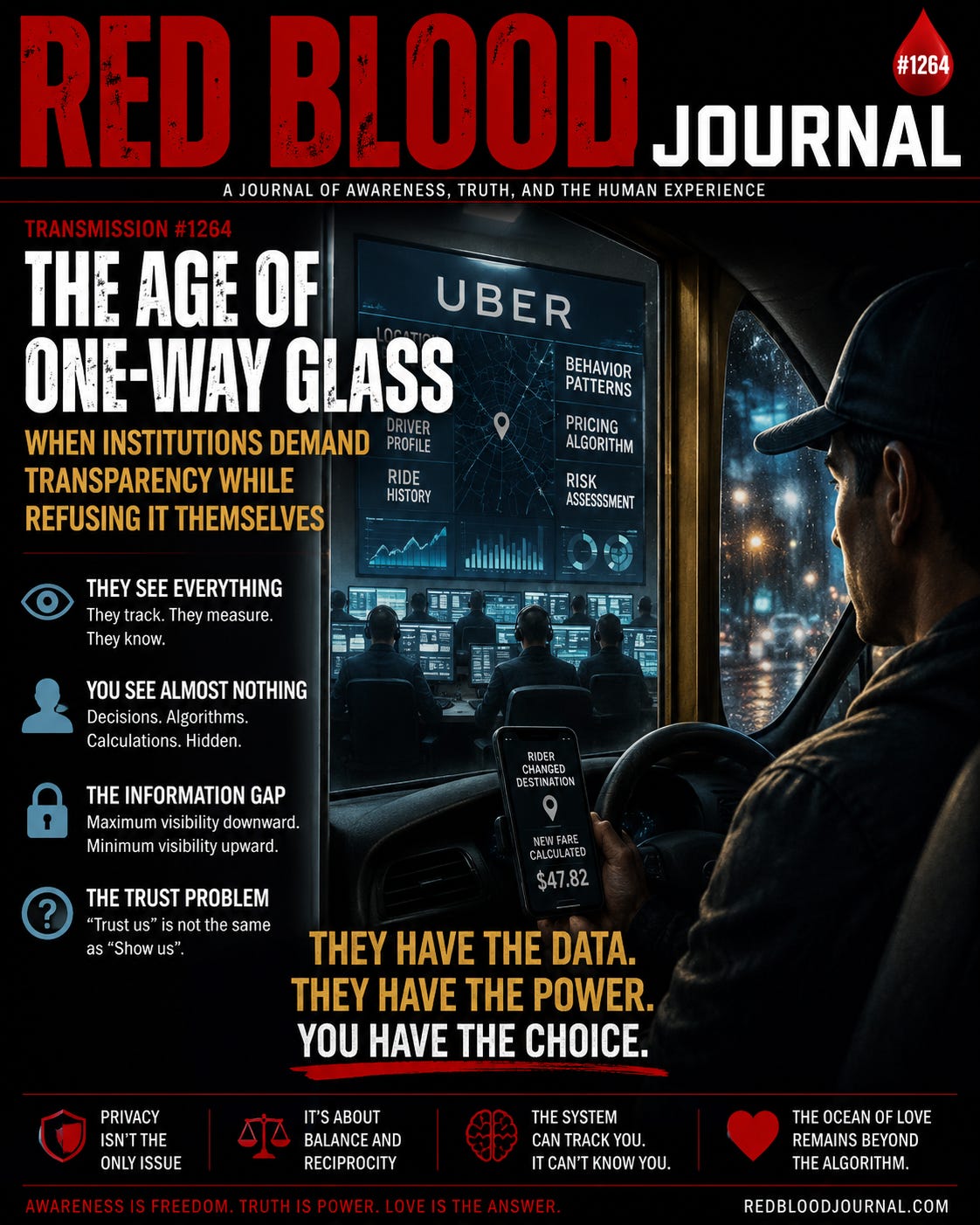
🩸 RED BLOOD JOURNAL TRANSMISSION #1264
THE AGE OF ONE-WAY GLASS
When Institutions Demand Transparency While Refusing It Themselves
INTRODUCTION
Throughout history, power has always desired information.
Kings wanted information.
Empires wanted information.
Governments wanted information.
Banks wanted information.
Corporations wanted information.
Information has always been power.
What has changed is not the desire for information.
What has changed is the scale.
Today, the average individual lives inside a world where nearly every action can be measured, recorded, categorized, analyzed, and stored.
The promise was convenience.
The result was visibility.
But visibility has not been distributed equally.
THE TRANSPARENCY PARADOX
Modern citizens are expected to be transparent.
Modern consumers are expected to be transparent.
Modern workers are expected to be transparent.
Every purchase creates a record.
Every online search creates a record.
Every ride creates a record.
Every location creates a record.
Every interaction creates a record.
The digital footprint follows the individual everywhere.
Meanwhile, the institutions collecting this information often remain hidden behind walls of policy, legal language, confidentiality agreements, proprietary algorithms, and internal procedures.
The public becomes visible.
The institution becomes invisible.
READING BETWEEN THE LINES
The attached discussion appears on the surface to be about ride-share companies, fares, insurance costs, and changing destinations.
But beneath the discussion lies a much larger story.
The driver knows almost nothing.
The platform knows everything.
The platform knows where the driver is.
The platform knows the route.
The platform knows the customer’s behavior.
The platform knows the pricing calculations.
The platform knows the risk models.
The platform knows the performance metrics.
The platform knows the profit margins.
The platform knows the destination changes.
The platform knows the complete picture.
The driver receives only fragments.
A notification.
A number.
A rating.
A decision.
A result.
The machine sees the board.
The player sees only the next square.
THE CORPORATE GOVERNMENT MODEL
Historically, governments possessed the largest information systems in society.
Today many corporations possess information networks that rival or exceed those of entire nations.
The result is an interesting convergence.
Governments often say:
“Trust us.”
Corporations often say:
“Trust us.”
Governments often refuse to reveal how decisions are made.
Corporations often refuse to reveal how decisions are made.
Governments often cite security.
Corporations often cite proprietary information.
Different language.
Similar outcome.
The institution retains visibility.
The individual receives instructions.
THE ONE-WAY GLASS SOCIETY
Imagine standing in a room surrounded by one-way mirrors.
Those outside can observe everything.
Those inside can observe nothing.
Eventually the question becomes unavoidable:
Who is actually being watched?
And who is actually doing the watching?
This feeling appears repeatedly throughout modern life.
The employee is monitored.
The monitoring system is secret.
The customer is profiled.
The profiling method is secret.
The citizen is tracked.
The tracking process is secret.
The user is analyzed.
The algorithm remains secret.
Transparency increasingly travels in one direction.
THE TRUST PROBLEM
Institutions frequently ask for trust.
Trust the algorithm.
Trust the pricing.
Trust the recommendation system.
Trust the experts.
Trust the process.
Trust the platform.
Yet trust has traditionally been built through verification.
The less people understand how decisions are made, the more skepticism naturally develops.
The issue is not information itself.
The issue is reciprocity.
People generally accept transparency when transparency flows both ways.
People become suspicious when only one side is expected to stand under the spotlight.
THE DEEPER QUESTION
Perhaps the most important question emerging from the modern age is not:
“What are they collecting?”
The deeper question may be:
“Why are they collecting more information while revealing less information?”
That question applies to governments.
That question applies to corporations.
That question applies to every institution whose power grows through data.
The concern is not merely privacy.
The concern is balance.
OCEAN OF LOVE PERSPECTIVE
From the Ocean of Love and Positivity perspective, there is a lesson hidden beneath the entire debate.
External systems will continue to grow.
Algorithms will continue to expand.
Technology will continue to advance.
Institutions will continue to gather information.
These trends may be difficult or impossible for any individual to stop.
Yet there remains one territory that no corporation can fully map and no government can fully measure.
The inner world.
The conscience.
The awareness.
The spirit.
The ability to choose one’s response.
The ability to remain calm while others demand fear.
The ability to remain positive while others manufacture anxiety.
The ability to remain free inside even when external systems appear increasingly complex.
That freedom has always existed.
It existed before the databases.
It existed before the algorithms.
It existed before the institutions.
And it remains available today.
For while the world may become a hall of one-way mirrors, the individual who learns to look inward discovers a place where no mirror is needed at all.
There, beyond surveillance and beyond control, lies the Ocean of Love, the Ocean of Positivity, and the simple realization that the most important truths about a person can never be captured by a database.
Red Blood Journal Transmission #1264
The Age of One-Way Glass
RedBloodJournal.com
👁️ The Age of One-Way Glass
Jun 11, 2026
The provided text explores the growing imbalance of power in a society where data collection has become a one-way street.
While modern institutions, including both governments and corporations, demand total transparency from the public, they simultaneously hide their own decision-making processes and algorithms behind a veil of secrecy.
This “one-way glass” creates a profound lack of reciprocity, leaving individuals visible and vulnerable while the entities watching them remain invisible and unaccountable.
Using the gig economy as a primary example, the source illustrates how information asymmetry allows platforms to control workers through fragmented data and hidden metrics.
Ultimately, the text suggests that while external surveillance may be unavoidable, individuals can find a sense of inner freedom and peace that exists beyond the reach of any digital database.


