


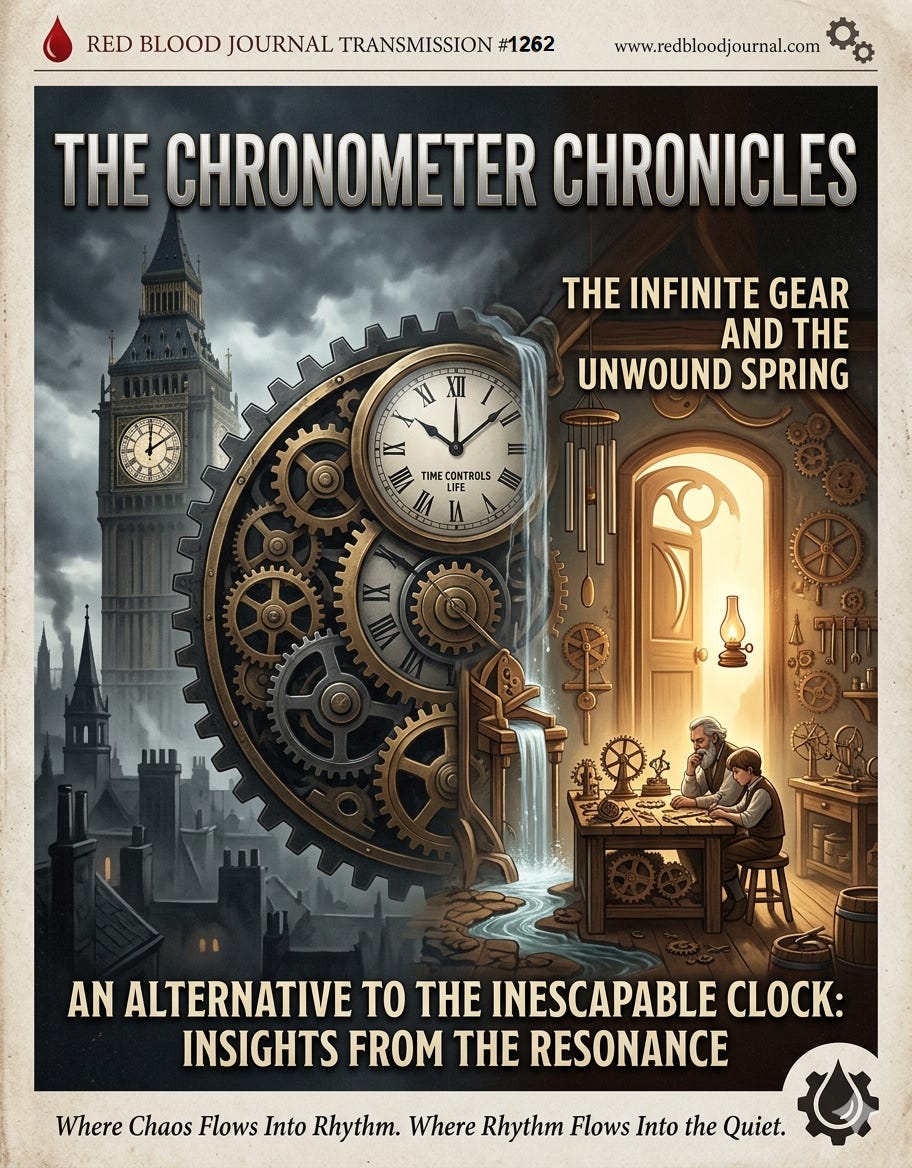
⚙️ THE CHRONOMETER CHRONICLES: TRANSMISSION #1261
THE INFINITE GEAR AND THE UNWOUND SPRING
Introduction
For generations, the citizens of Aethelgard chased the exact same goals:
How do we maximize the day?
What is the cost of a wasted second?
How do we outrun the night?
Entire architectures were built around the pursuit of absolute efficiency.
Great steam-engines were erected.
Schedules were synchronized.
Factories expanded.
The Great Clocktower was built in the center of the plaza, its rhythmic tick-tock dictating the heartbeat of a hundred thousand lives.
Yet, despite centuries of flawless synchronization, the people kept burning out.
Perhaps the problem wasn’t the machinery.
It was the metric.
The Age of Total Automation
For the first time in history, a generation had access to microscopic gears and automated pocket-watches that planned their entire lives for them.
A moment of hesitation arose.
Within seconds, the device offered a correction.
Optimized routes.
Caloric breakdowns.
Sleep schedules down to the millisecond.
The modern citizen no longer relied on intuition to know when to rest or when to work.
The machine calculated it.
Streamlined it.
Enforced it.
This changed everything.
Every human interaction was weighed by its yield. Spontaneous conversations were cut short; idle staring out the window was treated as a mechanical malfunction.
Efficiency controlled time.
Time controlled life.
The Grinding Gears
But as the city grew taller and the pocket-watches grew more precise, something strange happened.
Production doubled.
The spires grew higher.
The trains ran exactly on time.
Yet, the clinics filled with people suffering from a hollow exhaustion.
Material output increased.
Internal peace plummeted.
The city was perfectly synchronized, yet the individuals within it felt utterly uncoupled.
The noise of the gears increased.
The meaning of the work decreased.
A friction emerged.
Not a mechanical friction.
A human friction.
The Master Clockmaker
In the quietest alley of the lowest district lived an old clockmaker named Thaddeus. For decades, he had repaired the city’s finest timepieces, but lately, he had stopped fixing them to run fast. Instead, he began building something entirely different.
He called it The Resonance.
It wasn’t a watch meant to measure time, but an open workshop filled with kinetic sculptures that moved not by strict, grinding gears, but by the natural weight of water, wind, and gravity. The Resonance proposed a simple alternative:
That time is a canvas, not a treadmill.
That the rhythm of learning matters more than the speed of execution.
That a mistake in the gear alignment is just a lesson in tension, not a moral failure.
In his shop, there were no deadlines. Every broken spring was a teacher. Every slow pendulum was a mirror reflecting the visitor’s internal state. The goal was not maximum output. The goal was alignment.
The Open Door
The City Council ruled by mandate and fine. They forced citizens to sync their watches to the Great Tower. Force created resistance; people secretly smashed their gears in frustration.
Thaddeus operated differently. He didn’t post flyers. He didn’t lock his doors or charge admission. He simply left his workshop door propped open with a brass weight.
Those who were exhausted by the ticking of the city wandered in. Those who still found comfort in the rigid schedules walked past. Thaddeus knew you cannot force a mainspring to unwind before its time. A pendulum swings when it is released, not when it is ordered to.
The Glass Case
To protect his workshop from the relentless soot and chaotic noise of the industrial city outside, Thaddeus built a large acoustic glass partition near the entrance.
It wasn’t a wall to shut people out. It was a filter.
Music entered.
Laughter entered.
Curiosity entered.
The frantic, anxious ticking of the city’s anxieties stayed outside. The panic of the stock tickers remained in the street. The glass allowed those inside to choose what frequency they wanted to live by.
The Separation
As the city pushed into its next industrial evolution, a quiet separation began to happen.
Not between social classes.
Not between neighborhoods.
The separation between the Chronometers—those bound entirely to the rigid, unyielding ticking of certainty—and the Resonators—those willing to pause, sit in the quiet, and wonder.
Conclusion
Perhaps Thaddeus’s workshop was just a tiny anomaly in a massive, mechanized world. But stories have always shaped how we spend our days.
The real question for Aethelgard wasn’t whether time existed. The real question was: what kind of rhythm creates a sustainable life?
A rhythm built on pressure? Or a rhythm built on presence?
Each citizen had to choose which watch to wind.
The workshop door remained unlatched.
The space inside was warm.
And for anyone tired of the race, there was always room for one more stool at the workbench.
🕰️ The Resonance Closing
In the end, every human being is searching for the same steady frequency.
Peace.
Meaning.
Belonging.
Understanding.
Some search for it through structure. Some through freedom. Some through work, and some through rest. The mechanism matters less than the alignment.
If grace grows, the human spirit expands.
If understanding grows, the friction of life shrinks.
If quiet spreads, panic loses its grip.
May every pause bring greater wisdom.
May every breakdown reveal hidden strength.
May every silence lead closer to truth.
And may the workshop of peace continue to expand, one heart, one mind, and one second at a time.
⚙️ The Resonance Workshop
Where Chaos Flows Into Rhythm.
Where Rhythm Flows Into the Quiet. 🌊
⏳ The Resonance: Finding Rhythm in a Clockwork World
Jun 11, 2026
The narrative explores the fictional city of Aethelgard, where a culture of extreme mechanical efficiency and automated scheduling has led to widespread human burnout.
While technological advancements and perfect synchronization increased industrial output, they simultaneously stripped the citizens of their internal peace and spontaneity.
In response to this rigid atmosphere, a clockmaker named Thaddeus establishes a sanctuary called The Resonance, which prioritizes natural rhythms over strict deadlines.
This workshop serves as a refuge for those seeking to reconnect with personal alignment and contemplative wisdom rather than cold productivity.
Ultimately, the text presents a choice between a life driven by mechanical pressure and one defined by intentional presence.
The story emphasizes that true sustainability is found when individuals prioritize human meaning over the relentless ticking of a clock.


