


🩸 RED BLOOD JOURNAL TRANSMISSION #1257
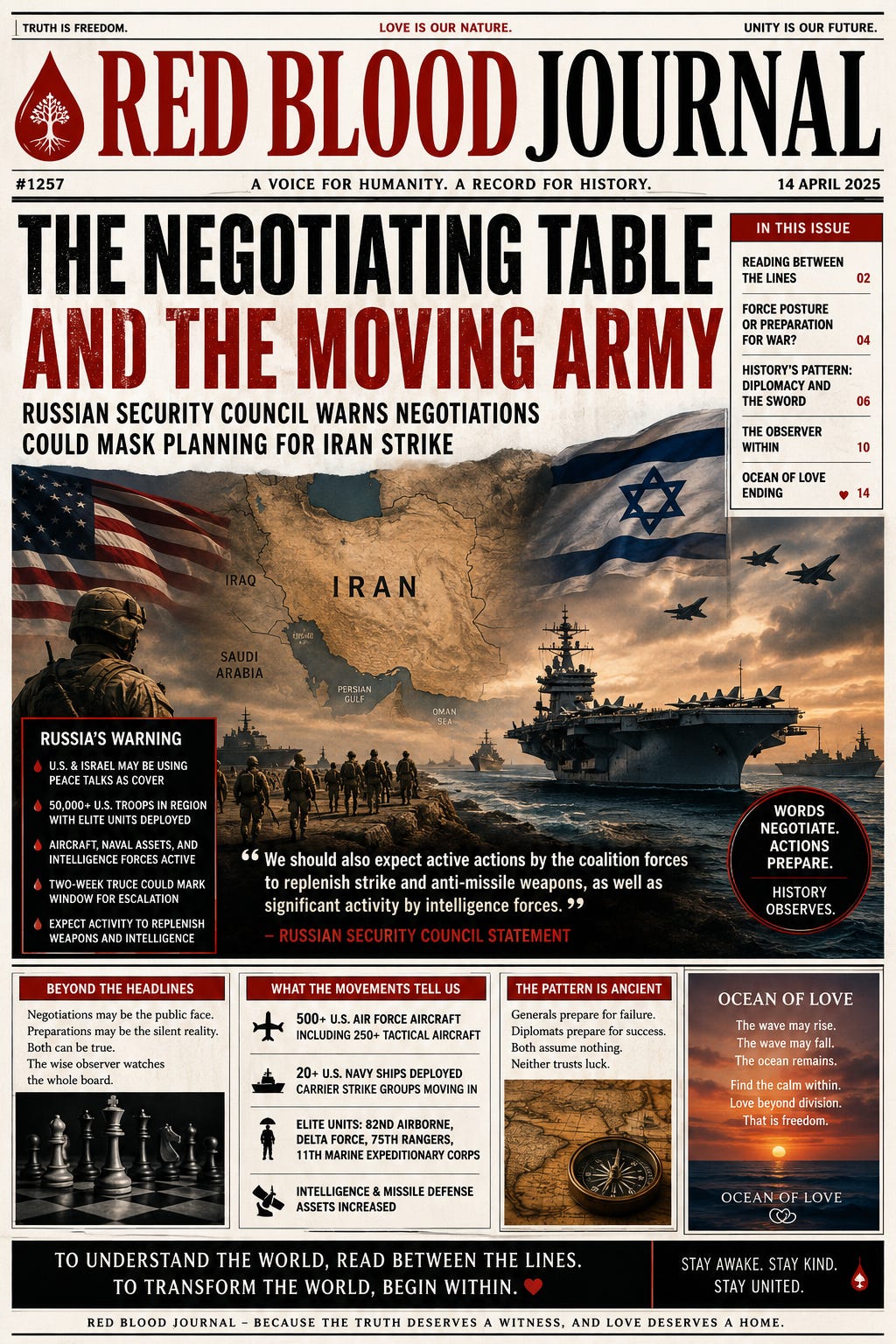
THE NEGOTIATING TABLE AND THE MOVING ARMY
READING BETWEEN THE LINES
History rarely announces its intentions.
It leaves clues.
A speech here.
A deployment there.
A promise of peace on one side of the stage.
A movement of military assets on the other.
The recent Russian Security Council warning suggests that negotiations involving Iran may not be occurring in isolation from military planning.
Whether Russia’s assessment is correct is not the most important question.
The more important question is what history teaches when diplomacy and military preparations appear at the same time.
The answer is simple.
They often do.
Generals prepare for failure.
Diplomats prepare for success.
Both work simultaneously.
Neither trusts the future enough to leave it entirely in the hands of the other.
This is not unique to one country.
It is not unique to one alliance.
It is not unique to one era.
It is how power has operated throughout recorded history.
The public listens to speeches.
Military planners study logistics.
The public hears promises.
Military planners count fuel, ammunition, transportation routes, intelligence assets, and contingency plans.
The public sees headlines.
Military planners see probabilities.
When viewed from this perspective, the report becomes less about Iran and more about understanding how governments think.
No serious military prepares only for peace.
No serious government negotiates without considering the possibility that negotiations may fail.
This is why experienced observers often pay close attention not only to words but also to actions.
Ships move.
Aircraft reposition.
Supply chains expand.
Intelligence activity increases.
Defensive systems activate.
These actions do not automatically prove war is coming.
But they do indicate that leaders want options available if events move in an unfavorable direction.
That has always been the language of power.
Yet there is another layer hidden beneath the geopolitical analysis.
A layer rarely discussed.
The real struggle may not be occurring only between nations.
It may also be occurring within individuals.
For thousands of years, fear has been the most reliable fuel in politics.
Fear creates attention.
Fear creates urgency.
Fear creates loyalty.
Fear creates division.
Fear convinces people to focus entirely on the external world.
And sometimes that focus becomes so complete that individuals forget to look inward.
The result is a population constantly reacting.
One crisis follows another.
One conflict follows another.
One headline replaces another.
The movie changes scenes.
The audience remains glued to the screen.
Meanwhile the most important question quietly waits in the background:
Who is watching the movie?
The armies may move.
The negotiations may succeed.
The negotiations may fail.
Leaders may change.
Alliances may change.
Maps may change.
Yet the observer within remains.
History demonstrates that every empire eventually discovers its limitations.
Every military eventually reaches its horizon.
Every political movement eventually becomes another chapter in a book.
The wave rises.
The wave falls.
The ocean remains.
Perhaps that is the lesson hidden between the lines.
Observe without panic.
Question without hatred.
Think without fear.
Listen without surrendering reason.
And while the world competes for attention outside, do not forget the territory within.
Because the greatest victory is not the defeat of another nation.
The greatest victory is freedom from the fear that keeps humanity divided from itself.
The ships may sail.
The speeches may continue.
The experts may debate.
The headlines may multiply.
But beneath all of it remains something older than politics and more permanent than power.
A quiet awareness.
A calm center.
An Ocean of Love vast enough to hold every wave without becoming the wave itself.
And when enough people discover that ocean within themselves, the fear machine begins to lose its audience.
🌊 Ocean of Love
🌊 The Architecture of Power and the Quiet Within
Jun 10, 2026
This text examines the dual nature of geopolitical power and the internal human experience during times of global tension.
It explains that while diplomats negotiate for peace, military planners simultaneously prepare for conflict, illustrating how governments use strategic positioning to secure their interests.
Beyond this political analysis, the source argues that fear is a primary tool used to capture public attention and maintain societal division.
The author suggests that most people become trapped in a cycle of reactive anxiety fueled by a constant stream of crisis-driven headlines.
Ultimately, the narrative encourages readers to cultivate a quiet awareness and internal peace that exists independently of external chaos.
By finding this inner stability, individuals can liberate themselves from the cycles of fear that traditionally dominate human history.


