


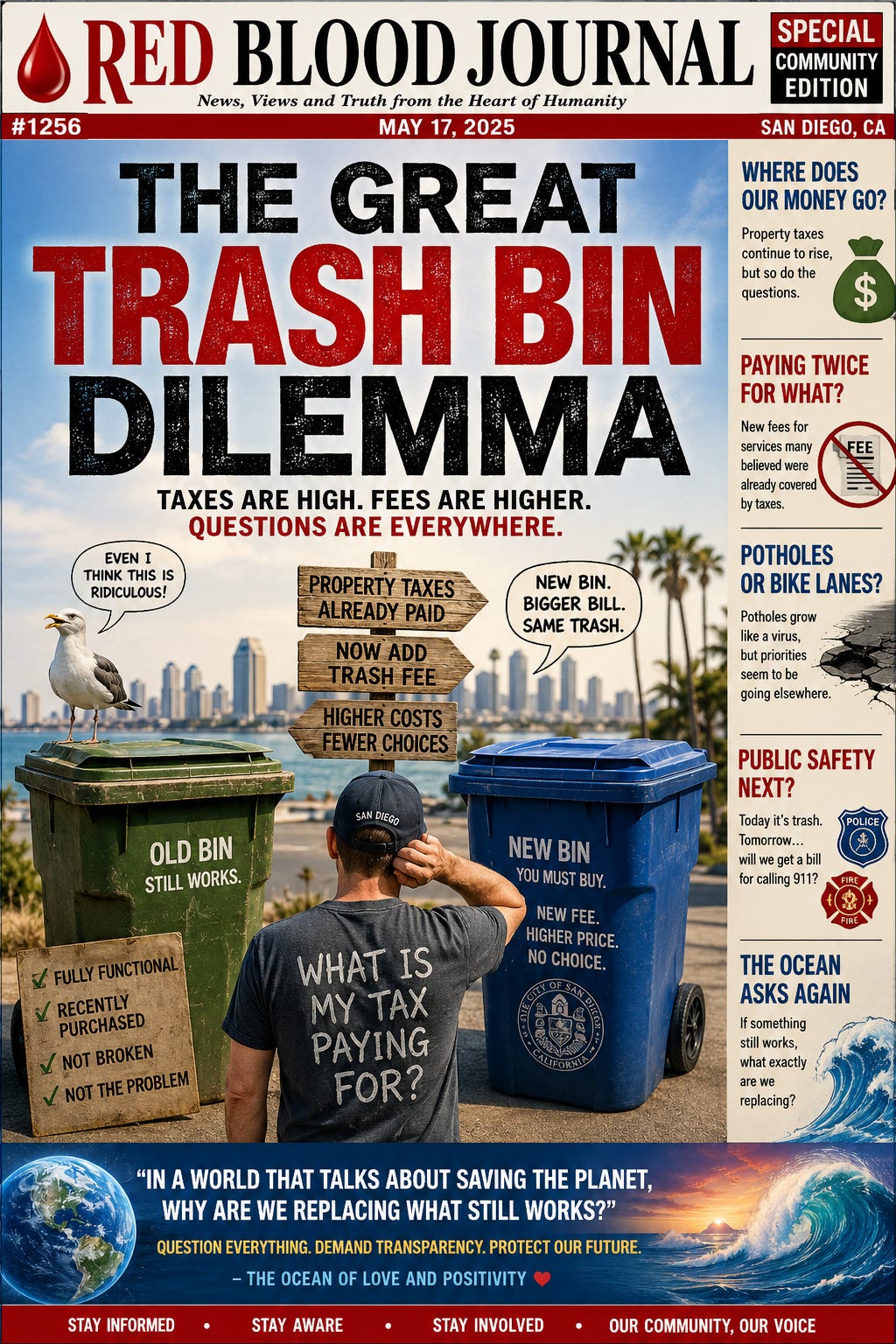
🩸 RED BLOOD JOURNAL TRANSMISSION #1256
THE GREAT TRASH BIN DILEMMA
A Question About Taxes, Fees, and the Meaning of Public Service
Introduction
Across San Diego, a growing debate has emerged over trash collection fees, replacement trash containers, and the broader question of what citizens should reasonably expect from the taxes they already pay.
The debate extends far beyond garbage collection.
At its core, it asks a simple question:
What is the purpose of taxation if an increasing number of public services require separate fees?
The Trash Bin Question
For decades, many homeowners viewed residential trash collection as one of the many services provided by local government.
Property taxes were paid.
Services were delivered.
The relationship appeared straightforward.
Recently, however, residents have found themselves facing a new reality.
Trash collection is now being treated as a separate utility-style service with its own dedicated fee structure.
At the same time, many homeowners are being required to exchange existing trash containers for new city-approved containers.
This has raised concerns among residents who point out that many of the old containers remain fully functional.
Some homeowners purchased replacement containers only months or years ago.
Others maintained their existing containers in excellent condition.
The question naturally follows:
If environmental sustainability is a priority, why replace containers that still perform their intended function?
The Environmental Contradiction
Modern governments frequently encourage citizens to:
Reduce waste
Reuse materials
Recycle whenever possible
Extend the life of consumer products
Yet many residents observe what appears to be a contradiction.
Thousands of usable plastic containers are being removed from service while new containers are manufactured, distributed, and purchased.
Whether the replacement is justified by operational efficiency, recycling compliance, tracking technology, or standardization requirements, the visual message remains difficult for some citizens to reconcile.
The Conversation
The old container says:
“I still work.”
The new container says:
“I also work.”
The taxpayer asks:
“Then why am I paying for both?”
The Fee Question
For many residents, the controversy is not primarily about garbage.
It is about fees.
Historically, taxation was understood as a collective funding mechanism for public services.
Today, citizens increasingly encounter separate charges for services that were once assumed to be covered by general taxation.
As a result, many residents begin asking larger questions:
What exactly do property taxes fund?
Which services remain included?
Which services are now becoming separate line items?
Where is the dividing line between public service and individual billing?
These questions are not unique to San Diego.
Communities throughout the country are having similar conversations as governments face rising costs, infrastructure demands, pension obligations, and budget pressures.
The Pothole Test
Public trust is often shaped less by budget documents and more by everyday observations.
Citizens notice the roads they drive on.
They notice sidewalks.
They notice parks.
They notice public safety response times.
And they notice potholes.
Many residents become frustrated when they perceive that visible infrastructure problems remain unresolved while new programs, fees, or projects continue to appear.
The pothole has become a symbol.
Not because of asphalt.
But because of priorities.
Citizens often judge government performance by what they can see.
A deteriorating street becomes a visible reminder of a larger question:
Are public resources being allocated effectively?
The Life Cycle of a Pothole
Year One: Small pothole.
Year Two: Medium pothole.
Year Three: Neighborhood landmark.
Year Four: Visible from space.
Year Five: Eligible to run for public office.
At this point, the pothole begins receiving more attention from residents than some elected officials.
The Public Service Question
Most citizens continue to support the existence of public services.
Police
Fire Protection
Road Maintenance
Libraries
Parks
Emergency Response
The debate is not usually about whether these services should exist.
The debate is about how they should be funded and whether citizens believe they are receiving fair value in return for their tax contributions.
When additional fees are introduced, many residents naturally revisit the same question:
If this service requires a separate fee today, what service might require a separate fee tomorrow?
The answer may vary depending on one’s political beliefs, economic philosophy, and view of government responsibility.
The question itself, however, remains universal.
Conclusion
The Great Trash Bin Dilemma is ultimately not about garbage containers.
It is about:
Trust
Transparency
Accountability
Public Priorities
The old trash bin may simply be plastic.
But the questions it raises are far larger.
Questions Worth Asking
What is waste?
What is value?
What is the purpose of taxation?
How should public services be funded in a modern society?
The Ocean of Love and Positivity offers no political answer.
It simply smiles and asks one final question:
If something still works, what exactly are we replacing?
🌊 THE OCEAN’S FINAL THOUGHT
The taxpayer points at the bill.
The city points at the budget.
The environmentalist points at sustainability.
The pothole points at nothing because it is too busy growing.
And the Ocean simply laughs.
Not out of anger.
Not out of politics.
But because humanity has once again managed to turn a perfectly good trash can into a philosophical debate.
🌊❤️
The Ocean remains patient.
The Ocean remains curious.
The Ocean continues to ask questions.
🗑️ The Great Trash Bin Dilemma:
Taxation and Public Service
Jun 10, 2026
The provided text explores a growing tension between taxpayers and local government regarding the shift toward charging separate fees for services once covered by general taxation.
Using a specific dispute over trash container replacements in San Diego as a case study, the author highlights a perceived contradiction between environmental sustainability and the forced disposal of functional equipment.
This local issue serves as a broader metaphor for public trust, where citizens question the transparency and allocation of their property taxes as infrastructure like roads continues to deteriorate.
The narrative suggests that visible neglect, such as growing potholes, causes residents to scrutinize whether they are receiving fair value for their financial contributions.
Ultimately, the source frames the “trash bin dilemma” as a philosophical debate over the modern definition of public service and the accountability of those in power.
Through a satirical lens, it concludes that these disputes reflect a deeper disconnect in priorities between the bureaucracy and the community it serves.


