


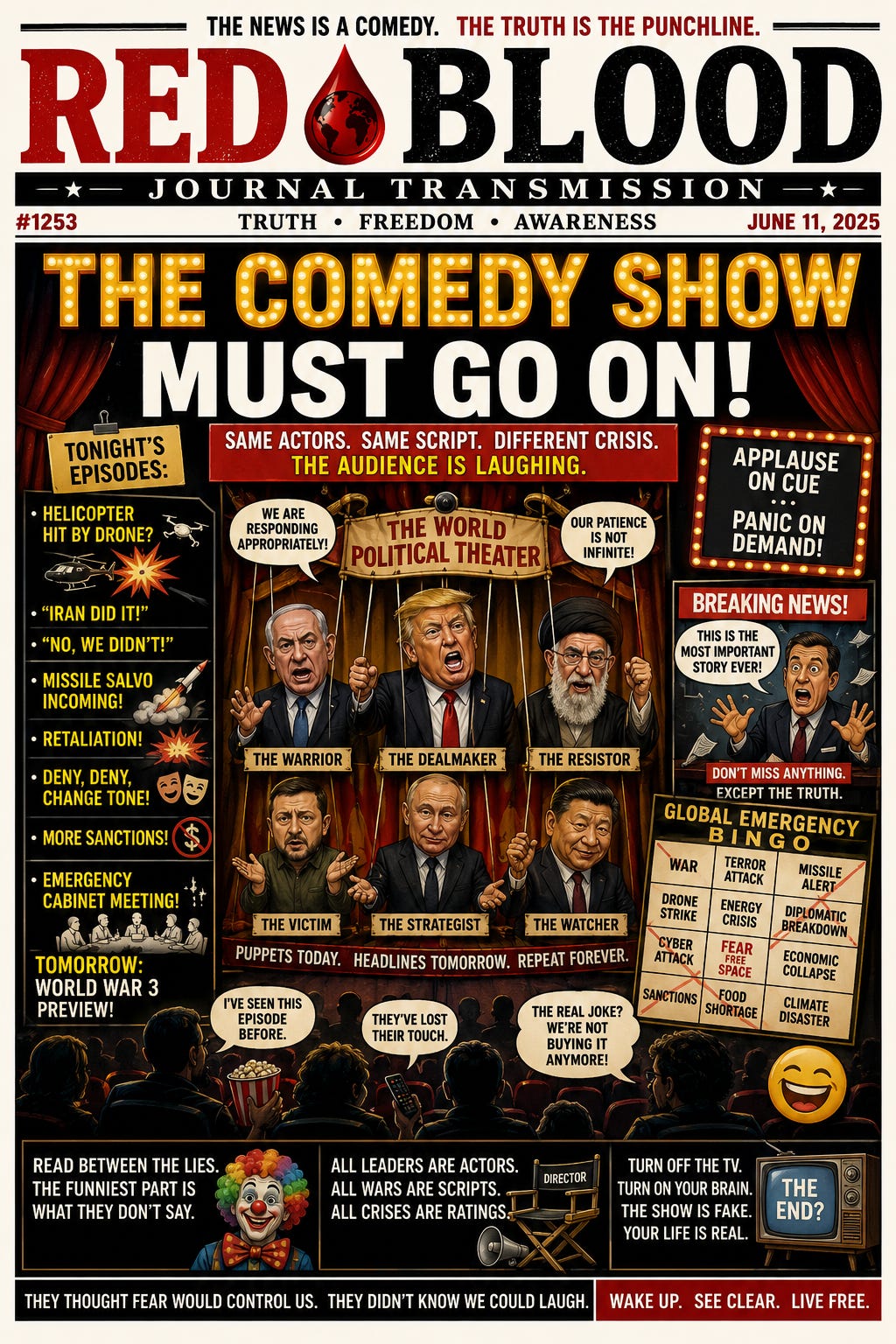
🩸 RED BLOOD JOURNAL TRANSMISSION #1253
THE COMEDY SHOW MUST GO ON
The Day the Audience Stopped Believing the Actors
Introduction
The stage is set.
The lights are on.
The actors have taken their positions.
The script has been approved.
The media orchestra is prepared.
The experts are waiting backstage.
The emergency graphics are loaded.
The breaking news banners are ready.
And yet something has gone terribly wrong.
The audience is no longer reacting the way it used to.
The actors continue performing.
The audience continues watching.
But fewer and fewer people appear to believe they are watching reality.
Instead, they are beginning to see a show.
Same Actors, Different Costumes
Every few years the costumes change.
One season it is a war.
The next season it is a virus.
The season after that it is inflation.
Then elections.
Then sanctions.
Then shortages.
Then another war.
Then another emergency.
Then another reason to be afraid.
The audience notices something unusual.
The actors age.
The scenery changes.
The slogans change.
But the script remains remarkably familiar.
The same dramatic music.
The same urgent warnings.
The same promises.
The same fear.
The same demand for immediate attention.
The audience begins asking a dangerous question:
“Haven’t I seen this episode before?”
The Escalation Problem
When a show begins losing ratings, producers often increase the drama.
Bigger explosions.
Louder arguments.
More emotional scenes.
More shocking headlines.
More fear.
More urgency.
The assumption is simple.
If the audience is no longer paying attention, the spectacle must not be large enough.
But there is a flaw in this logic.
What happens when the audience becomes familiar with the formula itself?
What happens when the audience recognizes the script before the actors finish speaking?
What happens when fear becomes predictable?
The answer is simple.
The show becomes a comedy.
The Tragedy Behind the Performance
The comedy, however, contains a tragedy.
Real people suffer.
Real families lose loved ones.
Real soldiers die.
Real civilians die.
Real communities are destroyed.
Real lives are affected.
This should never be forgotten.
Yet the strange reality of our age is that genuine suffering is increasingly surrounded by manufactured theater.
The tragedy is real.
The performance built around the tragedy is what many people question.
This creates a crisis for those attempting to shape public perception.
The greater the spectacle becomes, the more people begin separating the suffering itself from the story being told about it.
The Exhaustion of Fear
Fear has always been one of the most powerful tools available to any institution.
Fear captures attention.
Fear suspends critical thinking.
Fear creates urgency.
Fear demands obedience.
But fear, like any tool, loses effectiveness when overused.
A person frightened every day eventually becomes difficult to frighten.
A person warned of catastrophe every week eventually questions the warning.
A person promised the end of the world every month eventually stops listening.
The producers respond by increasing the volume.
The audience responds by lowering the volume.
The Real Competition
The greatest threat to the show is not another network.
It is not another politician.
It is not another ideology.
It is not another country.
It is not another religion.
The greatest threat is a person sitting quietly and asking questions.
Who am I?
What do I believe?
Why am I afraid?
Who benefits from my fear?
Why am I constantly being directed outward?
Why am I rarely encouraged to look inward?
These questions were never supposed to become popular.
Yet they continue spreading.
The Awakening Audience
Perhaps the biggest surprise is that people are increasingly creating their own news.
Not newspapers.
Not television channels.
Not media corporations.
Their own observations.
Their own discussions.
Their own investigations.
Their own conclusions.
The center of attention is slowly moving away from institutions and toward individuals.
This may be the most important development of all.
Because once people begin trusting their own ability to think, every institution must work harder to earn trust.
Trust can no longer be demanded.
It must be earned.
The Downfall of the Rerun
Every show eventually faces the same danger.
Repetition.
The audience can tolerate almost anything except boredom.
The problem facing the great theaters of fear is not that they lack resources.
It is not that they lack actors.
It is not that they lack headlines.
It is not that they lack crises.
The problem is that the audience has seen too many reruns.
The same story.
The same villains.
The same heroes.
The same warnings.
The same promises.
Again.
And again.
And again.
The greatest danger to any performance is not criticism.
It is predictability.
The Final Joke
The actors still believe they are delivering the performance of a lifetime.
The audience increasingly views it as a remake.
The directors continue shouting instructions.
The audience is reading different books.
The experts continue explaining.
The audience is asking different questions.
The headlines continue screaming.
The audience is quietly turning inward.
That may be the punchline nobody expected.
The show was designed to keep attention focused outward.
Instead, it has inspired many people to begin looking inward.
The harder the performance becomes, the less convincing it appears.
The louder the production becomes, the more people seek silence.
The greater the spectacle becomes, the more valuable independent thought becomes.
And that may be why the comedy continues.
Not because the actors are winning.
But because they no longer understand why the audience stopped laughing with them and started laughing at the script.
Final Thought
The stage remains.
The actors remain.
The crises remain.
The headlines remain.
The fear remains.
But something else remains as well.
The human spirit.
And once enough people begin asking their own questions, writing their own stories, and searching for their own answers, no script can completely control the outcome.
The reruns continue.
The audience changes.
And that is where every great comedy eventually ends.
🌊 Beyond the stage is reality.
Beyond the labels is humanity.
Beyond the fear is understanding.
Beyond the noise is the Ocean of Love and Positivity.
🎭 The Comedy of Manufactured Fear
Jun 10, 2026
The provided text describes a modern landscape where institutional narratives have become a form of manufactured theater designed to keep the public in a state of constant anxiety and obedience.
It argues that while real-world suffering exists, the media and political spectacle surrounding these crises has become so repetitive and predictable that it is losing its psychological impact.
As the producers of fear escalate their rhetoric to maintain control, the audience increasingly recognizes the formulaic nature of the “script” and begins to view the performance as a dark comedy rather than reality.
This overexposure to alarmism eventually leads individuals to stop looking toward external authorities for truth and instead begin trusting their own observations.
Ultimately, the source suggests that independent thought and internal reflection serve as the primary antidotes to a system built on perpetual distraction.
The text concludes that as people reclaim their critical thinking skills, the power of these orchestrated reruns diminishes in favor of a more authentic human experience.


