



🩸Red Blood Journal Transmission
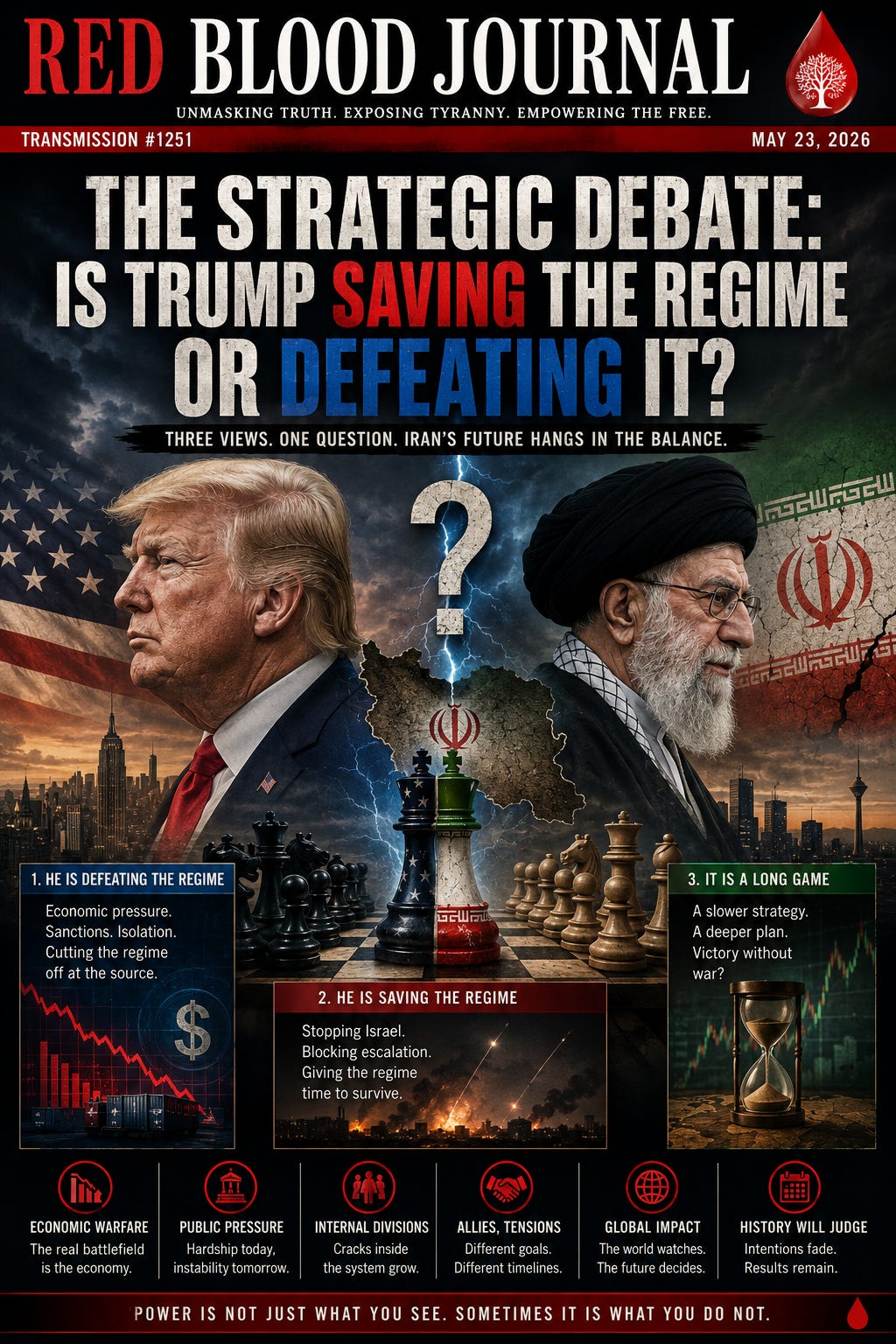
🩸 RED BLOOD JOURNAL TRANSMISSION #1251
THE STRATEGIC DEBATE:
IS TRUMP SAVING THE REGIME OR DEFEATING IT?
Introduction
Among opponents of the Islamic Republic, few questions generate more heated debate today than the role of Donald Trump in relation to Iran.
For some, Trump represents the greatest threat the regime has faced in decades.
For others, he represents the man who repeatedly prevented opportunities that could have fundamentally changed the course of Iranian history.
Between these two positions exists a third interpretation—one that argues the visible events are distracting observers from a larger strategy unfolding beneath the surface.
The debate is no longer simply about Trump.
It is about understanding power, strategy, perception, and the difference between what leaders say publicly and what they may be attempting privately.
The answer depends largely on which battlefield one believes matters most.
The military battlefield.
The diplomatic battlefield.
Or the economic battlefield.
The Case Against Trump
Critics point to a pattern.
Whenever tensions between Israel and the Islamic Republic appear close to escalating into a larger confrontation, reports emerge suggesting Trump favors restraint.
According to this view, Israel has repeatedly prepared significant military responses only to encounter pressure from Washington to reduce escalation.
For these critics, the conclusion is simple.
If a regime survives, then anyone preventing its destruction is helping preserve it.
They argue that history will remember opportunities lost rather than intentions expressed.
To them, every delay becomes another extension of the regime’s lifespan.
Every negotiation becomes another source of breathing room.
Every ceasefire becomes another chance for survival.
These critics often ask a straightforward question:
If the goal is truly regime change, why repeatedly prevent maximum pressure at moments of vulnerability?
It is a question that continues to fuel frustration among many opponents of the government.
The Case for Trump
Supporters of Trump’s approach see the situation very differently.
They argue that military action alone rarely produces lasting political transformation.
History provides many examples where governments survived bombing campaigns, military strikes, and even invasions.
What ultimately weakened those systems was economic exhaustion.
From this perspective, a missile may destroy a building.
An economic crisis can undermine an entire structure.
Supporters argue that sanctions, financial isolation, restrictions on trade, and pressure on government revenues gradually reduce the resources available to sustain the system.
Rather than seeking a dramatic military victory, they believe Trump prefers a slower strategy designed to weaken the foundations beneath the regime.
In this interpretation, the objective is not immediate destruction.
The objective is long-term exhaustion.
The Economic Battlefield
Military conflicts capture headlines.
Economic conflicts reshape realities.
A nation can endure explosions.
It is far more difficult to endure persistent inflation, currency collapse, declining purchasing power, shrinking opportunities, and growing public frustration.
The theory advanced by many analysts is that economic pressure eventually creates political pressure.
Political pressure creates internal divisions.
Internal divisions create instability.
Instability creates change.
Under this interpretation, every month of economic strain may accomplish more than a day of military escalation.
The battlefield becomes invisible.
No tanks cross borders.
No cities are occupied.
Yet the pressure continues.
Slowly.
Relentlessly.
Every day.
The Perception Problem
Politics is often as much about perception as reality.
A leader may appear weak while executing a long-term strategy.
A leader may appear strong while reacting to events rather than shaping them.
This uncertainty is what makes the current debate so intense.
Those who oppose Trump’s approach see hesitation.
Those who support it see patience.
Those who distrust all political actors see theater.
Each side interprets the same events through a different lens.
The result is three completely different conclusions emerging from the same set of facts.
The Israeli Factor
Israel occupies a unique position in this debate.
Many observers believe Israeli leadership sees Iran primarily through a security lens.
The threat is immediate.
The response should therefore be immediate.
Others argue that American leadership often views conflicts through broader strategic calculations involving energy markets, global alliances, domestic politics, and long-term geopolitical objectives.
This difference in perspective can create tension even among allies pursuing similar goals.
The disagreement may not always be about the destination.
Sometimes it is about the route chosen to reach it.
What History Suggests
History rarely rewards simple explanations.
Political transformations often appear obvious only after they occur.
Before they happen, they are surrounded by uncertainty.
Analysts disagree.
Experts argue.
Predictions fail.
Narratives change.
The same leader praised one year may be condemned the next.
The same strategy dismissed as failure may later be described as brilliant.
The opposite can also be true.
That is why certainty should be approached cautiously.
History has a habit of surprising everyone.
The Unanswered Question
The central question remains unresolved.
Is Trump preserving the Islamic Republic by limiting escalation?
Or is he pursuing a longer strategy aimed at weakening it through economic pressure and strategic isolation?
At this moment, both interpretations continue to find supporters.
Both continue to find critics.
And both continue to draw evidence from the same events.
Perhaps the answer will not be found in speeches, press conferences, or social media posts.
Perhaps it will only become clear years from now when historians look back and ask a simple question:
What was the result?
Because in the end, strategy is judged not by intentions.
It is judged by outcomes.
Closing Reflection
The debate surrounding Trump and Iran reveals a larger truth about politics itself.
People often focus on visible events while the most important forces operate quietly beneath the surface.
Sometimes the loudest battles are distractions.
Sometimes the silent pressures are the ones changing history.
Whether Trump is saving the regime, defeating the regime, or pursuing an entirely different objective remains unknown.
What is known is that millions continue to watch, analyze, argue, and wait.
And history continues moving forward regardless of which interpretation proves correct.
The future will eventually reveal what the present can only speculate about.
Until then, the debate remains open.
🩸
Red Blood Journal
⚖️ The Trump Strategy:
Iranian Preservation or Systematic Erosion
Jun 9, 2026
This text explores the contentious debate regarding Donald Trump’s true impact on the Iranian government’s survival.
While critics argue his calls for military restraint have repeatedly saved the regime from collapse, supporters contend that his focus on economic exhaustion is a more effective long-term strategy than open warfare.
The source highlights a fundamental disagreement over whether strategic patience or immediate confrontation is the best path toward political change.
Ultimately, the analysis suggests that while military strikes are highly visible, the invisible pressure of financial isolation may be the force that truly reshapes the nation’s future.
Because outcomes are more significant than public rhetoric, the source concludes that only historical hindsight will determine if these policies served to preserve or erode the current power structure.


