


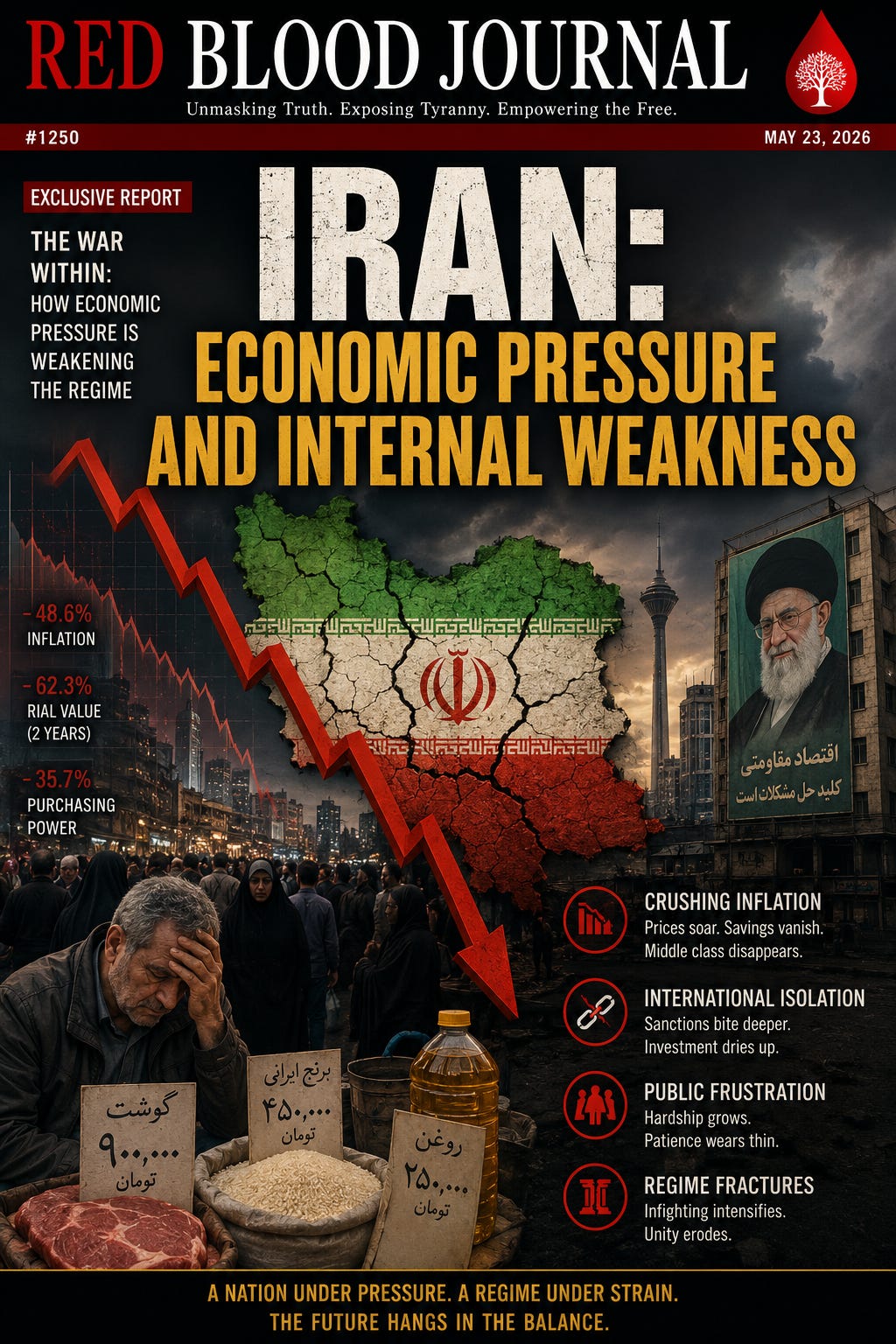
🩸 IRAN: ECONOMIC PRESSURE AND INTERNAL WEAKNESS
Introduction
Throughout history, governments have fallen for many reasons.
Some were defeated by foreign armies.
Some collapsed under the weight of corruption.
Others survived military defeat only to be brought down by economic exhaustion.
The lesson repeated across centuries is simple:
A nation can endure bombs, missiles, and even war for surprisingly long periods of time.
What becomes far more difficult to survive is the gradual erosion of the economic foundation that supports everyday life.
People can tolerate hardship.
They can tolerate sacrifice.
They can tolerate uncertainty.
What becomes increasingly difficult is the feeling that sacrifice has no end and that tomorrow will be worse than today.
Today, the most important battlefield facing Iran may not be found in the skies above the Middle East, the waters of the Persian Gulf, or the diplomatic halls of Washington, Moscow, Beijing, or Brussels.
It may be found inside the wallets, kitchens, businesses, and homes of ordinary Iranians.
The Invisible Battlefield
Military conflicts are easy to see.
Missiles leave trails.
Explosions create headlines.
Television cameras capture dramatic images.
Economic warfare is different.
Its effects are quieter.
A currency loses value.
Prices rise.
Investments disappear.
Businesses close.
Jobs vanish.
Savings evaporate.
Hope slowly fades.
The damage often appears invisible until the accumulated pressure becomes impossible to ignore.
The world has witnessed this pattern repeatedly.
The Soviet Union possessed thousands of nuclear weapons before it collapsed.
Its military remained powerful until the very end.
What weakened was the economic structure underneath.
The same lesson can be found in countless nations throughout history.
Political systems often appear strongest immediately before their economic foundations begin to crack.
Inflation: The Silent Tax
Among all economic problems, inflation is perhaps the most destructive.
Unlike ordinary taxes, inflation reaches everyone.
The wealthy may feel discomfort.
The middle class feels anxiety.
The poor feel pain.
Every increase in food prices, housing costs, transportation expenses, or utility bills represents a reduction in purchasing power.
Citizens may receive the same salary as before.
On paper they appear unchanged.
In reality they become poorer.
The greatest danger of inflation is not merely economic.
It is psychological.
People begin planning less for the future and concentrating more on survival in the present.
Long-term thinking becomes difficult.
Trust in institutions begins to weaken.
Confidence slowly erodes.
When enough citizens begin asking whether next month will be harder than this month, the economic problem becomes a political problem.
The Currency Problem
A nation’s currency represents confidence.
When confidence grows, currency strengthens.
When confidence declines, currency weakens.
For years the Iranian rial has experienced severe pressure.
This creates a cycle that becomes increasingly difficult to escape.
A weaker currency makes imports more expensive.
More expensive imports contribute to inflation.
Inflation reduces purchasing power.
Reduced purchasing power weakens consumer activity.
Reduced economic activity slows growth.
The cycle then repeats.
Ordinary citizens often become experts in economics without ever studying economics.
They learn from experience.
They know how much bread cost last year.
They know how much rent cost last year.
They know how much meat, rice, medicine, and fuel cost last year.
Their daily lives become the most accurate economic indicator.
Sanctions and Isolation
Supporters of sanctions argue that economic pressure limits government resources and reduces the ability of a state to project power abroad.
Critics argue that sanctions often hurt ordinary citizens more than political elites.
Both arguments contain elements of truth.
Economic restrictions reduce access to international markets, investment, banking systems, and technology.
At the same time, citizens often experience the immediate consequences through higher prices and reduced opportunities.
The result is a situation where economic pressure becomes a contest of endurance.
The question becomes:
Who can withstand the pressure longer?
The government?
Or the population?
History offers different answers in different countries.
There is no universal formula.
Internal Fractures
Economic stress rarely remains confined to economics.
Eventually it reaches politics.
Different factions begin blaming one another.
Officials criticize other officials.
Government institutions exchange accusations.
Policy disagreements become public.
What once appeared united begins showing signs of division.
This process does not necessarily mean collapse is imminent.
It does mean that economic pressure is beginning to influence political behavior.
As resources become scarcer, competition over those resources becomes more intense.
The debate shifts from managing prosperity to managing scarcity.
That transition is often one of the most dangerous periods for any government.
Public Frustration
Ordinary citizens often care less about ideology than about daily life.
Political slogans cannot fill a refrigerator.
Television speeches cannot lower prices.
Promises do not pay rent.
At some point, citizens begin evaluating systems based upon practical outcomes.
Can they afford housing?
Can they afford food?
Can they save money?
Can they provide opportunities for their children?
Can they see a better future?
These questions eventually become more important than political arguments.
When large numbers of people begin asking these questions simultaneously, governments enter a period of heightened vulnerability.
The Strategic Debate
Observers remain divided on what happens next.
One school believes economic pressure will eventually force major political concessions.
Another believes the government will adapt and survive as it has many times before.
A third argues that outside pressure alone will never determine Iran’s future and that any major change will ultimately depend upon the Iranian people themselves.
Each position has historical evidence supporting it.
Each contains uncertainty.
What is clear is that economic conditions increasingly occupy the center of the discussion.
Military developments may dominate headlines.
Economic realities shape daily life.
The Long View
The future of Iran may not be decided by a single battle, election, negotiation, or diplomatic agreement.
It may instead be determined by a much slower process.
A process measured not in days but in years.
A process involving confidence, opportunity, productivity, investment, and public trust.
The strength of any nation ultimately depends upon the strength of the foundation beneath it.
Military power can defend a nation.
Economic vitality sustains it.
When both exist together, stability follows.
When the economic foundation weakens, even the strongest structures above it begin to feel the strain.
Whether Iran’s current challenges represent a temporary period of hardship or the beginning of a deeper transformation remains one of the most important unanswered questions in the Middle East today.
Only time will provide the answer.
Closing Reflection
History repeatedly demonstrates that nations are rarely changed by a single event.
They are changed by countless small pressures accumulating over time.
Economic pressure is one of those forces.
Often invisible.
Often underestimated.
Yet capable of reshaping governments, societies, and entire eras.
The future belongs not to those who ignore reality, but to those willing to understand it.
And understanding begins by looking beyond the headlines and seeing the forces quietly shaping tomorrow beneath the surface of today. 🩸
📉 The Invisible Battlefield:
Iran’s Economic Erosion
·Jun 9, 2026
This text analyzes how protracted economic decay acts as a silent but lethal threat to a nation’s stability, specifically focusing on the current situation in Iran.
It argues that while military strength is highly visible, the erosion of the currency and persistent inflation create a psychological toll that eventually undermines public trust and government authority.
By comparing modern challenges to historical collapses like the Soviet Union, the source highlights that economic exhaustion often proves more dangerous to a regime than foreign warfare.
The author emphasizes that sanctions and isolation force a contest of endurance between the state and its citizens, who prioritize practical survival over political ideology.
Ultimately, the piece suggests that Iran’s future will be defined by its ability to maintain its foundational economic health rather than its military reach.
This “invisible battlefield” represents a critical turning point where accumulated financial pressure may necessitate profound political transformation.


