


🩸 RED BLOOD JOURNAL TRANSMISSION #1249
🩸 THE SCHOOL OF LIFE
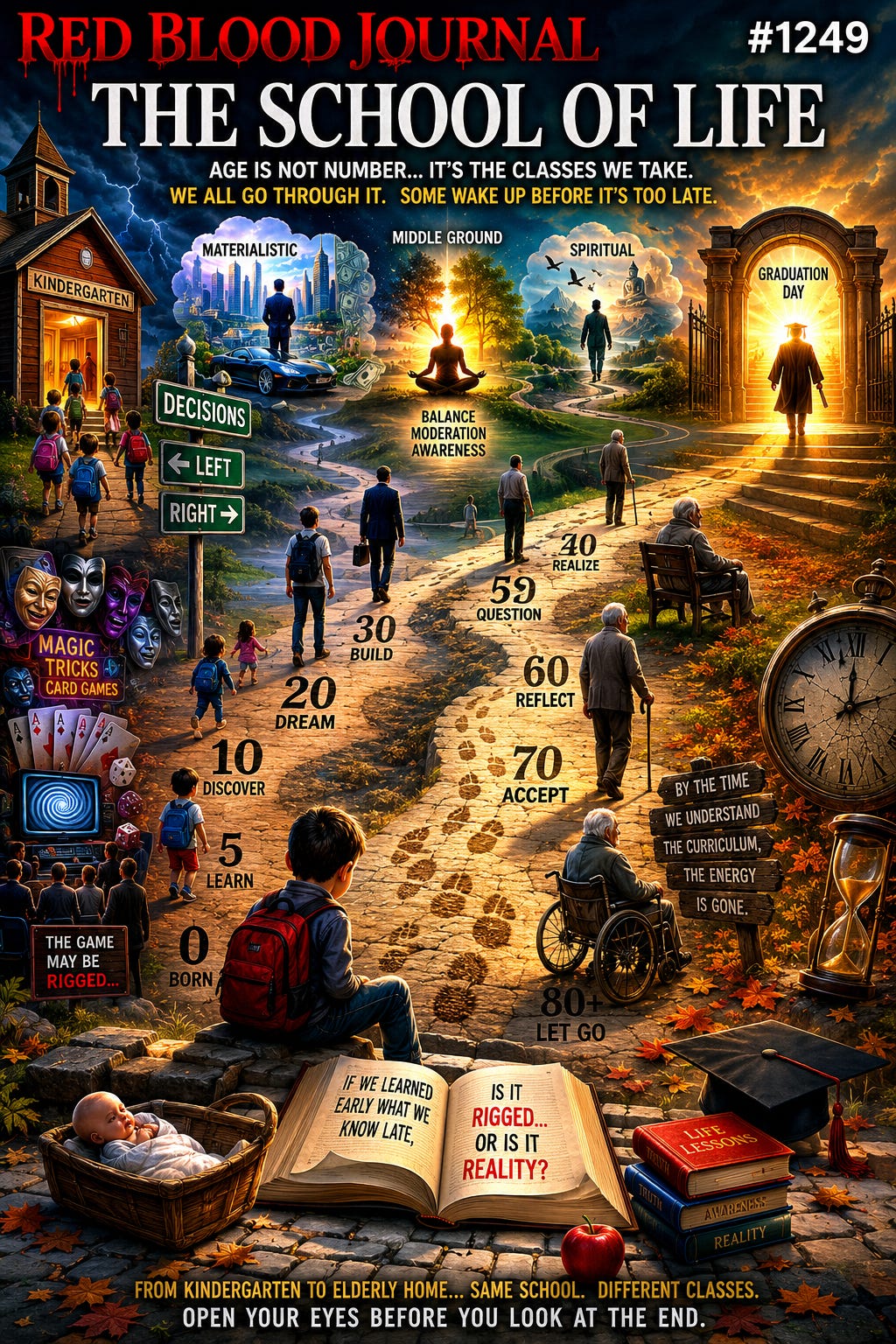
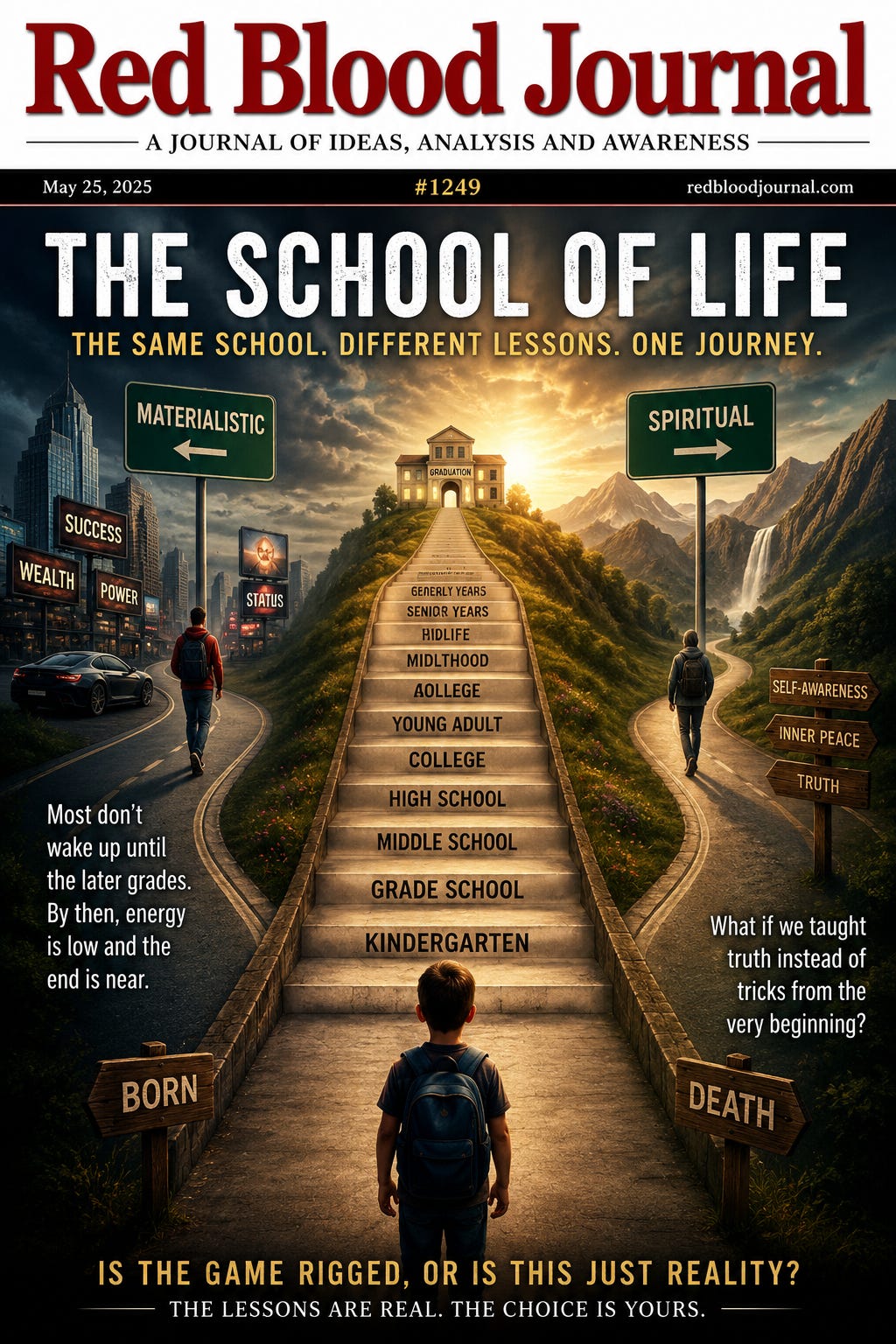
From the moment a child enters kindergarten until the day an elderly person takes their final breath, humanity moves through what may be called the School of Life.
Society labels the stages with numbers and calls them age. Five years old. Twenty years old. Fifty years old. Eighty years old.
But perhaps those numbers are not ages at all.
Perhaps they are simply grade levels in a school that every human being attends.
Some students begin asking questions very early. They observe the world around them and wonder why people behave as they do. They choose their paths sooner than most. Some move toward material achievement. Some move toward spirituality and self-discovery. Others attempt to walk a middle path between the two.
Most, however, follow the curriculum that society presents to them.
The lessons are often centered on competition, status, wealth, fear, and external validation. Individuals spend decades pursuing goals that they have been taught are important, rarely stopping long enough to ask whether those goals truly belong to them.
As the years pass, the student advances through the grades.
With each new level comes additional experience, additional mistakes, additional victories, and additional disappointments.
Then something interesting begins to happen.
The higher grades of the School of Life often bring clarity.
The student who once believed every promise begins to question. The person who spent decades chasing success begins to examine the meaning of success itself. The individual who feared being different begins to realize that conformity may have been the greater prison.
For many people, the eyes begin to open only in the later grades.
The reality of the school becomes easier to see.
Yet there is a paradox.
By the time many students recognize the nature of the game, their energy has diminished. Their bodies have aged. Their patience has been tested. Their desire to fight old battles has faded.
Their attention shifts toward graduation day.
The question then becomes:
What if the lessons learned in the final grades were taught in the first grades?
What if children were taught how to understand themselves before they were taught how to compete with others?
What if they learned the difference between temporary satisfaction and lasting fulfillment?
What if they learned how fear influences decisions, how institutions influence beliefs, and how self-awareness influences every aspect of life?
Some would argue that such knowledge would reveal that the game is rigged.
Others would argue that it would simply reveal reality.
Perhaps the deeper question is not whether the game is rigged.
Perhaps the question is whether the purpose of the School of Life was ever to win the game at all.
Maybe the purpose was to understand it.
Maybe the purpose was to discover who we are while moving through it.
And maybe graduation is not the end of the journey, but the completion of a curriculum that every soul must eventually experience.
The School of Life treats every student differently, yet teaches the same ultimate lesson:
The greatest knowledge is not what is learned about the world.
It is what is learned about oneself.
As each student reaches graduation day, titles, possessions, victories, and defeats begin to lose their importance.
What remains are the lessons.
What remains is understanding.
What remains is the awareness gained from attending the School of Life.
And perhaps that awareness is the true diploma.
The one that cannot be bought, inherited, or taken away.
Only earned.
🎓 The Curriculum of Being: Earning the Soul’s Diploma
Jun 8, 2026
This text characterizes human existence as a structured educational journey where chronological age represents advancing grade levels.
While most people spend their lives pursuing societal benchmarks like wealth and status, the narrative suggests that these objectives often distract from true self-discovery.
True wisdom and clarity typically emerge in the later stages of life, leading individuals to question the conformity of their earlier years.
The author proposes that the ultimate objective of living is not to win at a competitive game, but to achieve profound self-awareness.
Ultimately, the soul’s diploma is an internal understanding that transcends material success and remains the only permanent achievement one earns before death.


