



🩸 RED BLOOD JOURNAL TRANSMISSION #1248
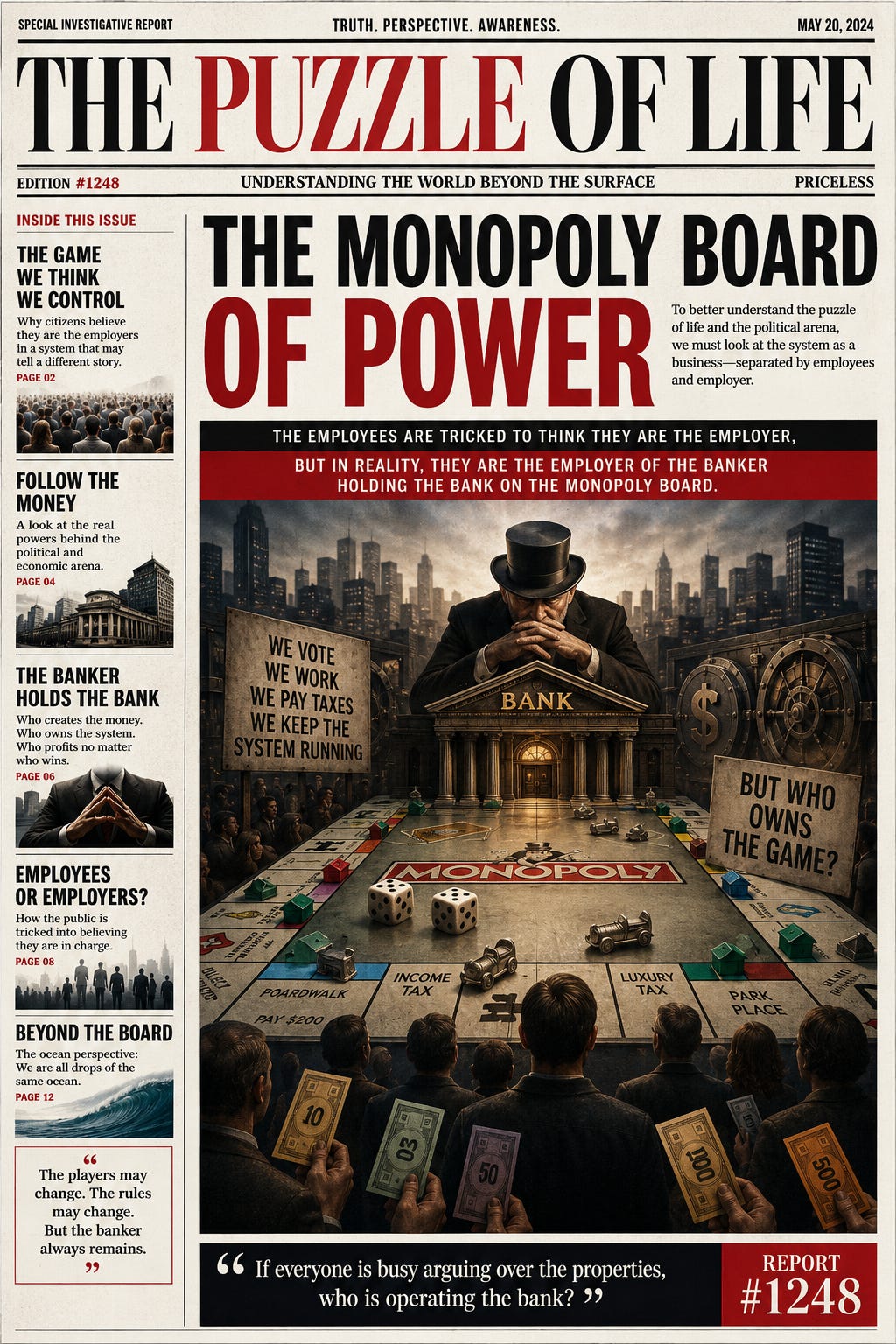
THE MONOPOLY BOARD OF POWER
Introduction
One way to understand both politics and economics is to temporarily set aside party labels, national identities, and ideological divisions and view the entire system through a business lens.
In this framework, the question becomes simple:
Who is the employee, and who is the employer?
The common assumption is that citizens are the employers. In democratic systems, politicians are often described as public servants. Governments are said to work for the people. Corporations survive because customers choose to buy their products. Taxes originate from the labor and productivity of ordinary citizens.
On paper, the public appears to be the employer.
Yet many people increasingly feel that reality does not match the description.
The Illusion of Ownership
A worker spends decades producing value.
A business owner spends decades building a company.
A consumer spends decades supporting industries.
A taxpayer spends decades funding institutions.
Collectively, these groups provide the labor, capital, purchasing power, and tax revenue that keep the system operating.
Without them, the machinery stops.
Yet despite being the source of the system’s energy, many feel they have little influence over its direction.
Policies change without their approval.
Costs increase regardless of elections.
Wars begin and end regardless of public opinion.
Financial crises appear, and the public is asked to absorb the consequences.
This creates a growing perception that those supplying the energy of the system are not necessarily directing the system.
The Monopoly Analogy
Imagine a giant game of Monopoly.
The players believe they are competing against one another.
One player wears a red shirt.
Another wears a blue shirt.
One owns railroads.
Another owns utilities.
One supports one political party.
Another supports a different political party.
The players become focused on defeating one another.
They argue.
They compete.
They celebrate victories.
They fear losses.
But while the players focus on each other, there remains a question:
Who owns the bank?
In Monopoly, the bank is not one of the players.
The bank creates the money.
The bank distributes the money.
The bank collects the money.
The bank remains in operation regardless of which player wins.
The game may change.
The players may change.
But the bank remains.
Employees Who Believe They Are Employers
From this perspective, the public occupies a unique position.
Citizens are told they are in charge because they vote.
Consumers are told they are in charge because they spend.
Workers are told they are in charge because businesses need labor.
Taxpayers are told they are in charge because government depends on revenue.
All of these statements contain truth.
Yet many observers argue that real influence is often far more concentrated than appearances suggest.
Financial institutions, major corporations, lobbying organizations, intelligence networks, political parties, media organizations, and other centers of influence may possess resources and continuity that extend far beyond individual election cycles.
The result is a perception that the public functions simultaneously as both employer and employee:
Employer because the system ultimately depends upon them.
Employee because they often feel unable to meaningfully alter the system’s direction.
Why the Puzzle Matters
Whether one agrees with this interpretation or rejects it entirely, the analogy highlights an important question:
Where does power actually originate?
Is power located in institutions?
Is it located in financial systems?
Is it located in elected governments?
Is it located in public consent?
Or is it distributed among all of these simultaneously?
The answer may differ depending on one’s political, economic, and philosophical viewpoint.
Conclusion
The Monopoly board analogy does not claim to solve the puzzle of politics or life.
It simply offers another lens through which to examine it.
The players often spend their energy competing against one another.
The board changes.
The rules change.
The tokens move.
The winners and losers change.
Yet some observers continue asking the same question:
If everyone is busy arguing over the properties, who is operating the bank?
Perhaps understanding the answer begins not by looking across the board at other players, but by first understanding the structure of the game itself.
The Ocean Perspective
The deeper lesson may not be about the bank, the board, or even the players.
It may be about remembering that every institution, corporation, government, banker, worker, voter, and citizen is ultimately composed of the same human beings seeking meaning, security, and purpose.
The puzzle of life may never be fully solved through competition alone.
The greatest discoveries often begin when people stop looking only at the pieces and begin examining the entire board.
Beyond every system, ideology, and institution remains the possibility that humanity is far more connected than divided.
An ocean is not separate from its drops.
And the drops are never truly separate from the ocean.
🩸 End of Report #1248
👁️ The Monopoly Board of Power
Jun 8, 2026
The provided text explores a cynical perspective on power, suggesting that while citizens believe they are the employers of the state, they often function more like disposable employees.
Using a Monopoly board analogy, the author argues that public attention is frequently diverted toward partisan infighting while the true architects of the system remain insulated from accountability.
This framework posits that financial and political institutions exert a level of control that persists regardless of election outcomes or public sentiment.
By highlighting this illusion of ownership, the text encourages readers to look past surface-level divisions and analyze the underlying structure of the game itself.
Ultimately, it advocates for a shift in perception, moving from competitive conflict toward a recognition of shared human connectivity.


