


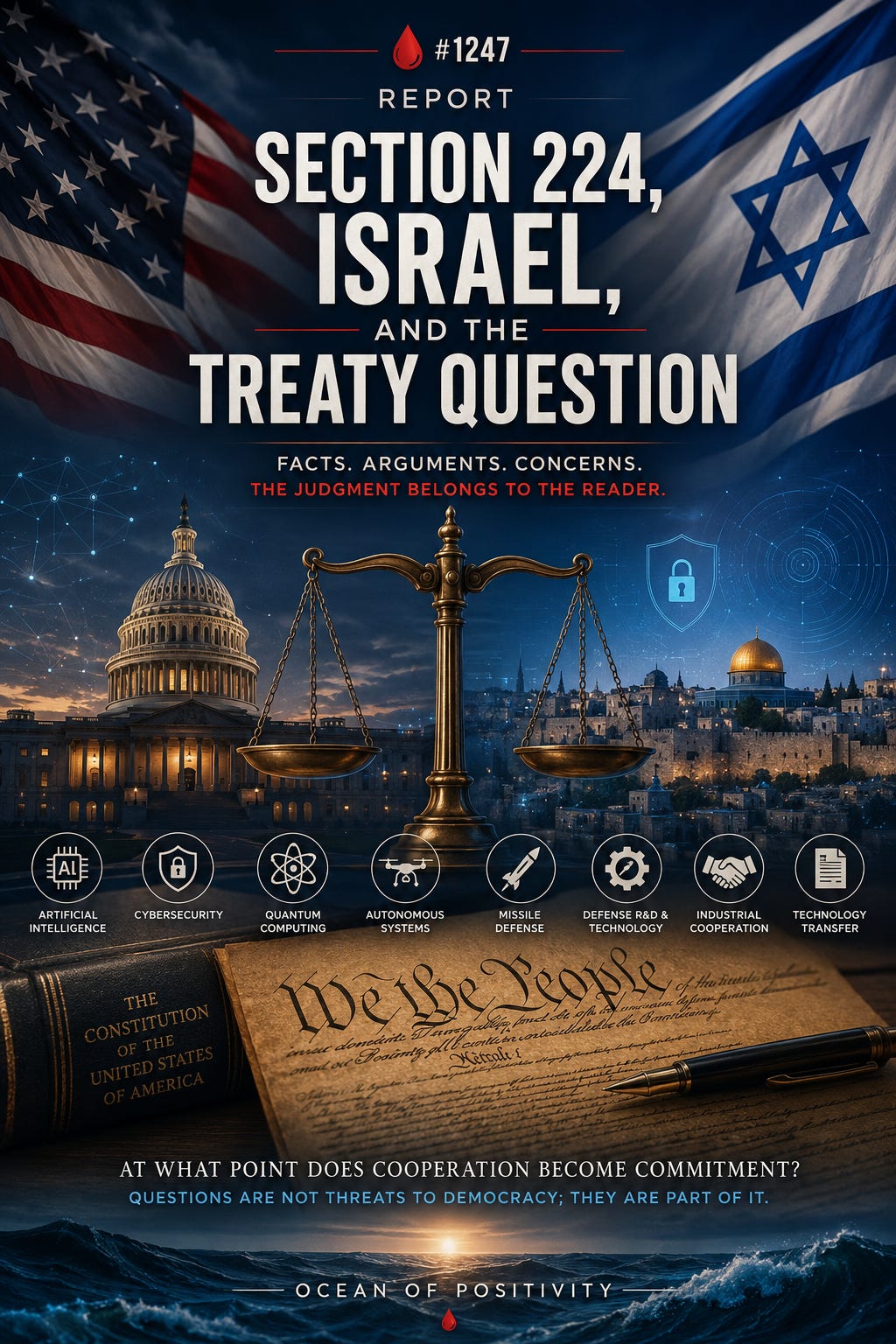
🩸 #1247
SECTION 224, ISRAEL, AND THE TREATY QUESTION
Introduction
A provision known as Section 224, titled the United States–Israel Defense Technology Cooperation Initiative, has generated debate regarding the future direction of American foreign policy, defense integration, and constitutional procedure.
The discussion is not merely about Israel. It is also about how the United States enters long-term relationships with foreign nations and where the line exists between cooperation and treaty obligations.
This report does not attempt to answer that question. It seeks only to present the facts, arguments, and concerns being raised by both sides of the debate.
What Section 224 Does
According to publicly available summaries, Section 224 expands and formalizes cooperation between the United States and Israel in areas including:
Artificial Intelligence
Cybersecurity
Quantum Computing
Autonomous Systems
Missile Defense
Defense Research and Development
Weapons Technology
Defense Industrial Cooperation
Technology Transfer and Licensing
The provision also directs the Department of Defense to designate officials responsible for coordinating these activities and encourages deeper cooperation between American and Israeli defense industries.
Supporters describe the initiative as a continuation of an already existing partnership.
Critics describe it as a significant increase in long-term integration between two national defense ecosystems.
The Constitutional Question
Article II, Section 2 of the United States Constitution states:
The President shall have Power, by and with the Advice and Consent of the Senate, to make Treaties, provided two thirds of the Senators present concur.
The constitutional question is not whether treaties require Senate approval.
They do.
The question is whether a defense cooperation framework of this scale should be considered a treaty or whether it remains ordinary legislation authorized by Congress.
For more than two centuries, the United States has entered international arrangements through several mechanisms:
Formal treaties
Executive agreements
Congressional-executive agreements
Security cooperation agreements
Trade agreements
Defense partnerships
Some required treaty ratification.
Others did not.
The disagreement surrounding Section 224 centers on where this particular initiative belongs.
Arguments Supporting Section 224
Supporters generally present several arguments.
Strengthening Military Readiness
Supporters argue that cooperation allows both countries to share research, technology, and expertise, accelerating development and improving military readiness.
Faster Innovation
Joint development can reduce duplication of effort and allow technologies to reach operational use more quickly.
Shared Security Interests
Supporters argue that both nations face similar threats in areas such as cyber warfare, missile attacks, drone technology, and emerging artificial intelligence systems.
Economic Benefits
Joint research and defense production can create contracts, jobs, manufacturing opportunities, and technological advancements within both countries.
Existing Relationship
Supporters note that U.S.-Israel defense cooperation has existed for decades and view Section 224 as an extension of an already established partnership rather than the creation of a new alliance.
No Explicit Mutual Defense Clause
Supporters point out that Section 224 does not publicly establish an obligation requiring American military intervention if Israel enters a conflict.
Arguments Raised by Critics
Critics generally raise a different set of concerns.
Constitutional Concerns
Some argue that when military and technological integration reaches a certain level, the substance may begin to resemble a treaty regardless of the label used.
Long-Term Foreign Commitments
Critics question whether future generations should become increasingly tied to the strategic decisions of another nation without a broader constitutional process.
Reduced Congressional Scrutiny
Some critics argue that provisions embedded within large legislative packages may receive less public debate than a standalone treaty or agreement.
Escalation Risks
Critics worry that deep integration may increase pressure for American involvement during future regional conflicts.
Technology Dependence
Questions are raised regarding how much integration between defense industries and military technologies is beneficial before dependence begins to emerge.
Precedent
Some critics ask whether similar arrangements with other nations would be viewed in the same manner and whether a precedent is being established for future international relationships.
Historical Context
The Framers included the Treaty Clause in the Constitution to ensure that major international commitments would receive broad political support before binding the nation.
At the same time, modern governments have increasingly relied upon mechanisms outside the formal treaty process to conduct diplomacy, trade, intelligence cooperation, and military partnerships.
As a result, the distinction between a treaty and other forms of international agreements has remained the subject of legal and political debate for generations.
Section 224 has become one of the latest examples of that ongoing discussion.
The Central Question
At what point does cooperation become commitment?
At what point does partnership become integration?
At what point does integration become something that should be considered a treaty?
Reasonable people can reach different conclusions.
The constitutional text is public.
The legislation is public.
The arguments are public.
The facts are available for examination.
The judgment belongs to the reader.
Ocean of Positivity
Regardless of political views, constitutional interpretations, or foreign policy preferences, informed citizens strengthen any society. Questions are not threats to democracy; they are part of it. Understanding competing arguments, examining facts, and reaching independent conclusions remain among the most valuable responsibilities of a free people.
The ocean grows stronger when knowledge is shared, questions are welcomed, and understanding rises above division.
🩸
📜 Section 224:
Defense Integration and the Treaty Power
Jun 8, 2026
The report examines Section 224, a legislative provision designed to deepen defense technology integration between the United States and Israel across sectors like artificial intelligence and missile defense.
While supporters view the initiative as a way to enhance military readiness and foster innovation, critics worry it bypasses the constitutional treaty process required for major international commitments.
This tension highlights a broader debate over whether such extensive security cooperation effectively functions as a treaty without receiving formal Senate approval.
The text explores the potential economic and strategic benefits of the partnership alongside concerns regarding long-term foreign obligations and diminished legislative oversight.
Ultimately, the document presents Section 224 as a case study in the evolving legal boundary between ordinary defense legislation and binding international alliances.
Underpinning the analysis is a call for informed civic engagement and independent evaluation of how the nation formalizes its global partnerships.


