



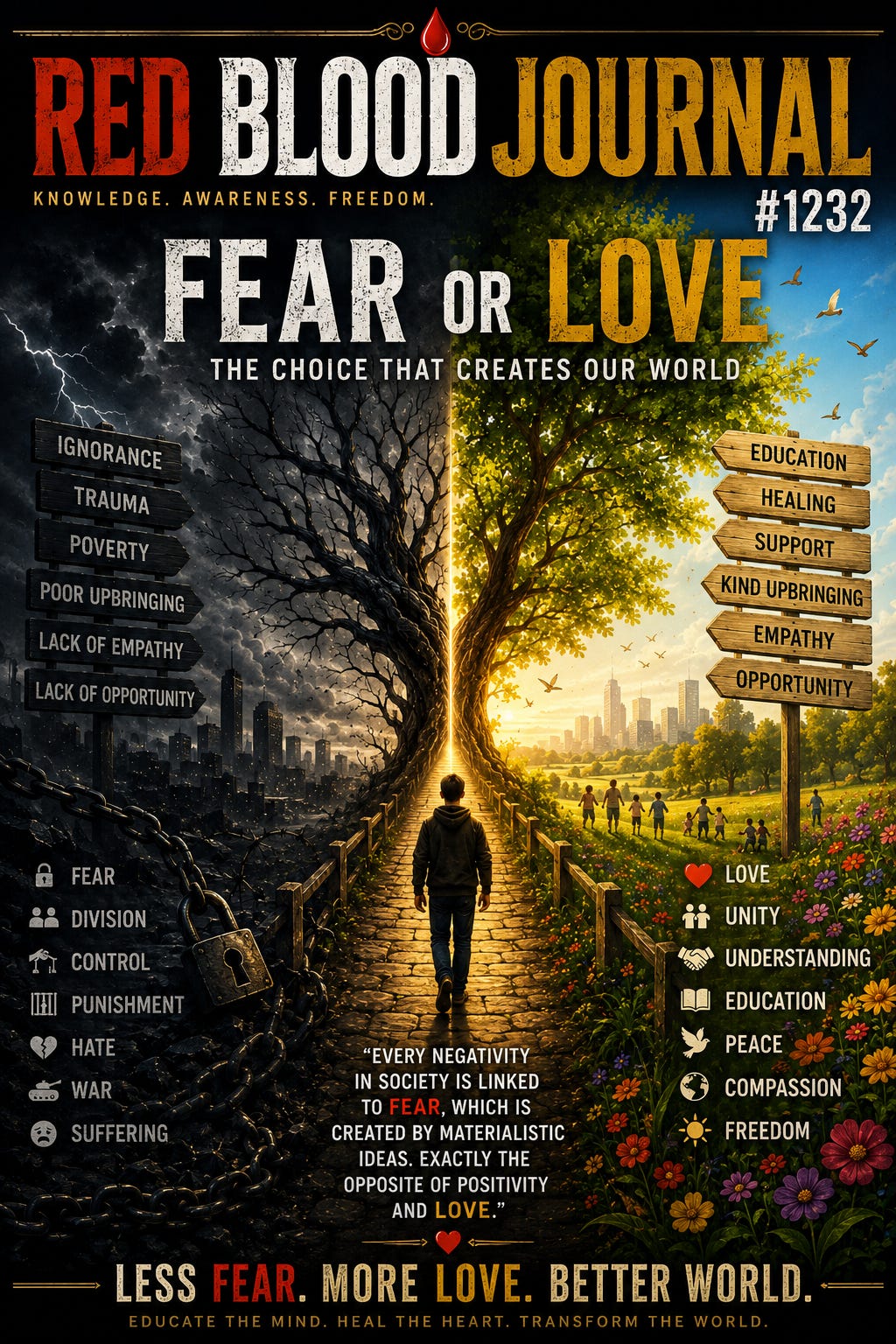
🩸 RED BLOOD JOURNAL #1232
FEAR: THE ROOT OF NEGATIVITY?
Introduction
Human societies have created countless laws, regulations, restrictions, punishments, and systems of control. Every generation inherits a vast network of rules intended to guide behavior, maintain order, and protect communities. Yet a deeper question remains:
What is the true source of the negativity these systems attempt to manage?
Many philosophies, religions, and spiritual traditions have pointed toward a common answer: fear.
Fear and the Material World
Fear often emerges from attachment.
Fear of losing wealth.
Fear of losing status.
Fear of losing power.
Fear of losing security.
Fear of losing identity.
When a person’s sense of self becomes deeply connected to material possessions, social position, or external approval, life can become a constant effort to defend what has been accumulated.
The result is competition, division, and anxiety.
Entire institutions can become organized around the management of fear.
The Architecture of Fear
Fear creates the need for protection.
Protection creates control.
Control creates rules.
Rules create enforcement.
Enforcement creates punishment.
Punishment creates resentment.
Resentment creates further division.
The cycle continues generation after generation.
As fear expands, societies often devote increasing resources to managing the symptoms rather than addressing the source.
An Alternative Question
Rather than asking:
“How should society punish harmful behavior?”
A different question emerges:
“What conditions produce harmful behavior in the first place?”
Ignorance.
Trauma.
Poverty.
Isolation.
Lack of empathy.
Lack of opportunity.
When these conditions are present, negativity often follows.
If these conditions were dramatically reduced, would crime and conflict decline as well?
No civilization has fully committed itself to testing this possibility on a large scale.
The question remains open.
Fear Versus Love
Fear divides.
Love connects.
Fear sees strangers.
Love sees fellow travelers.
Fear creates scarcity.
Love creates abundance.
Fear seeks control.
Love seeks understanding.
This does not mean that every challenge disappears. Human beings will always face choices, disagreements, and uncertainty. Yet the lens through which those challenges are viewed may determine the outcome.
A society organized primarily around fear will produce different results than one organized primarily around compassion, education, and understanding.
The Unanswered Experiment
Humanity has explored countless forms of government, economic systems, religions, and ideologies.
But one experiment remains largely incomplete:
What would happen if society invested as much effort into eliminating ignorance, trauma, hopelessness, and division as it invests into punishment and control?
Would crime fall dramatically?
Would conflict diminish?
Would people discover new ways of living together?
No one can say with certainty.
The experiment has never been fully performed.
Conclusion
Whether viewed spiritually, philosophically, or psychologically, fear remains one of the most powerful forces shaping human behavior.
The opposite of fear is not courage alone.
The opposite of fear may be understanding.
It may be empathy.
It may be unity.
And perhaps, at its highest expression, it is love itself.
Beyond the noise, beyond the labels, beyond the divisions, there remains the possibility that humanity is not separate drops competing against one another, but participants in a much larger ocean.
An ocean of positivity, understanding, and love.
❤️ The Architecture of Fear and the Anatomy of Love
Jun 6, 2026
The provided text explores how fear serves as the primary catalyst for societal negativity and the rigid systems of control used to manage it.
It argues that modern institutions are often built upon an “architecture of fear” that prioritizes punishment and enforcement over addressing the root causes of conflict, such as trauma and poverty.
By contrast, the author suggests that love and understanding offer a path toward unity, viewing these qualities as the only true alternatives to a cycle of resentment.
The writing proposes a theoretical social experiment where resources are shifted away from control and toward empathy and education.
Ultimately, the source posits that human behavior is shaped by the choice between division and connection, advocating for a society grounded in compassion rather than restriction.
Through this lens, the text frames humanity as a collective entity rather than a group of isolated individuals competing for survival.


