


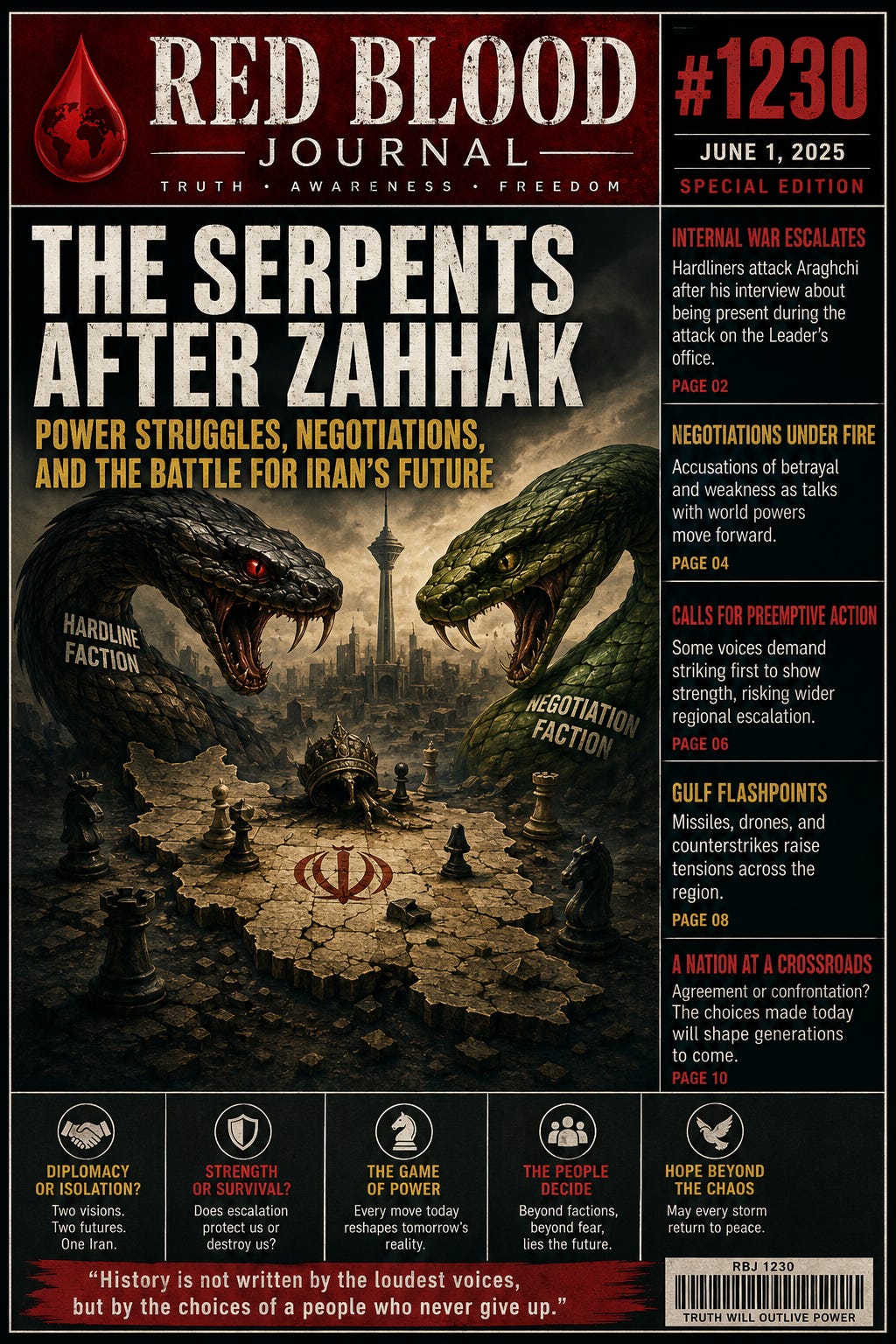
🩸 RED BLOOD JOURNAL TRANSMISSION #1230
THE SERPENTS AFTER ZAHHAK
Power Struggles, Negotiations, and the Battle for Iran’s Future
Executive Summary
As military tensions appear to cool, a different conflict is emerging within the political establishment itself. The public battlefield may be quieter, but an internal struggle over power, succession, negotiation, and the future direction of the nation appears to be intensifying.
Competing factions increasingly accuse one another of betrayal, weakness, recklessness, or ideological deviation. The result is a political environment where every statement, every negotiation, and every policy move becomes part of a larger struggle for influence.
The New Front: Internal Conflict
While external military confrontation dominates headlines, a growing number of observers believe the most significant battle is now occurring inside the governing structure itself.
The conflict is increasingly framed as a contest between:
Advocates of negotiation and de-escalation.
Supporters of continued confrontation and resistance.
Competing visions of national survival.
Rival groups seeking influence over the next political era.
What was once a united front against external pressure now appears increasingly fragmented by internal disagreements.
The Symbolism of Zahhak
From a mythological perspective, some commentators compare the current moment to the ancient Persian story of Zahhak.
In this interpretation:
Zahhak symbolizes centralized authority.
The serpents represent factions that once depended upon that authority.
With the weakening or removal of the central figure, the serpents begin fighting one another.
Whether one accepts this symbolism or not, it reflects a growing perception that old alliances are weakening and that competing groups are now focused on securing their own positions.
Negotiation Versus Confrontation
A central divide concerns negotiations.
One faction argues:
Economic recovery requires diplomatic engagement.
Isolation weakens national resilience.
Stability creates opportunities for reconstruction and growth.
The opposing faction argues:
Negotiation rewards foreign pressure.
Concessions invite additional demands.
Deterrence requires strength rather than compromise.
As discussions of potential agreements increase, criticism between these camps has become increasingly public and intense.
The Politics of Fear
A recurring theme throughout the debate is fear of what comes next.
Different groups express different concerns:
The Negotiation Camp Fears:
Endless conflict.
Economic decline.
International isolation.
Long-term instability.
The Hardline Camp Fears:
Loss of influence.
Political accountability.
Ideological dilution.
A future in which they no longer control events.
These fears help explain the increasingly emotional rhetoric appearing across political and media platforms.
The Infrastructure Question
Among the most controversial discussions are proposals advocating stronger military responses and even preemptive action.
Critics warn that attacks on regional infrastructure could trigger retaliatory actions against Iran’s own infrastructure.
The underlying question becomes:
Would escalation strengthen national security, or would it accelerate destruction?
This debate remains one of the most significant strategic disagreements facing policymakers.
A Nation in Suspension
Perhaps the most striking aspect of the current moment is uncertainty.
Questions remain unresolved:
Will negotiations succeed?
Will confrontation return?
Which faction will gain influence?
What political system emerges after the current transition?
Many citizens find themselves watching events unfold without clear answers.
The future appears neither fully determined nor entirely predictable.
Entering a Transitional Era
If a meaningful agreement emerges, historians may eventually view this period as the beginning of a broader transition.
Transitions are often confusing while they are occurring.
Old structures weaken.
New structures have not yet fully formed.
Competing visions struggle for legitimacy.
The outcome remains uncertain until history has already moved forward.
Final Observation
The loudest voices often speak as if the future has already been decided.
History suggests otherwise.
Nations are rarely shaped by a single faction, a single leader, or a single event. They are shaped by millions of decisions made over time by ordinary people navigating extraordinary circumstances.
Whether the future brings confrontation, compromise, reform, or transformation, the ultimate direction will depend not only on political actors but also on the choices, patience, and resilience of the people themselves.
And beyond every struggle for power, beyond every faction, beyond every negotiation and conflict, remains the possibility that humanity can choose understanding over division, wisdom over anger, and cooperation over destruction.
May every storm eventually return to calm waters.
May every conflict eventually give way to understanding.
And may all rivers ultimately find their way back to the Ocean of Positivity, Peace, and Love.
🩸 Red Blood Journal #1230
THE SERPENTS AFTER ZAHHAK
End of Transmission
🐍The Serpents After Zahhak:
Iran’s Internal Power Struggle
Jun 6, 2026
The provided text analyzes a critical internal power struggle currently fracturing Iran’s political establishment as external military tensions subside.
Utilizing the mythological imagery of Zahhak, the source describes how competing factions—once united under a central authority—are now clashing over the nation’s future strategic direction.
A primary divide exists between diplomatic advocates seeking economic stability and hardline supporters who view any concession as a threat to national strength.
These groups are driven by opposing fears, ranging from total economic collapse to the loss of ideological control and political influence. Ultimately, the report suggests that Iran is entering a volatile transitional era where the final outcome remains unpredictable and dependent on the collective choices of its people.


