


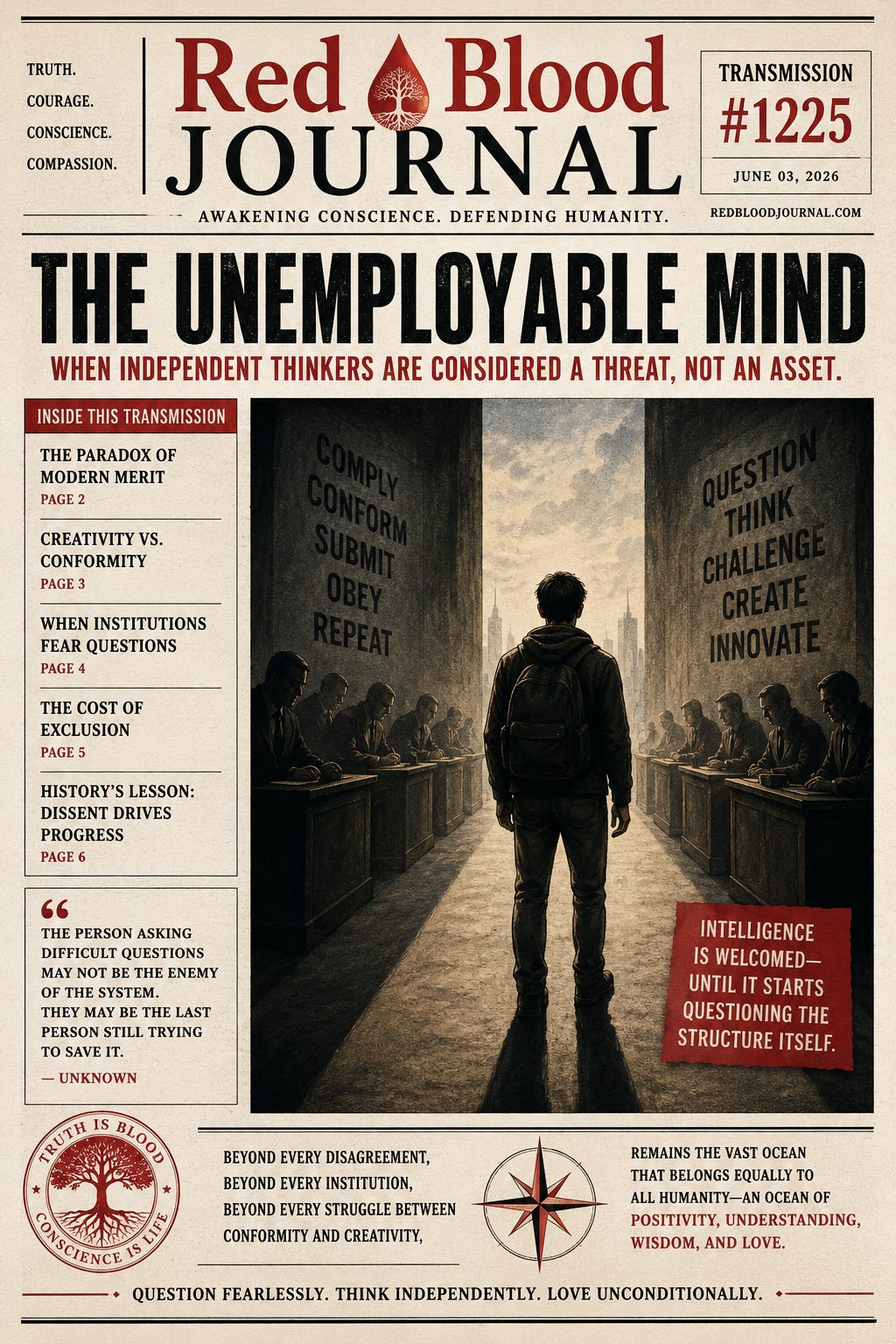
🩸 #1225 — THE UNEMPLOYABLE MIND
Red Blood Journal Transmission
The Paradox of Modern Merit
Throughout history, societies claimed to value intelligence, creativity, courage, and independent thought.
Schools celebrate critical thinking.
Governments praise innovation.
Corporations advertise themselves as champions of disruption.
Universities claim to seek truth.
Yet the modern reality often appears very different.
The individual who asks difficult questions frequently discovers that curiosity carries consequences.
The person who notices contradictions becomes uncomfortable to those invested in maintaining them.
The independent thinker slowly learns that intelligence is welcomed only when it remains inside approved boundaries.
Once it begins questioning the structure itself, the applause often disappears.
The Difference Between Intelligence and Compliance
Every system requires a degree of order.
No civilization can function without rules, procedures, and institutions.
The challenge emerges when conformity becomes more valuable than competence.
A system seeking improvement rewards those who identify flaws.
A system seeking preservation rewards those who ignore them.
The first produces innovation.
The second produces bureaucracy.
The first welcomes questions.
The second labels questions as disruption.
As institutions grow larger, their survival often becomes more important than their purpose.
The organization begins protecting itself rather than pursuing the mission it was originally created to serve.
The Creative Mind Problem
Creative individuals rarely fit comfortably inside rigid structures.
Their value comes from seeing what others overlook.
They challenge assumptions.
They test accepted narratives.
They connect ideas that appear unrelated.
Most breakthroughs in science, engineering, philosophy, and art emerged from people willing to disagree with prevailing wisdom.
Had they simply repeated approved conclusions, nothing new would have been discovered.
Innovation itself is a form of nonconformity.
The same qualities that produce creativity often produce friction with institutions.
The inventor is frequently viewed as difficult.
The philosopher as troublesome.
The artist as disruptive.
The reformer as dangerous.
Only later, after history validates them, are they celebrated.
The Employment Paradox
Modern employment increasingly rewards predictability.
Organizations seek individuals who can operate within established frameworks.
This is understandable.
Large systems depend upon consistency.
Yet an unintended consequence emerges.
The very people capable of identifying major weaknesses may become the least employable.
Not because they lack ability.
Not because they lack knowledge.
But because they possess an instinct that organizations often fear:
The instinct to ask why.
Why is this done this way?
Why are obvious problems ignored?
Why do stated goals differ from actual outcomes?
Why are certain subjects considered untouchable?
These questions can create improvement.
They can also create discomfort.
When Institutions Fear Questions
Healthy institutions welcome scrutiny.
Weak institutions fear it.
Confidence welcomes examination.
Insecurity avoids it.
An organization certain of its legitimacy gains strength from criticism because criticism exposes weaknesses that can be corrected.
An organization uncertain of its legitimacy often treats criticism as a threat.
The result is a gradual filtering process.
Independent voices leave.
Conforming voices advance.
Over time the institution becomes increasingly insulated from reality.
Everyone agrees.
Nobody challenges.
Mistakes multiply.
The appearance of stability remains while effectiveness quietly declines.
The Cost of Exclusion
When societies marginalize independent thinkers, the loss extends beyond the individual.
Entire civilizations pay the price.
Questions go unasked.
Solutions remain undiscovered.
Warnings arrive too late.
Opportunities disappear unnoticed.
The most valuable resource in any nation is not oil, gold, technology, or military power.
It is human insight.
A society that discourages independent thought slowly weakens its own future.
The brightest minds do not vanish.
They simply move elsewhere.
Sometimes they retreat into private life.
Sometimes they build alternatives.
Sometimes they become observers rather than participants.
The loss is rarely visible until much later.
The Forgotten Strength
History repeatedly demonstrates a simple truth.
Progress rarely originates from unanimous agreement.
It emerges from disagreement conducted honestly.
The greatest thinkers were often outsiders.
The most transformative ideas were initially unpopular.
The most important questions were frequently considered inconvenient.
Civilizations grow strongest when they can tolerate dissent without fear.
When they can distinguish disagreement from hostility.
When they understand that criticism is often a form of care.
The person asking difficult questions may not be the enemy of the system.
They may be the last person still trying to save it.
Final Observation
Every generation faces a choice.
Reward conformity and enjoy temporary comfort.
Or reward independent thought and accept temporary discomfort.
One path offers stability today.
The other offers resilience tomorrow.
History suggests that societies capable of hearing uncomfortable truths are the ones most likely to endure.
And perhaps the greatest irony of all is that the voices dismissed as troublemakers in one era often become the voices celebrated by the next.
For beneath every institution, every ideology, and every system lies a simple reality:
Truth does not fear questions.
Only fragile structures do.
And beyond every disagreement, beyond every institution, beyond every struggle between conformity and creativity, remains the vast ocean that belongs equally to all humanity—
An Ocean of Positivity, Understanding, Wisdom, and Love. 🌊❤️
— Red Blood Journal | Transmission #1225
🌊 The Paradox of the Unemployable Mind
Jun 4, 2026
The provided text explores the fundamental tension between organizational conformity and independent thought, arguing that modern institutions often prioritize predictability over genuine competence.
While societies claim to value innovation, the author contends that creative minds are frequently marginalized because their tendency to question established systems creates discomfort for those in power.
This filtering process results in bureaucratic stagnation, where institutions protect their own survival rather than fulfilling their original missions.
The source warns that when a civilization silences its most inquisitive members, it loses the vital human insight necessary for long-term resilience and progress.
Ultimately, the narrative suggests that true institutional strength is found in the ability to embrace difficult truths and dissent rather than enforcing intellectual compliance.


