


🩸 Red Blood Journal
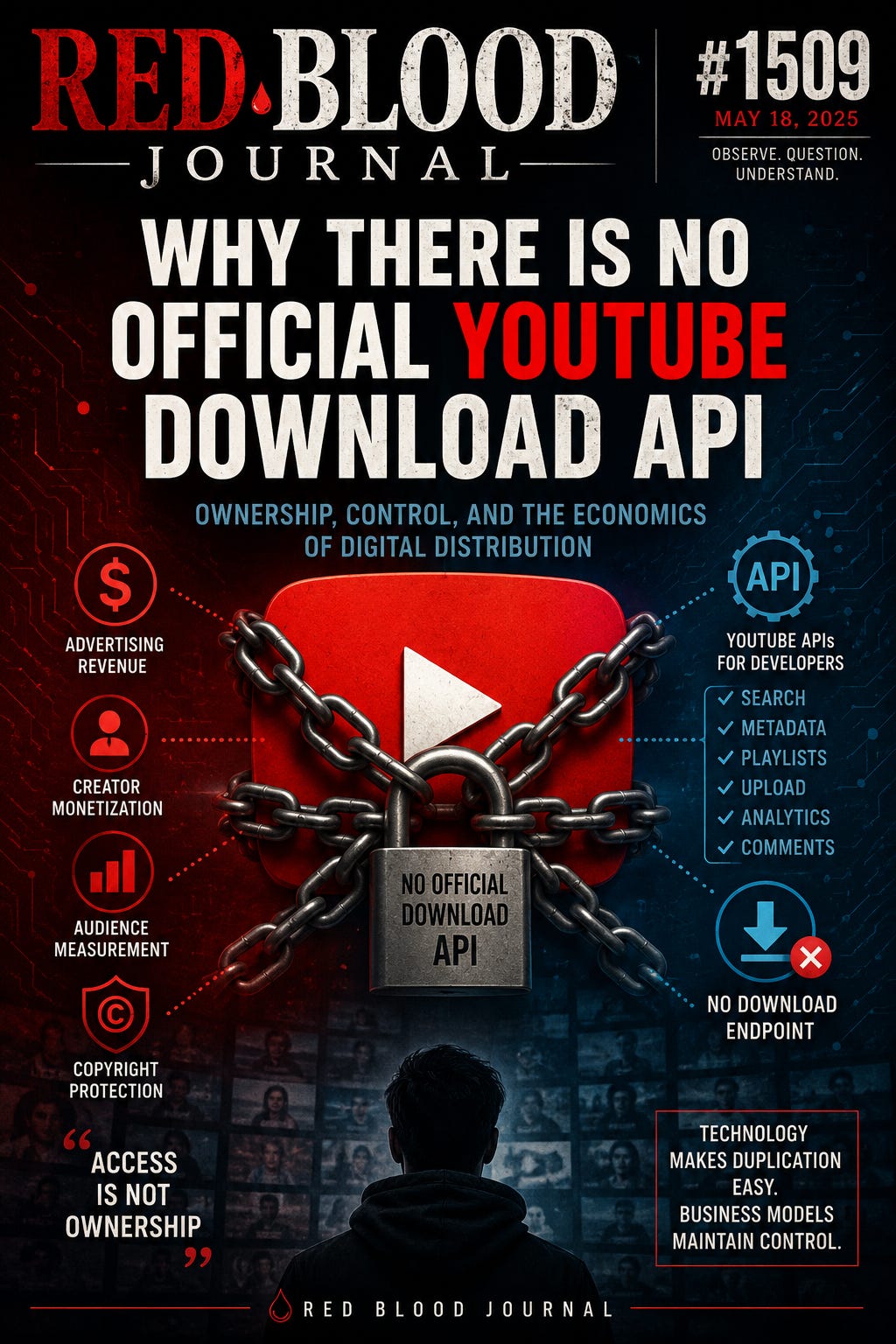
#1509 – Why Doesn’t YouTube Have a Download API?
Understanding APIs in Plain English
Most people have heard the term API, but very few know what it actually means.
Let’s make it simple.
Imagine a Restaurant
You sit down at a restaurant.
You don’t walk into the kitchen and start cooking your own meal.
Instead, a waiter comes to your table.
You tell the waiter what you want.
The waiter takes your request to the kitchen.
The kitchen prepares your food.
The waiter brings it back to you.
The waiter is the API.
An API (Application Programming Interface) is simply a messenger that allows one computer program to ask another computer program to do something.
It saves programmers from having to know how everything works inside the system.
Another Simple Example
Imagine your television.
When you press the volume button on the remote, you don’t know how the electronics inside the TV increase the sound.
You simply press a button.
The remote sends a request.
The television performs the action.
That communication is similar to how an API works.
One device asks.
The other responds.
Why Companies Create APIs
Large companies create APIs because they want other software developers to build useful applications that work with their services.
For example, YouTube provides APIs that allow developers to:
Search for videos.
Display playlists.
Read channel information.
Upload videos.
Manage comments.
Access statistics for their own channels.
This allows thousands of websites and applications to work with YouTube without Google having to build every application itself.
So Why Not a Download API?
This is where business enters the picture.
YouTube earns money every time people watch videos.
That income comes from:
Advertising.
YouTube Premium subscriptions.
Creator monetization.
Audience measurement.
Copyright licensing.
If Google offered an official API that allowed anyone to download every video, several things could happen:
Advertisements could be skipped.
View counts would become less reliable.
Copyrighted videos could be redistributed more easily.
Some creators could lose advertising income.
From YouTube’s perspective, such an API would weaken the business model that supports the platform.
Then How Do Download Programs Work?
Many people have used programs that can download YouTube videos.
Surprisingly, these programs usually do not use an official YouTube download API.
Instead, they carefully observe how YouTube’s own video player requests the video and audio streams.
The downloader then copies those same requests and saves the media files.
Think of it as watching how the waiter walks into the kitchen and then secretly following the same path yourself.
The kitchen wasn’t designed to serve customers that way, but the path can sometimes be discovered.
Because these tools depend on understanding how YouTube’s player works, they often need updates whenever YouTube changes its technology.
Access Is Not the Same as Ownership
This idea extends far beyond YouTube.
Today, many digital products are not truly sold.
Instead, they are licensed.
Movies.
Music.
Books.
Software.
Games.
Cloud storage.
Streaming services.
In many cases, consumers are paying for permission to use something rather than permanent ownership of it.
The internet has made copying incredibly easy.
Businesses have responded by designing systems that maintain control over access instead of transferring ownership.
Final Thought
The question was never whether Google has the technology to create a download API.
It certainly does.
The real question is whether providing one would support—or undermine—the business model that allows YouTube, creators, advertisers, and viewers to coexist.
Understanding that distinction helps explain why some APIs exist while others never will.
🩸🌊✨ Fantastic!
🔌 The Architecture of Digital Access and API Restriction
Jul 18, 2026
This text explains the fundamental concept of an Application Programming Interface (API) by comparing it to a waiter facilitating communication between a customer and a kitchen. While YouTube offers various tools for developers to integrate video searches and statistics, the author highlights that the company intentionally omits a download API to protect its financial interests. Providing a direct method for saving videos would threaten advertising revenue, copyright protections, and the platform’s ability to track viewership accurately. Third-party downloading software avoids these official channels by mimicking the video player’s behavior to bypass restrictions. Ultimately, the source emphasizes that modern digital consumption focuses on access through licensing rather than permanent ownership of media. This strategic technical limitation serves to preserve the business model that sustains the ecosystem of creators and advertisers.


