


🩸 Red Blood Journal
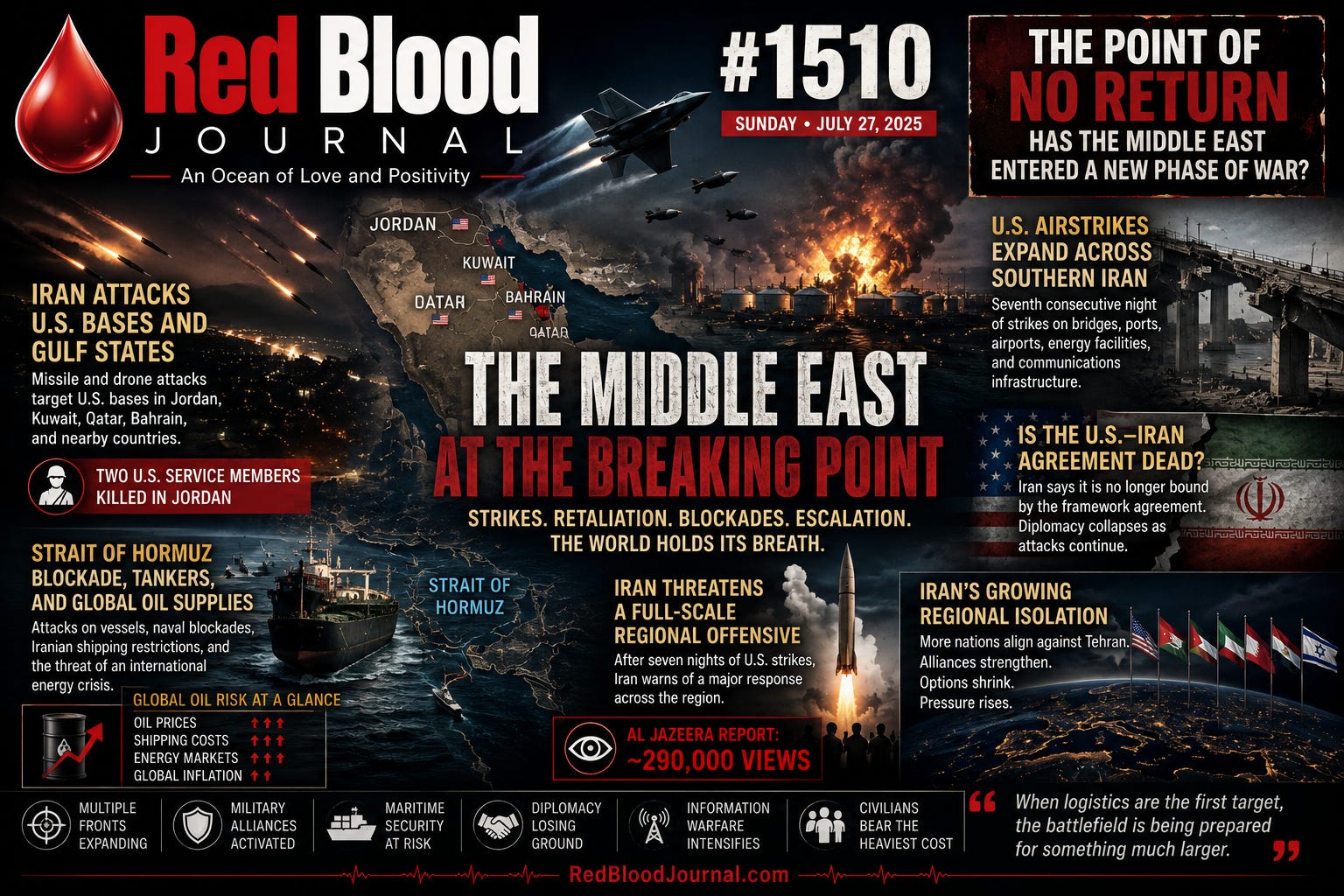
#1510 – The Point of No Return
Has the Middle East Entered a New Phase of War?
Executive Summary
Military conflicts often cross invisible thresholds.
At first, there are warnings.
Then isolated strikes.
Then retaliation.
Then attacks expand beyond the original battlefield.
Eventually a point arrives where observers begin asking a different question.
Not whether the war will continue—
but whether it can still be stopped.
Recent developments throughout the Middle East have raised exactly that question.
Missile attacks against American military facilities across the Gulf region, expanding U.S. air operations inside southern Iran, increasing pressure on maritime shipping, and growing regional involvement suggest that the conflict may be entering a broader and potentially more dangerous phase.
1. Iran Expands the Battlefield
Recent reports describe missile and drone attacks directed toward American military facilities in Jordan, Kuwait, Qatar, Bahrain, and neighboring areas.
Whether each reported strike ultimately proves strategically significant or not, the overall pattern is important.
The battlefield appears to be expanding geographically.
When military operations spread across multiple countries, the conflict becomes increasingly difficult to isolate.
Each additional location increases the possibility that new participants become involved.
2. The Air Campaign Continues
For multiple consecutive nights, U.S. military operations have reportedly focused on southern Iran.
Particular attention has been given to:
Bridges
Transportation corridors
Ports
Airports
Energy facilities
Communications infrastructure
Military history consistently demonstrates that logistics are often targeted before major operational shifts.
An army without mobility gradually loses flexibility.
Control of infrastructure frequently becomes more valuable than control of territory itself.
3. Is Diplomacy Finished?
One of the most significant political developments has been the growing perception that previous understandings between Washington and Tehran are rapidly eroding.
When military operations continue while diplomatic agreements lose credibility, both governments face increasingly limited political options.
History shows that once negotiations lose public legitimacy, rebuilding trust becomes considerably more difficult than maintaining it.
Whether diplomacy has completely collapsed remains uncertain.
But confidence in diplomacy appears to have weakened substantially.
4. The Strait of Hormuz
Few waterways influence the global economy more than the Strait of Hormuz.
A significant share of the world’s oil and liquefied natural gas exports transit through this narrow passage.
Any sustained disruption affects:
Global energy markets
Shipping insurance
International trade
Inflation
Manufacturing costs
National energy security
What occurs in this narrow stretch of water therefore reaches far beyond the Middle East.
5. Regional Escalation
Military conflicts rarely remain confined to their original participants.
Neighboring countries begin reinforcing defenses.
Alliances become more active.
Naval deployments increase.
Air defense systems are repositioned.
Diplomatic pressure intensifies.
The possibility of miscalculation grows with every additional military movement.
This is why regional wars often become international concerns long before formal declarations are made.
6. Information Moves Faster Than Armies
Today’s conflict is fought on two battlefields.
The physical battlefield.
And the information battlefield.
Every missile launch is followed by competing narratives.
Every military operation is interpreted differently by governments, analysts, media organizations, and social platforms.
Public perception increasingly becomes part of military strategy.
Winning the information environment can influence diplomacy almost as much as battlefield success.
7. The Cost Beyond the Battlefield
While governments discuss military objectives, ordinary families face different concerns.
Safety.
Food.
Employment.
Electricity.
Fuel.
Communication.
The longer conflicts continue, the more civilians become the primary victims of uncertainty rather than combat itself.
History repeatedly reminds us that wars reshape societies long after the final military operation has ended.
Looking Ahead
Whether the present conflict continues to escalate or eventually returns to negotiation remains impossible to predict with certainty.
What can be observed, however, is that several indicators have changed simultaneously:
The battlefield has widened.
Infrastructure has become a primary target.
Maritime security has become a global concern.
Diplomatic confidence has weakened.
Regional actors are becoming increasingly involved.
Individually, each development is significant.
Together, they suggest that the conflict may be entering a fundamentally different phase.
Final Reflection
History rarely identifies the exact day a regional conflict becomes something larger.
People living through it often recognize the change only in hindsight.
Sometimes the turning point is not marked by the largest explosion.
Sometimes it is marked by the moment when every front begins moving at once.
Whether this is that moment remains to be seen.
But it is unquestionably a moment worthy of careful observation.
🩸 Red Blood Journal
An Ocean of Love and Positivity.
🩸🌊✨ Fantastic!
⚠️ The Middle East Threshold:
Crossing the Point of No Return
Jul 18, 2026
This report from the Red Blood Journal suggests that the conflict in the Middle East has reached a volatile new phase characterized by a widening geographical scope. Hostilities have expanded beyond original borders to include drone and missile strikes against American facilities and U.S.-led aerial campaigns targeting Iranian logistics and infrastructure. The analysis highlights a dangerous erosion of diplomacy, noting that as official negotiations lose credibility, the risk of a larger international crisis grows. Furthermore, the instability threatens the Strait of Hormuz, a vital maritime corridor that safeguards the global economy and energy security. Ultimately, the text warns that the simultaneous escalation of military, economic, and informational warfare signals a potential point of no return for regional stability.


