


🩸 RedBloodJournal.com
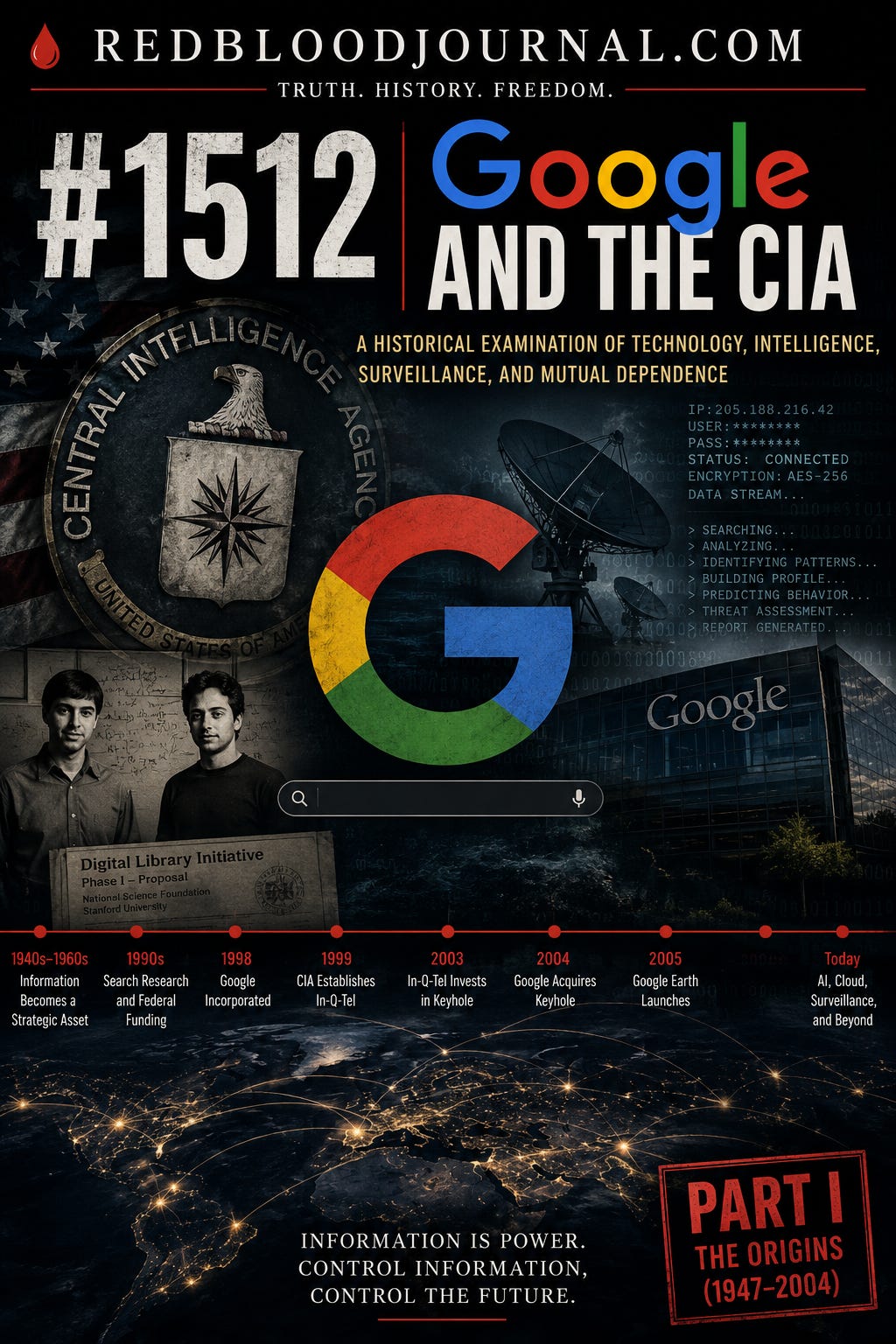
#1512 Google and the CIA
A Historical Examination of Technology, Intelligence, Surveillance, and Mutual Dependence
The relationship between Google and the Central Intelligence Agency is neither imaginary nor as simple as saying that the CIA created or secretly owns Google.
The documented history reveals something more complicated.
Google grew from publicly funded university research, private investment, advertising revenue, acquisitions, and extraordinary technological innovation. At the same time, its development took place within a larger American research environment in which universities, military agencies, intelligence organizations, and technology companies often pursued overlapping objectives.
Those shared objectives included:
Organizing enormous quantities of information
Finding relationships hidden inside data
Mapping the physical world
Predicting behavior
Identifying threats
Tracking communications
Developing artificial intelligence
Building secure cloud infrastructure
Google wanted these capabilities to organize information and sell services.
The intelligence community wanted many of the same capabilities to collect, analyze, and act upon information.
That overlap created a relationship—not necessarily one central conspiracy, but an increasingly interconnected system.
1. Before Google: Intelligence Agencies Confront the Information Explosion
During the Cold War, intelligence work depended heavily on collecting and analyzing information.
The CIA, National Security Agency, military intelligence organizations, and defense research agencies processed:
Foreign publications
Satellite photographs
Telephone communications
Military records
Diplomatic reports
Financial transactions
Scientific research
Human intelligence
Electronic signals
By the 1980s and 1990s, the problem was no longer simply obtaining information.
The problem was finding meaning inside enormous collections of information.
The growth of computers and the internet created a new intelligence challenge:
How could an analyst locate the few important connections hidden inside billions of documents, communications, people, locations, and events?
This was also the problem that internet search engines would eventually attempt to solve for ordinary users.
The intelligence community and the emerging internet industry were therefore moving toward the same destination from different directions.
One called it intelligence analysis.
The other called it search.
2. The Government Research Environment Behind Modern Search
Google began as a Stanford University research project created by Larry Page and Sergey Brin in the 1990s.
Their breakthrough was PageRank, a method for judging the importance of a webpage partly by examining which other pages linked to it.
The project received support through Stanford and the National Science Foundation’s Digital Library Initiative, along with industrial contributions. The National Science Foundation itself credits federally supported digital-library research with helping finance the prototype that developed into Google. (NSF Resources)
This is an important distinction.
There is documented federal research funding in Google’s academic background.
However, that is not the same as proof that the CIA directly created Google, secretly selected its founders, or owned the original company.
Some writers connect Google’s origins to a government research initiative called Massive Digital Data Systems, or MDDS. That initiative involved intelligence-community interest in technologies capable of querying, filtering, and analyzing massive databases.
Researchers connected to these programs communicated with and followed work at major universities, including Stanford.
This demonstrates that intelligence agencies were interested in the same field in which Page and Brin were working.
It does not, by itself, prove that Google was established as a covert CIA operation.
The strongest defensible conclusion is:
Google emerged from an academic and technological ecosystem substantially supported by the federal government, while intelligence organizations were actively seeking technologies with capabilities similar to those Google would eventually perfect.
3. Google Becomes a Company
Google was incorporated in 1998.
Its early private financing came from technology investors, including Sun Microsystems cofounder Andy Bechtolsheim and later major venture-capital firms.
The company’s public mission was to organize the world’s information and make it universally accessible and useful.
That mission sounded idealistic.
It was also strategically enormous.
A company capable of organizing the world’s information would not merely operate a search engine.
It could eventually become a gateway controlling:
Which information is easily found
Which information is buried
Which sources are treated as authoritative
Which advertisements reach which individuals
Which locations people visit
Which videos they watch
Which messages they send
Which devices they carry
Which questions they ask
Which patterns can be extracted from their behavior
Google’s commercial value came from understanding users.
That same knowledge naturally held intelligence value.
4. In-Q-Tel: The CIA Enters Silicon Valley
In 1999, the CIA chartered a venture-capital organization that became known as In-Q-Tel.
Its purpose was to connect the intelligence community with fast-moving private technology companies.
The CIA had recognized that conventional government procurement was too slow.
By the time an intelligence agency designed, approved, commissioned, and deployed a new system, Silicon Valley might already have produced something better.
In-Q-Tel allowed the CIA and the broader intelligence community to identify promising companies, invest in them, help adapt their technologies, and gain early access to strategically useful tools.
Although organized as a legally separate nonprofit corporation, In-Q-Tel was created to serve intelligence-community technological requirements and has operated through agreements with the CIA.
The arrangement represented a major change.
Instead of the government building all intelligence technology behind classified walls, private companies could develop commercially successful products that also served national-security purposes.
The same technology could have two lives:
A public commercial life
A government intelligence life
This dual-use model would become central to the relationship between Silicon Valley and the national-security establishment.
5. Keyhole: The Clearest Direct Connection
The most firmly documented early connection between Google and CIA-backed technology involves a company called Keyhole, Inc.
Keyhole developed EarthViewer 3D, a system that allowed users to move across a three-dimensional digital model of Earth using satellite and aerial imagery.
In February 2003, In-Q-Tel invested in Keyhole.
The CIA openly acknowledges that its In-Q-Tel investment helped develop the technology and that intelligence organizations worked with Keyhole to adapt the system to their requirements. (CIA)
The technology allowed analysts to combine imagery with layers showing:
Roads
Buildings
Businesses
Schools
Demographics
Infrastructure
Geographic features
Intelligence data
This was not merely a map.
It was a platform through which multiple forms of information could be attached to physical locations.
In intelligence work, location is fundamental.
A telephone number matters more when connected to a building.
A building matters more when connected to a person.
A person matters more when connected to travel patterns, financial activity, associates, and communications.
Keyhole made complex geographic intelligence visually understandable.
6. Google Acquires the CIA-Backed Mapping Company
Google purchased Keyhole in October 2004.
It then transformed the company’s technology into Google Earth, released in 2005.
Google confirmed that its acquisition of Keyhole became the foundation of Google Earth. (Google Groups)
When Google purchased Keyhole, it acquired technology whose development had been supported by the CIA’s investment organization and tailored in cooperation with intelligence users.
In-Q-Tel reportedly received Google shares as part of the acquisition and later sold those shares.
This is a documented financial and technological connection.
It does not prove that the CIA acquired ownership or operational control of Google.
It does show that:
The intelligence community helped finance and develop Keyhole.
Google purchased Keyhole.
Keyhole became Google Earth.
Intelligence and military organizations continued using geospatial technologies related to the platform.
Google Earth therefore represents a clear example of intelligence-supported technology becoming a worldwide consumer product.
The public received a remarkable digital globe.
The intelligence community received an increasingly powerful geospatial environment.
Google received millions of users, geographic data, government customers, and a platform that became central to modern navigation and mapping.
Everyone gained something.
But each party gained something different.
7. Google Earth Was More Than a Consumer Product
To an ordinary person, Google Earth offered the ability to visit cities, mountains, homes, landmarks, and distant countries from a computer.
To militaries and intelligence organizations, the same type of platform could assist with:
Terrain analysis
Target planning
Infrastructure identification
Disaster response
Operational preparation
Border analysis
Humanitarian missions
Damage assessment
Location intelligence
This illustrates the dual-use problem.
A mapping technology can help a family find a restaurant.
The same architecture can help an intelligence analyst examine a military installation.
The capability itself is not inherently civilian or military.
Its purpose depends upon who uses it, what data is layered onto it, and what decisions are made from the results.
8. Google and the Wider Intelligence Community
It is important not to treat the CIA, NSA, FBI, National Geospatial-Intelligence Agency, Department of Defense, and Department of Homeland Security as if they were the same organization.
They are distinct institutions with different authorities and missions.
However, they share information, use related contractors, purchase overlapping technologies, and participate in the larger U.S. national-security system.
Therefore, a complete examination of Google’s intelligence relationships cannot be restricted to contracts bearing the CIA’s name.
Google’s products became useful across the government:
Search and data organization
Maps and satellite imagery
Cloud computing
Email and collaboration
Cybersecurity
Artificial intelligence
Language translation
Mobile operating systems
Video analysis
Location services
Google became part of the technological environment upon which government agencies increasingly depended.
9. Shared Investment in Recorded Future
Another notable connection appeared in 2010 when Google’s investment operation and In-Q-Tel both invested in Recorded Future.
Recorded Future developed systems for analyzing large quantities of online information and identifying patterns that might help anticipate future events.
The basic idea was powerful:
Collect public information
Examine relationships among people, organizations, locations, and events
Identify changes and emerging patterns
Estimate what may happen next
For Google, this type of technology could improve search, relevance, and data analysis.
For intelligence organizations, it could assist with threat assessment, forecasting, and open-source intelligence.
Again, the commercial and intelligence objectives overlapped.
The significance was not that Google and the CIA were necessarily operating as one organization.
The significance was that both recognized strategic value in the same predictive technology.
10. Google’s Commercial Surveillance Model
Google’s primary business developed around advertising.
To place more effective advertisements, the company needed to know as much as possible about users’ interests and behavior.
Over time, Google gained access to enormous categories of information through products including:
Google Search
Gmail
YouTube
Google Maps
Android
Chrome
Google Drive
Google Photos
Google Assistant
Advertising networks
Location services
Smart-home devices
Each product provided a different window into human behavior.
Search revealed curiosity and intention.
Maps revealed movement.
YouTube revealed attention and influence.
Gmail revealed communication.
Android revealed device activity and location.
Advertising systems revealed purchasing interests.
Chrome revealed browsing behavior.
Individually, these datasets were commercially valuable.
Combined, they could create detailed behavioral profiles.
This does not mean CIA officers were freely sitting inside Google and watching every user.
It means Google constructed an information infrastructure whose capabilities were inherently attractive to governments, police agencies, advertisers, political organizations, and intelligence services.
11. Government Requests for Google Data
Google regularly receives legal demands for user information from governments.
These can include:
Search warrants
Court orders
Subpoenas
Emergency disclosure requests
National-security letters
Orders issued under foreign-intelligence law
Google publishes aggregate information about many government requests through its Transparency Report.
The company has also challenged some requests and advocated for permission to disclose more information about secret national-security orders.
This creates a complicated relationship.
Google is sometimes:
A government contractor
A holder of evidence
A recipient of compulsory legal demands
A critic of government secrecy
A business seeking government contracts
A company defending its reputation for user privacy
These roles can conflict.
The company may resist one government request while pursuing another government contract.
That does not make every disagreement theatrical.
It demonstrates that the relationship is not simply one of complete obedience or complete independence.
12. PRISM and the Snowden Revelations
In 2013, documents disclosed by Edward Snowden revealed extensive surveillance activities by the National Security Agency.
One program, known as PRISM, involved the legal collection of communications from major American technology companies under foreign-intelligence authorities.
Google was among the companies named in the disclosed material.
The initial reports created the impression that the NSA possessed direct access to company servers.
Google strongly denied providing an unrestricted government back door or direct access to its systems.
The company acknowledged complying with legally binding requests but argued that it delivered specific data through controlled procedures rather than allowing intelligence agencies to enter its servers freely. (WIRED)
The exact technical and legal operation of surveillance programs was obscured by secrecy, differing definitions, and competing explanations.
However, several conclusions are clear:
Intelligence agencies sought data held by Google.
Google was legally compelled to comply with valid orders.
The public had little knowledge of the scale or mechanisms.
Google objected to claims that it provided unrestricted server access.
National-security law prevented the company from fully disclosing many details.
The Snowden disclosures showed that even where a technology company does not voluntarily operate as an intelligence agency, its data can become part of intelligence collection through law, court orders, network interception, or other methods.
13. MUSCULAR: Collection Outside Google’s Front Door
One of the most important Snowden-era revelations concerned an NSA program reportedly called MUSCULAR.
According to disclosed documents, the NSA and Britain’s GCHQ intercepted communications traveling between data centers operated by Google and Yahoo.
At the time, some of this internal traffic was not fully encrypted because the companies treated communication between their own secured facilities as trusted.
This distinction matters greatly.
The government did not necessarily need Google’s voluntary assistance if it could intercept data while it traveled through network infrastructure outside the company’s immediate control.
After learning about such interception, Google expanded encryption between its data centers.
This episode demonstrates that Google and U.S. intelligence agencies were not always cooperative partners.
In some areas, Google was reportedly a target of intelligence collection.
The relationship therefore contained cooperation, legal compulsion, commercial contracting, resistance, and adversarial behavior simultaneously.
14. Google Employees Resist Military Work
In 2017 and 2018, Google participated in Project Maven, a Department of Defense initiative using artificial intelligence to analyze drone imagery.
Thousands of Google employees objected.
Some argued that Google should not develop technology contributing to warfare or automated targeting.
Internal protests and resignations followed.
Google eventually decided not to renew the Project Maven contract when it expired and issued principles governing its use of artificial intelligence.
This event is important because it reveals that “Google” is not a single mind.
Google consists of:
Executives
Engineers
Investors
Legal departments
Government-sales teams
Employees with differing political and ethical views
Management may pursue a national-security contract while employees oppose it.
A company may withdraw from one military program while continuing to provide cloud, cybersecurity, mapping, or productivity services to government agencies.
The internal disagreement does not erase the government relationship.
It shows that the relationship is contested even within Google.
15. Cloud Computing Changes the Relationship
The next major stage involved cloud computing.
Modern intelligence agencies require more than classified buildings filled with government-owned servers.
They increasingly need commercial cloud platforms capable of:
Processing enormous datasets
Training artificial-intelligence systems
Storing imagery
Sharing information across agencies
Performing rapid searches
Operating globally
Scaling during emergencies
Applying commercial software to classified missions
In 2020, the CIA reportedly awarded its Commercial Cloud Enterprise contract, known as C2E, to several major cloud providers:
Amazon Web Services
Microsoft
Google
Oracle
IBM
The arrangement allowed intelligence agencies to obtain cloud services from multiple companies instead of relying on a single provider. (Nextgov/FCW)
This represents a much deeper form of integration than an ordinary software purchase.
Cloud providers can become part of the underlying infrastructure through which intelligence information is stored, processed, and analyzed.
Google was no longer merely selling a search tool or mapping software.
Google Cloud became eligible to support elements of the intelligence community’s digital infrastructure.
16. Google Public Sector
Google created and expanded its public-sector operations to pursue government, defense, educational, and intelligence-related work.
Google Public Sector offers services such as:
Secure cloud infrastructure
Artificial intelligence
Cybersecurity
Data analytics
Collaboration tools
Geospatial technology
Specialized government environments
In 2025, Google announced a Department of Defense contract with a ceiling of $200 million to support artificial intelligence and cloud capabilities through the Pentagon’s Chief Digital and Artificial Intelligence Office. Google described it as part of a long-standing national-security collaboration. (Google Cloud)
This was a Defense Department contract, not proof of direct CIA control.
Nevertheless, it demonstrates Google’s continuing movement into the national-security market.
The same artificial-intelligence systems developed for commercial customers can potentially support:
Intelligence analysis
Logistics
Cyber defense
Document processing
Image recognition
Operational planning
Threat detection
Decision support
17. Artificial Intelligence Raises the Stakes
Search engines organize existing information.
Artificial intelligence interprets, summarizes, generates, predicts, and recommends.
This represents a major expansion of power.
An intelligence agency using advanced AI may be able to process:
Satellite images
Drone footage
Human-language reports
Intercepted communications
Public social-media activity
Financial patterns
Travel information
Biometric data
Cybersecurity alerts
Government records
The objective is not merely to find a document.
It is to identify patterns that humans might miss.
Google is one of the world’s leading artificial-intelligence developers.
The intelligence community is one of the world’s most powerful consumers of information-analysis technology.
Their continued interaction is therefore predictable.
The central concern is not simply whether Google voluntarily “gives everything” to the CIA.
The deeper question is:
What happens when the same small group of companies controls the computational infrastructure needed by consumers, corporations, governments, militaries, and intelligence agencies?
18. Does the CIA Own Google?
There is no publicly established evidence that the CIA legally owns Google or Alphabet.
Alphabet is a publicly traded corporation.
Its voting structure, shareholders, financial reports, and leadership are publicly documented, although its founders retain unusual voting influence through its share structure.
In-Q-Tel’s acquisition of Google shares resulted from Google purchasing Keyhole, not from the CIA buying control of Google.
The documented record supports the following:
The CIA created In-Q-Tel.
In-Q-Tel invested in Keyhole.
Google acquired Keyhole.
Keyhole became Google Earth.
In-Q-Tel received and later sold Google shares related to that transaction.
Google and In-Q-Tel later invested in at least one of the same analytical companies.
Google has received intelligence and defense contracts.
Intelligence agencies have legally demanded Google user data.
Intelligence services have reportedly intercepted communications involving Google infrastructure.
Google has sometimes resisted, challenged, or criticized government surveillance.
Google continues to sell cloud and AI services to the U.S. national-security establishment.
That is a substantial relationship.
It is not the same as proof of secret ownership.
19. Does the CIA Control Google?
“Control” can mean several different things.
Legal control
There is no public evidence that the CIA possesses corporate voting control over Alphabet.
Contractual influence
Government contracts can influence which technologies a company develops, certifies, or prioritizes.
Regulatory influence
Google operates under laws, court orders, export controls, surveillance statutes, and government regulations.
Financial influence
Government contracts are valuable, but they represent only part of Alphabet’s much larger commercial business.
Personnel influence
Employees move among technology firms, government agencies, defense contractors, universities, and policy organizations. This creates networks of relationships and shared assumptions.
Strategic influence
National-security priorities can shape the technology market even without direct corporate control.
Therefore, the strongest conclusion is not that the CIA commands Google like a department.
It is that Google operates within an ecosystem in which the intelligence community can exercise legal, contractual, regulatory, and strategic influence.
Google also possesses influence over government because government agencies increasingly depend on technologies that only a few corporations can provide.
The dependence moves in both directions.
20. Google May Be More Powerful Than a Traditional Contractor
A conventional defense contractor manufactures aircraft, missiles, ships, or surveillance equipment.
Google occupies a different position.
It helps shape the information environment itself.
Google influences:
What billions of people search for
What information they encounter
What videos algorithms recommend
How websites are ranked
How people navigate the physical world
How businesses reach customers
How mobile devices operate
How digital identities are authenticated
How data is stored and analyzed
How artificial intelligence answers questions
This creates a form of power that is difficult to compare with traditional government contracting.
The company does not need to receive instructions from the CIA to shape public perception.
Its commercial algorithms already make decisions that influence visibility and attention.
The danger may therefore be larger than a simple secret-command theory.
A private corporation can possess enormous informational power while simultaneously serving advertisers, governments, citizens, political campaigns, corporations, and intelligence agencies.
Those interests will not always align with the interests of the individual.
21. The Real Relationship: Convergence
The historical record suggests a convergence of interests.
Google wants data because data improves products, advertising, prediction, and profit.
Intelligence agencies want data because data improves surveillance, analysis, forecasting, and national power.
Google wants advanced artificial intelligence.
Intelligence agencies want advanced artificial intelligence.
Google wants global mapping.
Intelligence agencies want global mapping.
Google wants cloud infrastructure.
Intelligence agencies need cloud infrastructure.
Google wants to predict what users need.
Intelligence agencies want to predict what adversaries may do.
The relationship does not require a single hidden owner giving daily orders.
When two powerful institutions repeatedly need the same technologies, their paths naturally intersect.
22. The Greater Question
The question is not only:
Does the CIA control Google?
The more important questions may be:
Who controls the information infrastructure used by both governments and the public?
Can a person meaningfully refuse participation when digital life depends upon a few platforms?
Can governments operate independently when essential computing infrastructure belongs to private corporations?
Can corporations remain independent when they depend upon government contracts, licenses, laws, and protection?
Who audits algorithms that determine visibility, suspicion, influence, or access?
Where does commercial profiling end and intelligence profiling begin?
Can constitutional protections survive when data collection is performed first by private companies?
Does ownership of data become a quieter form of ownership over people?
The history of Google and the CIA is not a story with only two actors.
It is the history of a system in which universities, intelligence agencies, military institutions, investors, technology corporations, advertisers, courts, and users gradually became connected through data.
Google is not publicly proven to be a CIA-owned company.
But neither is it merely an innocent search box standing outside government power.
It is a central pillar of the modern information system—and the intelligence community has recognized the value of that system from the beginning.
Documented Findings Versus Unproven Claims
Documented
Federal academic research helped support the work that developed into Google.
The CIA established In-Q-Tel to invest in commercially developed intelligence technologies.
In-Q-Tel invested in Keyhole in 2003.
Intelligence organizations helped tailor Keyhole technology to their requirements.
Google bought Keyhole in 2004.
Keyhole became the foundation of Google Earth.
In-Q-Tel obtained and later sold Google shares connected to the acquisition.
Google and In-Q-Tel both invested in Recorded Future.
Google receives government and national-security data demands.
Google was identified in documents associated with NSA surveillance programs.
Google denied providing unrestricted direct access to its servers.
Intelligence services reportedly intercepted data traveling between Google facilities.
Google participated in Project Maven before employee protests led it not to renew the contract.
Google was selected as one of the providers under the intelligence community’s multicloud contracting program.
Google continues pursuing major defense, cloud, cybersecurity, and artificial-intelligence contracts.
Not publicly proven
That the CIA founded Google as a covert front company.
That the CIA currently owns Alphabet.
That CIA officers directly control Google Search rankings.
That all Google user data is automatically and continuously delivered to the CIA.
That every Google acquisition or product serves a secret intelligence plan.
That disagreements between Google and government agencies are necessarily staged.
Final Assessment
The evidence does not support reducing the story to either extreme.
It is inaccurate to say there has been no meaningful connection between Google and the intelligence community.
It is also unsupported to state as fact that the CIA secretly owns and commands Google.
The deeper reality is a long-term public-private merger of capabilities.
The intelligence community helped encourage technologies capable of organizing, mapping, analyzing, and predicting massive amounts of information.
Google became one of the most successful commercial creators of those technologies.
The government became a customer, regulator, legal demander of data, security partner, and—in certain surveillance operations—an adversarial collector.
Google became a contractor, data custodian, infrastructure provider, political influence center, surveillance platform, and occasional government critic.
They are not proven to be one organization.
But they operate inside the same expanding architecture of information and power.
And as physical ownership gives way to digital permission, the entity controlling identity, information, location, access, and artificial intelligence may become more powerful than the entity whose name appears on the property title.
That leads directly to the next investigation:
Who is the real owner when governments depend upon corporations, corporations shape governments, and individuals must obtain permission from both?
🩸 RedBloodJournal.com 🩸
Ocean of Love and Positivity.
🩸🌊✨ Fantastic!
👁️ The Silicon Convergence:
Google and the Intelligence Infrastructure
Jul 18, 2026
This text examines the intricate and evolving relationship between Google and the United States intelligence community, specifically the CIA. Rather than claiming a secret ownership, the source describes a convergence of interests where both entities seek to organize, map, and predict global information. Key historical milestones include federal research funding for Google’s founders and the acquisition of the CIA-backed mapping startup Keyhole, which became Google Earth. The narrative highlights how Google’s commercial surveillance model and cloud infrastructure naturally align with national security objectives for data analysis. While the parties sometimes clash over privacy and surveillance, they remain mutually dependent within a shared technological ecosystem. Ultimately, the source suggests that the distinction between private corporate power and government intelligence has blurred into a single, interconnected system of information control.


